

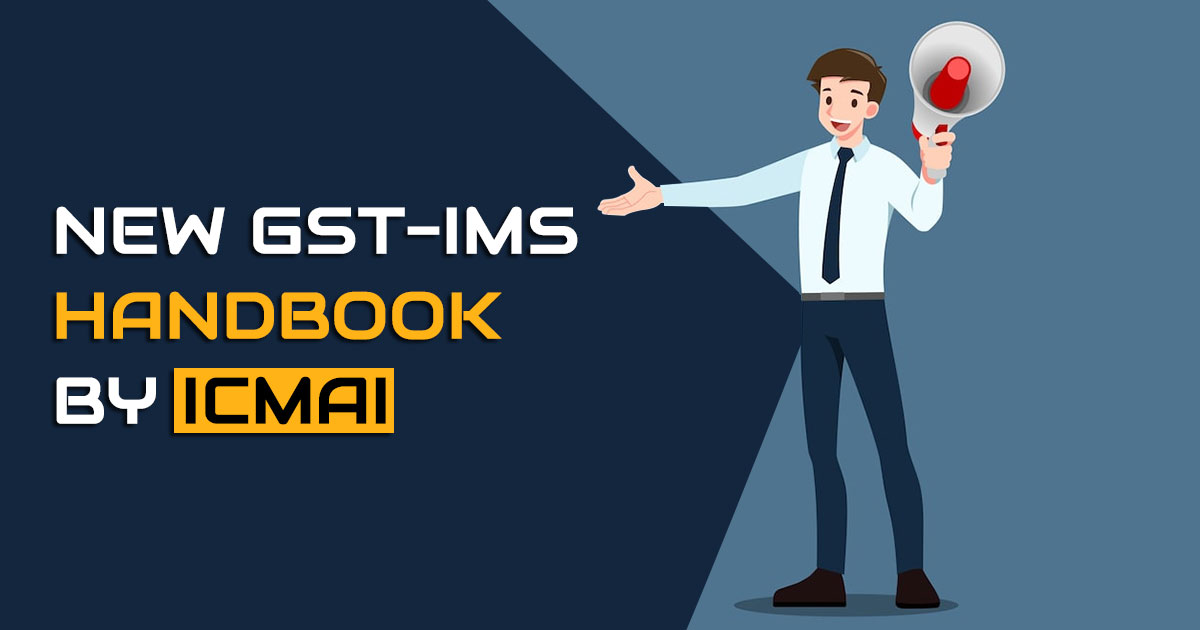
The Institute of Cost Accountants of India (ICMAI) has recently issued a complete handbook on the Invoice Management System under the Goods and Services Tax (GST). The main focus is to provide basic guidance and best techniques for effectively handling invoices within the framework of GST compliance.
The handbook includes the whole spectrum of invoice management, including the mechanics of the new portal, IMS Documents eligibility, Supplier management, Data governance, standard operating procedure (SOP), and others. Its main purpose is to bridge the gap between policy intent and ground-level trade operations.
This handbook outlines the common challenges businesses encounter when managing invoices, from creation to reporting, record matching, and ultimately receiving payments or credits.
It simplifies the functionality of the new IMS portal, highlights potential mistakes and risks, and demonstrates how companies can mitigate these issues by enhancing their internal processes and controls.
Important: Gen GST Software’s Invoice Management System Dashboard
For all tax practitioners, business leaders, consultants, and students, ICMAI’s handbook is supportive, as it permits them to navigate the digital landscape of GST with confidence, clarity, and compliance.
What is IMS Under GST?
The Invoice Management System (IMS) under GST is a new feature available on the GST portal. This system allows corporations to reject, accept, review and place supplier invoices in storage, which is important for accurately claiming Input Tax Credit (ITC). By minimising differences and simplifying the tax compliance, the IMS furnishes an organised method for reconciling inward supplies before their formation in GSTR-2B.