

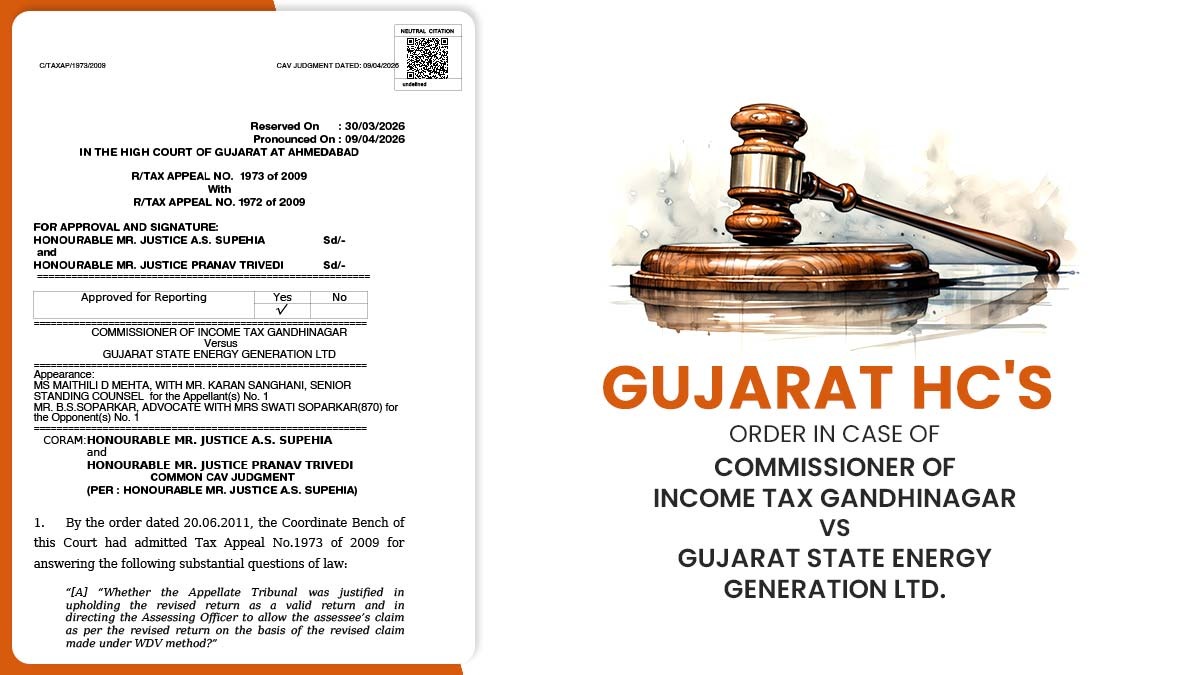
Recently, the Gujarat High Court held that a taxpayer can submit a revised return u/s 139(5) of the Income Tax Act, 1961, only when it discovers a bona fide omission or incorrect statement in the original return submitted u/s 139(1). The provisions could not be used to make intentional or afterthought amendments.
The Bench of Justices A.S. Supehia and Pranav Trivedi outlined that a valid revised return substitutes the original return for all objectives under the act, however, merely when it shows genuine correction of errors and not a strategic revision of claims. It stated.
“…..The statute enables the assessee to file the revised return only if he or she discovers the omission or the wrong statement which were missing in the original return by way of any bona fide reasons, and it should not be deliberate or concocted. The giving provision of Section 139 (5) of the Act will only come to the rescue of an assessee who has acted bona fide and due to such omission or wrong statement in his original return, he had failed himself to avail any advantage or claim.”
Gujarat State Energy Generation Ltd, for AY 2002–03, filed its original return declaring income and claiming depreciation under the Straight Line Method (SLM) under Rule 5 read with Appendix-IA of the Income Tax Rules. The return has been processed by the department u/s 143(1) and granted a refund.
Thereafter, the company submitted a revised return u/s 139(5). It mentioned that specific power sales were not acknowledged via the Gujarat Electricity Board, some expenditure on power consumption had not been claimed, and depreciation had been incorrectly calculated.
It lessened taxable income, added expenditure claims, and switched depreciation to the Written Down Value (WDV) method under Rule 5, read with Appendix I.
The Assessing Officer rejected the revised return, stating that there were no omissions or incorrect statements in the original return. As a result, the assessment was completed under Section 143(3) based on the original filing.
The Commissioner (Appeals) accepted the revised return but refused relief based on the merits of the case. However, the Income Tax Appellate Tribunal upheld the revised return and granted the taxpayer’s claims.
HC acknowledged with the Tribunal and discovered that the revised return emerged from bona fide discovery of omissions along with unrecognised income and unclaimed expenditure. It repeated that Section 139(5) allows revision in these situations and that a valid revised return substitutes the original return.
The Court on depreciation stated that the taxpayer practised its option within the deadline u/s 139(1). Thus, it authorised the switch to the WDV method in the revised return.
Further, the court held that Rule 5(1A) functions as a machinery provision and should not be interpreted in a way that conveys benefits when a valid revised return exists. It mentioned that:
Read Also: How Income Tax Software Assists Taxpayers After the Filing?
“…..The original return filed under Section 139(1) of the Act can further open an avenue of filing a revised return under Section 139(5) of the Act if an assessee discovers any omission or any wrong statement. Thus, any fact which was omitted or a wrong statement which was made in the original returns, subsequently comes to the knowledge of the assessee, can enable him to file a revised return under Section 139(5) of the Act. Such knowledge or discovery of the omission or a wrong statement cannot be deliberately used……..”
The judges held that after the acceptance of the revised return as valid by the Tribunal, it substitutes the original return for all objectives under the Act, along with depreciation claims.
Subsequently, the ITAT’s order has been upheld by the High Court, and it dismissed the appeals submitted by the Revenue.
| Case Title | Commissioner of Income Tax Gandhinagar v. Gujarat State Energy Generation Ltd. |
| Case No. | R/TAX APPEAL NO. 1973 of 2009 |
| For Petitioner | Ms Maithili D Mehta, Mr Karan Sanghani |
| For Respondent | Mr B.S.Soparkar, Mrs Swati Soparkar |
| Gujarat High Court | Read Order |