

The GST Appellate Tribunal, Lucknow Bench, has held that the mere delay in recording genuine business transactions in the books of accounts cannot justify the confiscation of stock.
The tribunal stated that, “There is a vast legal distinction between a delayed entry of a genuine transaction and an unaccounted transaction designed for clandestine removal. Delayed bookkeeping backed by regular commercial invoices cannot be branded as a statutory offense under Section 130.”
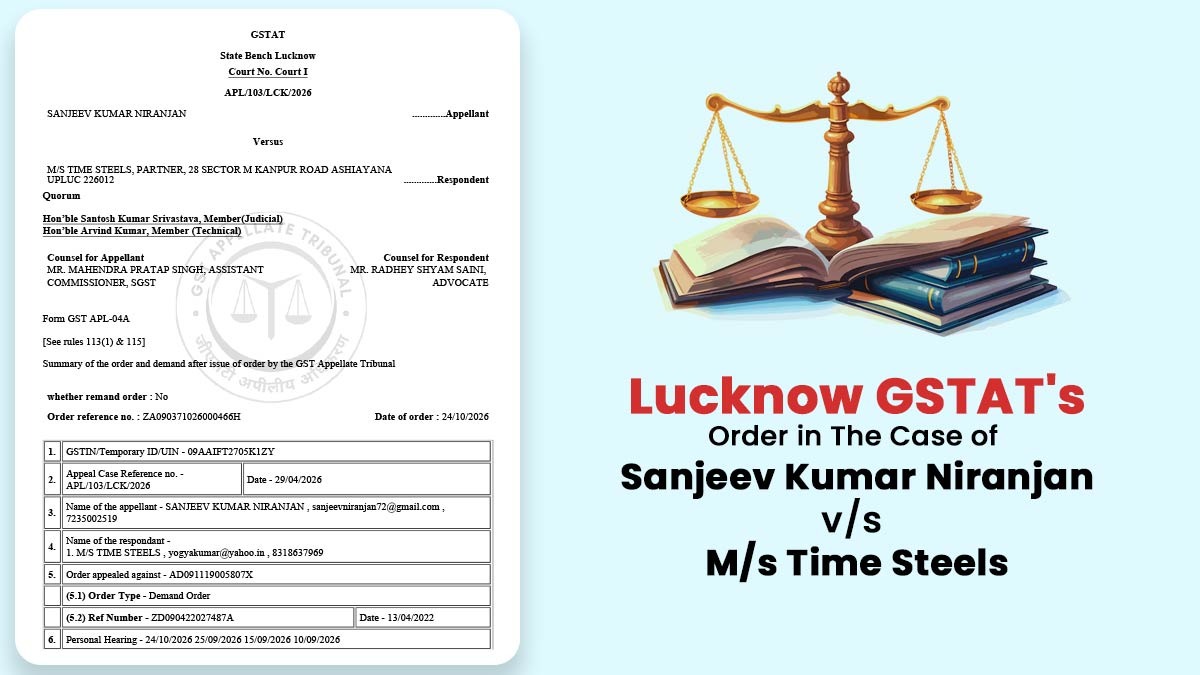
A bench comprising Judicial Member Santosh Kumar Srivastava and Technical Member Arvind Kumar made this observation while dismissing an appeal filed by the Revenue Department against an order that had set aside the total tax, penalty, and redemption fine of Rs 1.89 lakh imposed on ‘Time Steels’. The Tribunal discovered that the disputed entries could be verified from the business’s regular books of accounts and were supported by an invoice issued prior to the inspection.
The dispute started when officials scrutinized Time Steels on March 20, 2018, and discovered a mismatch between its physical stock and books of accounts. The business stated that its accountant was on leave, delaying entries. It provided an invoice dated March 19 for an inward supply of 9.56 metric tonnes and relied on its GST returns to support its explanation.
The proper officer ordered seizure, but the first appellate authority quashed it. It discovered that the books were updated on March 17 and that a two-day delay did not indicate intentional concealment. It also questioned why the survey team, instead of accurately weighing the goods, merely estimated their weight by sight.
The revenue department stated that seizure proceedings were independent of tax assessment and the following invoices or GST returns could not revise the stock position recorded in the inspection.
The tribunal did not consider this claim and discovered that the invoice predated the inspection and that the entries were validated against the books and statutory returns of the business. It observed that the survey team had placed reliance on rough calculations instead of standard physical weighment.
The tribunal acknowledged separate proceedings u/s 74 where the assessing officer considered the explanation of the taxpayer on the majority of issues. The stock left discrepancy was confined to 1.750 metric tonnes.
“It is a basic rule of law that the department cannot maintain two contradictory positions, it cannot accept a transaction as a reconcilable business variance under Section 74 while simultaneously calling it a confiscable offense under Section 130,” the tribunal stated.
Read Also: Supreme Court: Section 74 Cannot Be Invoked Without Proof of Fraud or Fake ITC
The tribunal upheld that the first appellate authority had accurately quashed the seizure order and dismissed the appeal of the revenue department. It carried the deletion of the tax, penalty, and redemption fine of Rs 1.89 lakh.
| Case Title | Sanjeev Kumar Niranjan vs. M/s Time Steels |
| GSTIN/Temporary ID/UIN | 09AAIFT2705K1ZY |
| Appeal Case Reference No | APL/103/LCK/2026 |
| GSTAT Lucknow | Read Order |