

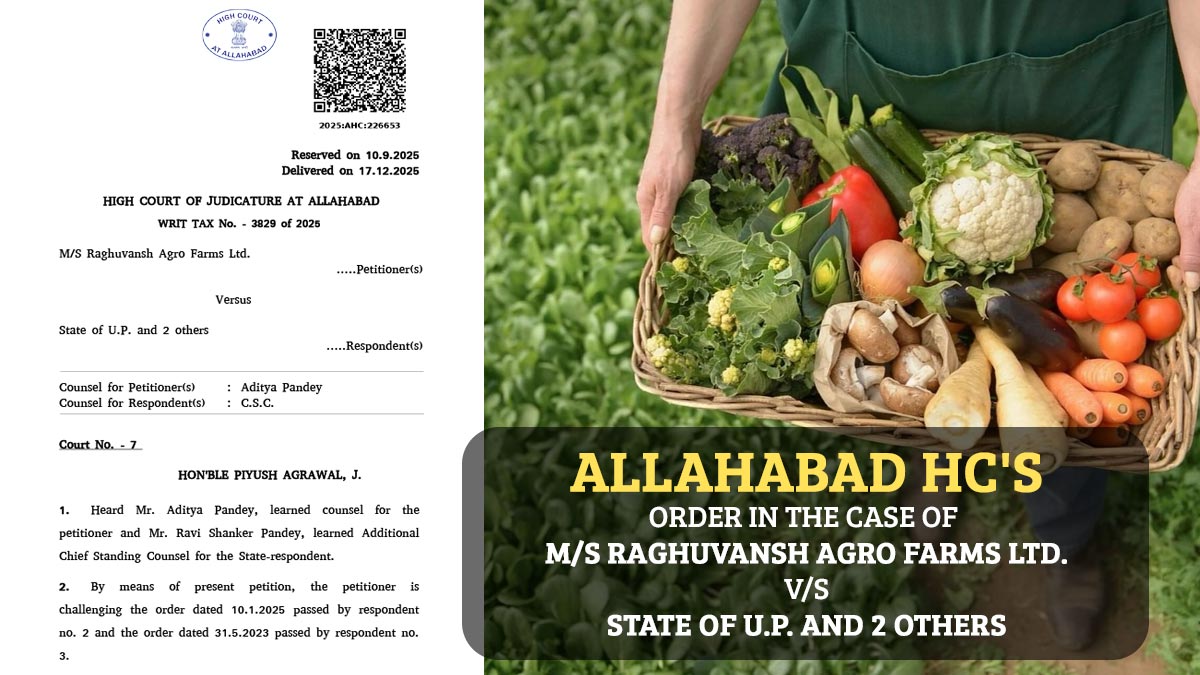
The Allahabad High Court, production of toll plaza receipts is not mandatory to establish the actual movement of goods when transactions are supported by valid e-way bills, tax invoices, banking-channel payments, and proper disclosure in GST returns.
The Court then ruled that State GST authorities could not investigate or adjudicate cases of Central GST taxpayers in the absence of specific cross-empowerment under GST, and that proceedings u/s 74 need proof of fraud, not vague allegations of circular trading.
The Bench, presided over by Justice Piyush Agrawal, clarified that the GST framework does not mandate toll plaza receipts or weighbridge slips as statutory documentation.
The Court held that when e-way bills, transport documents, bank statements, and GST filings (GSTR-1, 2A, and 3B) remain uncontroverted, the physical movement of goods is sufficiently proven. Consequently, drawing an adverse inference solely based on the absence of toll receipts was deemed perverse and legally unsustainable.
Also Read: How GST Software Resolves GSTR-3B & 2A/2B ITC Mismatches
The case is of the proceedings initiated by State GST authorities against a private limited company that supplies agricultural goods and areca nuts. After a survey in January 2019, an SCN u/s 74 of the UPGST Act was issued alleging wrongful availment of ITC due to alleged circular trading without movement of goods.
The adjudicating and appellate authorities passed the adverse orders even after the taxpayer provided complete statutory records and proof of tax payment.
A pivotal issue raised by the assessee concerned jurisdictional competence, specifically questioning the authority of State GST officers to initiate proceedings against a Central GST assessee.
The petitioner argued that, barring specific exceptions like refund processing, no GST Council recommendation or statutory notification existed to authorise such cross-jurisdictional action.
The Court upheld this contention, ruling that jurisdiction under the GST framework must be derived from explicit statutory empowerment and cannot be assumed by administrative presumption.
The court in section 74 repeated that it is applicable merely where fraud, wilful misstatement, or suppression with intent to evade tax is particularly established.
The SCN and assessment order do not have effective findings or proof of fraud. Mere use of expressions like “circular trading” or “suspicious transactions” was held inadequate, as suspicion cannot replace proof.
Read Also: Gen GST E Way Bill Software: A Complete E Waybill Solution For Suppliers & Transporters
The Court, relying on prior Division Bench rulings and the CBIC Circular dated 13 December 2023, quashed the assessment and appellate orders, declared the proceedings without jurisdiction, and directed the refund of any amount deposited by the taxpayer within 1 month as per the law.
| Case Title | M/S Raghuvansh Agro Farms Ltd. vs State of U.P. and 2 others |
| Case No. | WRIT TAX No. – 3829 of 2025 |
| Counsel for Petitioner | Aditya Pandey |
| Counsel for Respondent | C.S.C. |
| Allahabad High Court | Read Order |