

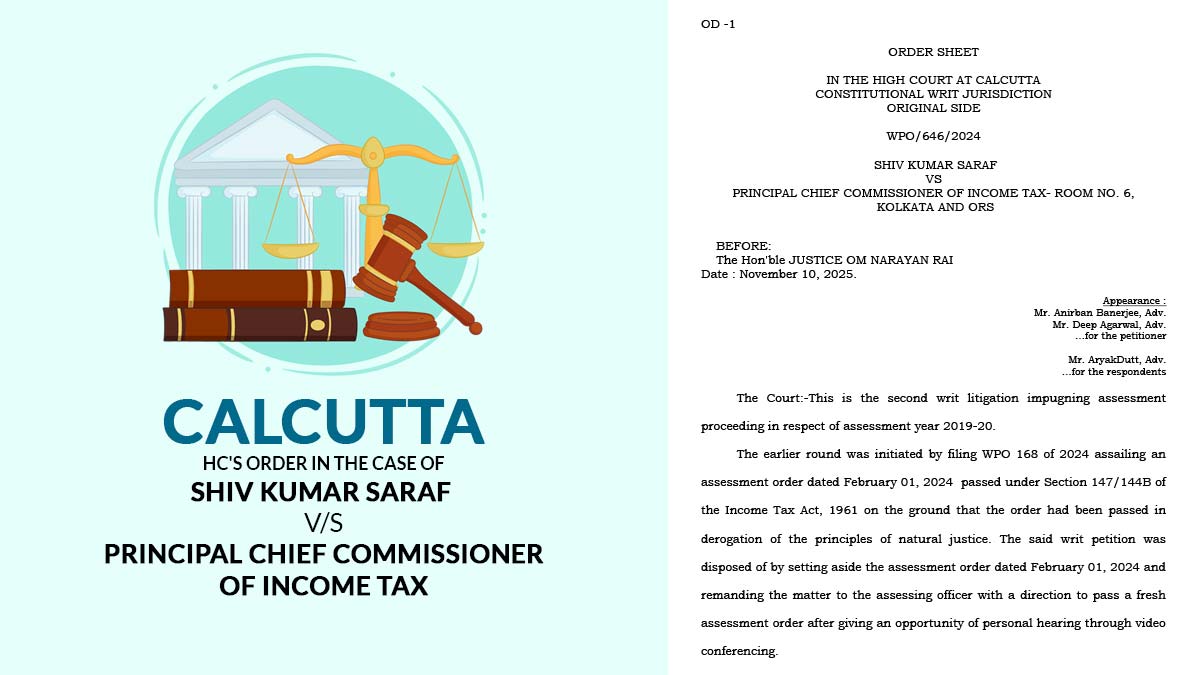
The Calcutta High Court has ruled that proceedings u/s 153C of the Income Tax Act could not be initiated unless incriminating material of the taxpayer is discovered in a search and both the assessing officers (the Assessing Officer of the searched person, along with the Assessing Officer of the person other than the searched person) record the crucial satisfaction.
Section 153C of the Income Tax Act includes a special provision for the assessment of ‘other person’ based on material found in search operations conducted u/s 132 on any person, or as a result of a requisition made u/s 132A of the Act.
Justice Om Narayan Rai, nothing on record is there to demonstrate that any incriminating material was seen against the taxpayer during the search and seizure operation.
Taxpayer previously submitted the petition contesting the assessment order passed u/s 147/144B of the Income Tax Act, 1961, on the ground that the order had been passed in derogation of the principles of natural justice.
By setting aside the assessment order, the cited writ petition was disposed of, and the case was remanded to the assessing officer for fresh consideration.
A fresh assessment order under Section 147 read with Sections 260 and 144B of the said Act of 1961, has been passed by the assessing officer on providing a chance of hearing to the taxpayer.
The taxpayer’s case is that the assessment proceedings must be initiated and concluded u/s 153C of the said Act of 1961 instead of u/s 147 of the said Act of 1961.
Taxpayer, on the search operation performed u/s 132 of the Income Tax Act 1961, if any incriminating material is discovered in the search operation, then the assessing officer needs to finish the assessment u/s 153A and the name of the taxpayer will be called “persons searched” and the third party against whom the incriminating material is discovered will be called “other persons”.
From the taxpayer’s submission, the bench does not agree and referred to section 153C of the Income Tax Act.
The bench, there is nothing in the record to specify that either of the two assessing officers had attained such satisfaction.
The assessment order specifies that the assessment proceedings are as per the data obtained from ADIT(Inv), Unit 2(4), Kolkata, as present in the insight portal, as evidence gathered not merely in the search investigations but even after search investigations, the bench cited.
Read Also: Calcutta HC Allows G.P. Tronics to File GST Appeal Despite Missing Response to SCN
The bench stated that since the jurisdictional issue raised by the taxpayer did not withstand scrutiny under Article 226 of the Constitution of India, and because the taxpayer has an alternative and effective remedy available before the Appellate Authority under Section 246 of the Act of 1961, the petition cannot be entertained.
The bench in the above view had dismissed the petition.
| Case Title | Shiv Kumar Saraf vs. Principal Chief Commissioner of Income Tax |
| Case No. | WPO/ 646/2024 |
| For Petitioner | Mr Anirban Banerjee, Mr Deep Agarwal |
| For Respondent | Mr. AryakDutt |
| Calcutta High Court | Read Order |