

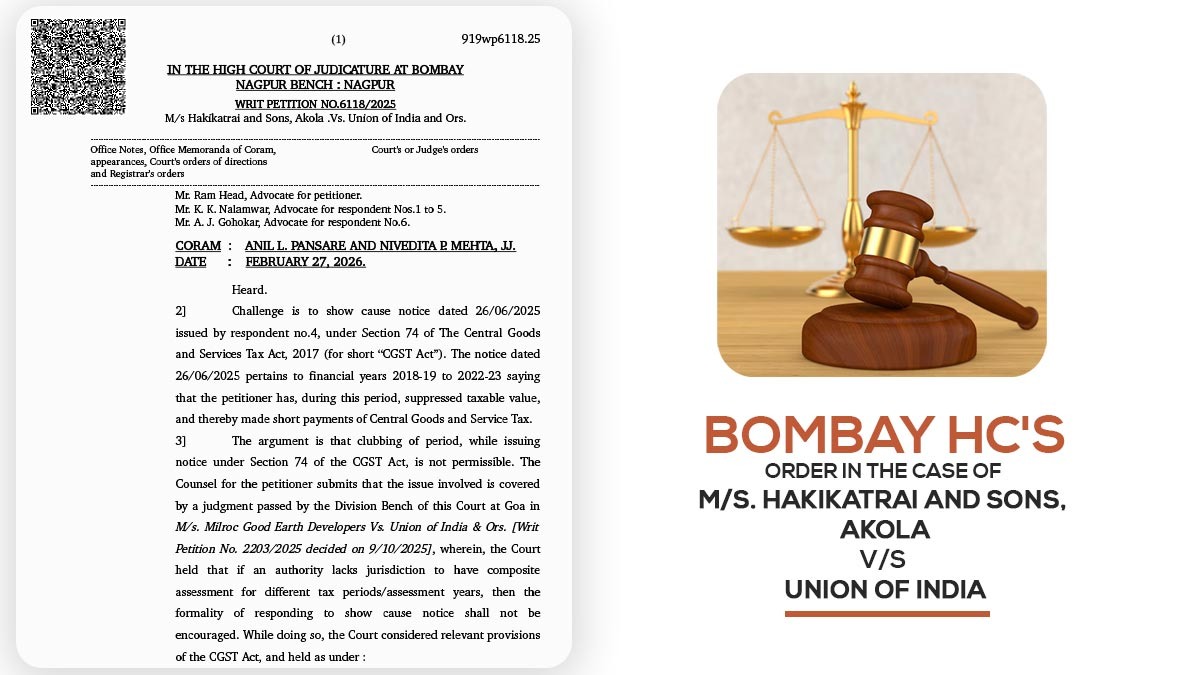
The applicant for the case contested a Show cause notice issued via the tax authorities, especially u/s 74. alleging suppression of taxable value and consequent short payment of Central GST.
A composite period from Financial Year 2018-19 to 2022-23 is covered in the impugned notice, alleging that in these years the applicant had suppressed taxable turnover and thereby short-paid tax.
The applicant approached the HC claiming that the notice was without jurisdiction, as it integrates multiple financial years into a single show cause notice (SCN). The applicant said that the GST statutory framework needs a year-wise determination of tax obligation, and thus, issuance of a consolidated notice for several financial years was not allowable.
The applicant supporting this claim put reliance on the ruling of the HC in Milroc Good Earth Developers v. Union of India, where it was mentioned that the scheme of the CGST Act does not allow consolidation of different fiscal years or tax durations in a single SCN. u/s 74.
The petition was countered by the tax department, which claimed that the case comprises fake Input Tax Credit ( ITC) availment over the years. The department said that when fake transactions are spread across various years, a consolidated SCN may be furnished to show the pattern of fraud.
The department put reliance on the Delhi High Court’s decision in Mathur Polymers v. Union of India, where the court ruled that the CGST Act does not restrict the issuance of a consolidated SCN for multiple years in cases of fake ITC.
Thereafter, the department said that the Delhi High Court’s decision had been contested before the Apex Court, which declined to intervene with the ruling while dismissing the special leave petition, thereby implying that the statutory position had attained finality.
Issue-
Whether a single consolidated SCN u/s 74 of the CGST Act can be issued for multiple financial years (2018-19 to 2022-23), alleging suppression of taxable value and fake availment of ITC, or whether the GST statutory scheme needs separate notices for each financial year/tax period.
Held That:
The Court said that Sections 73(10) and 74(10) of the CGST Act specify a separate limitation period for each financial year, permitting the tax authorities to pass an order in 5 years from the last date of filing the annual return for that fiscal year.
If a consolidated notice that includes various years were allowed, then it would merge different tax periods with different limitation timelines, which is rebellious to the statutory procedure. The Court put reliance on its earlier decisions in Milroc Good Earth Developers and Rite Water Solutions, which had analyzed the regulatory scheme of GST in detail.
The Court mentioned that the GST structure for different tax durations, where tax obligation is determined as per the returns submitted for each fiscal year. Returns can be submitted monthly; the statutory framework connects assessment, recovery, and limitation to the fiscal year and the annual return.
Subsequently, the Court referred to the definition of “tax period” u/s 2(106) of the CGST Act, which shows the period for which returns must be furnished. This statutory framework shows that each financial year forms a distinct tax period for assessment and recovery purposes.
Read Also: Madras HC: Officials Must Issue Separate GST SCNs Instead of Combined Notices
As per that, the Court said that section 74 does not allow for the consolidation of notices for various fiscal years, even in cases that consist of alleged fake availment of ITC. Thereafter, the impugned SCN was quashed and set aside.
The HC permitted the petition and quashed the SCN, keeping that merging multiple financial years into a single notice u/s 74 of the CGST Act is not allowable.
| Case Title | M/s. Hakikatrai and Sons, Akola vs. Union of India |
| Case No | WRIT PETITION NO.6118/2025 |
| For Petitioner | Mr. Ram Head |
| For Respondent | Mr. K. K. Nalamwar, Mr. A. J. Gohokar |
| Bombay High Court | Read Order |