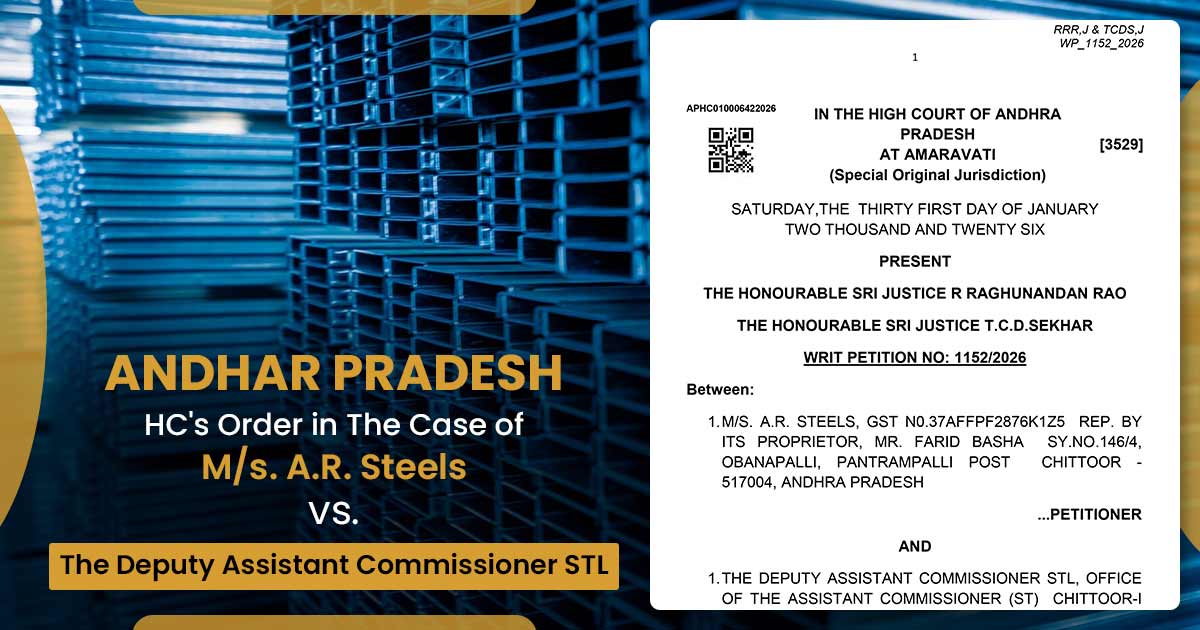



The Andhra Pradesh High Court has established a significant ruling regarding best judgment assessment orders. According to the court, these orders, which are issued when a taxpayer fails to file their returns, are automatically considered withdrawn if the taxpayer later submits their returns along with the payment of tax, interest, and any applicable late fees within the designated statutory or extended timeframe.
This decision underscores the importance of compliance and timely filing for registered persons.
The bench of Justice R Raghunandan Rao and Justice T.C.D.Sekhar cited that minor delays beyond the stipulated period can be condoned in appropriate cases.
The petitioner, who is a registered taxpayer under the Andhra Pradesh Goods and Services Tax Act, 2017, failed to submit GST returns for the period from March 2023 to May 2023 by the required deadlines. As a result of this non-compliance, the assessing authority commenced proceedings in accordance with Section 62 of the GST Act. This section permits best judgment assessments when taxpayers do not file their returns as mandated.
The tax authorities later issued a Notice for Unpaid Balances as per Section 79 of the GST Act. This notice initiated recovery proceedings, which included warnings of potential coercive actions.
The taxpayer, dissatisfied with such recovery measures, approached the HC, claiming that the assessments stood automatically withdrawn under Section 62(2) after the filing of returns, including statutory dues.
The question before the court was whether the best judgment assessments u/s 62 could be effective once returns were filed belatedly, particularly under the extended time duration of 120 days rolled out by revision to Section 62(2) w.e.f 1 October 2023, and whether such an amendment could work retrospectively.
Read Also: Simple Guide to File Every GST Return Online for Taxpayers
For May 2023, the applicant stated that returns were submitted within 120 days from the assessment order, resulting in automatic withdrawal under Section 62(2). For March 2023, although returns were filed within the statutory 60-day period, the subsequent amendment extending the period to 120 days must apply retrospectively.
For April 2023, the delay outside 120 days was marginal (12 days) and merited condonation, relying on earlier decisions of the Andhra Pradesh High Court and similar rulings of the Madras High Court.
The court said that section 62(2) is an effective provision; it delivers taxpayers a chance to regularise compliance even after best judgment assessments. The revision, which extends the time limit to 120 days from 60 days, should be considered as retrospective in nature, particularly where the assessments were still in dispute.
Recommended: How Modern GST Software Keeps Your Financial Data Safe
The return filing and tax payment for May 2023 were under the extended time duration. But a delay was there for March and April 2023, and this delay was condonable, especially for the consistent judicial precedents from both the Andhra Pradesh and Madras High Courts.
The writ petition was disposed of by the High Court by declaring that the assessment orders dated 27.05.2023, 21.06.2023, and 12.07.2023 will be considered to have been withdrawn u/s 62(2) of the GST Act. The recovery proceedings begin u/s 79, founded on such assessment could not be effective.
The relief is contingent upon verification of the payment of the late fee, including interest, if any, which should be filed within the said 6 weeks if found unpaid. All due recovery actions and pertinent proceedings were closed.
| Case Title | Meka Dredging Company Private Limited Versus The Deputy Assistant Commissioner |
| Case No. | NO: 34558/2025 |
| Counsel for the Petitioner | Singamsetty V.M. Sankar |
| Andhra Pradesh High Court | Read Order |