

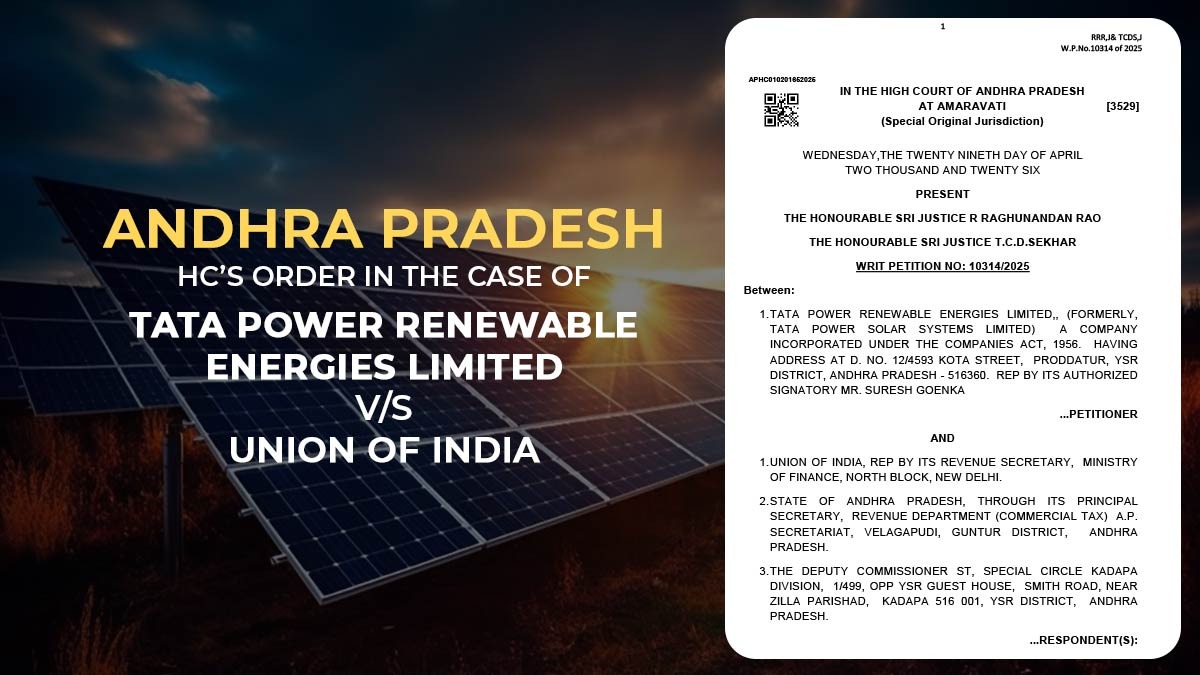
The Andhra Pradesh High Court, in a ruling in favour of Tata Power, has held that the issuance of separate invoices for goods and services does not prevent the application of the 70:30 valuation procedure set out in GST notifications for solar power generating systems.
An assessment order has been set aside by the Court that had charged an 18% tax on the complete turnover, resulting in a demand of Rs 9.19 crores.
Tata Power Renewable Energy Limited, the petitioner, supplies solar power-generating systems along with related services. The company had been discharging GST at an effective rate of 8.9%, applying 5% tax on 70% of the value attributable to goods and 18% on the remaining 30% attributable to services, in line with the explanation to Entry 234 of Notification No. 1/2017 and Entry 38 of Notification No. 11/2017.
The Revenue claimed that since the applicant has issued separate invoices for the supply of goods and for erection/installation services, the transaction cannot be considered as a single composite contract.
Therefore, the Deputy Commissioner refused the benefit of the 70:30 split and taxed the entire supply at 18%, alleging tax evasion u/s 74 of the CGST Act. The revenue claimed that goods that fall under distinct HSN codes could not avail the lower rate.
The applicant contended that the explanations included in the relevant notifications established a legal fiction that classifies 70% of the consideration as goods and 30% as services.
Citing the Division Bench decision in Sterling and Wilson Pvt. Ltd. vs. Joint Commissioner, they argued that the supply was inherently composite and that the valuation procedure applied regardless of the billing structure.
Important: GST Impact on Solar Project Prices in India
The Coram of Justice R. Raghunandan Rao and Justice T.C.D. Sekhar stated that the explanation to Entry 234 mandates the 70:30 split if goods are supplied with taxable services mentioned in Entry 38. The Court observed that no dispute was conducted by the revenue that the supplies were made as per the contracts.
The Court Stated:
“By virtue of the inclusion of the explanations, in entry 234 and entry 38 of the two notifications, a legal fiction has been created, that in the supply of Solar Power generating Systems, the value of supply of goods is 70% and the value of services is 30%.”
Examining the approach of the department, the Court held that mere issuance of separate invoices does not revise the nature of the supply or take the transaction out of the ambit of the advantageous notifications.
Read Also: Andhra Pradesh HC Cancels GST Demand Order on Free Supply of Materials to Concrete Firm
It was observed that the department did not perform any exercise to find out the individual values of goods and services, if it truly assumes they were separate supplies, and instead arbitrarily charged 18% on the total turnover.
The Court granted the writ petition and set aside the Assessment Order dated March 6, 2025, specifically regarding the imposition of a differential tax rate. It instructed the Respondent to issue the necessary consequential orders in line with the 70:30 mechanism.
| Case Title | Tata Power Renewable Energies Limited vs. Union of India |
| Case No. | NO: 10314/2025 |
| Counsel for the Petitioner | Doddala Prudhvi Teja |
| Counsel for Respondent | GP For Commercial Tax |
| Andhra Pradesh High Court | Read Order |