

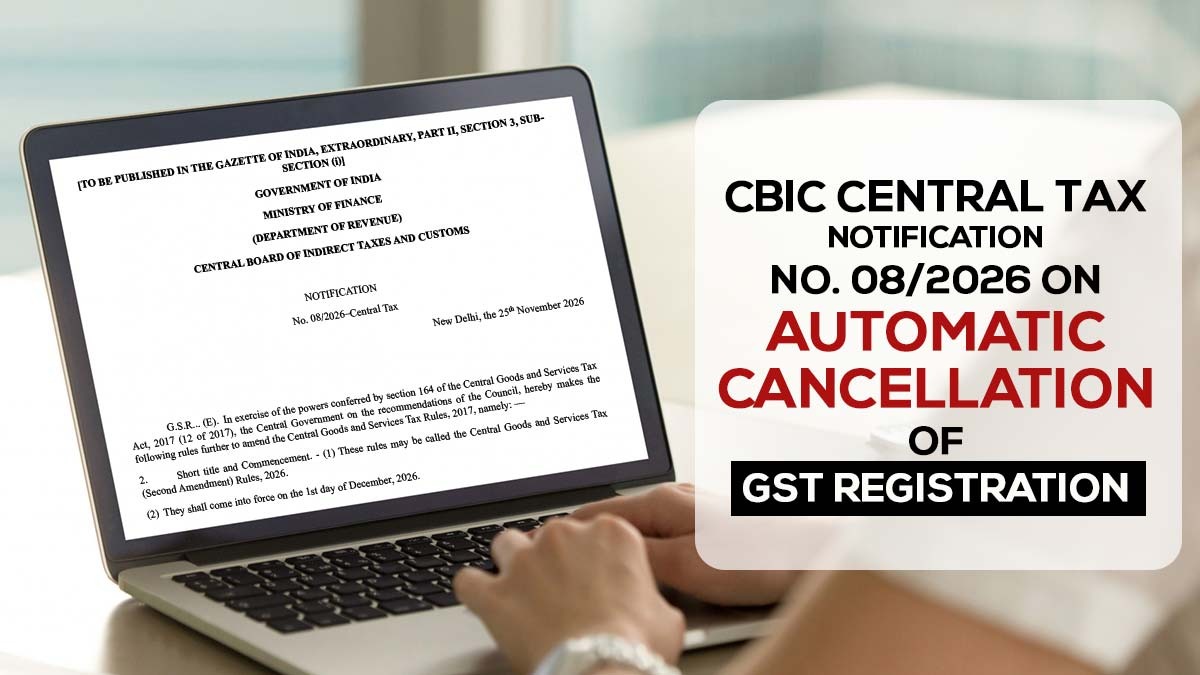
The Central Board of Indirect Taxes and Customs (CBIC) has issued a notification amending Rule 20 of the Central Goods and Services Tax (CGST) Rules, 2017. This amendment introduces changes to the procedure for the cancellation of GST registration upon a taxpayer’s application.
The Central Government, via Notification No. 08/2026-Central Tax dated November 25, 2026, has rolled out the revisions to sub-rules (5) and (6) of Rule 20. The revised provisions will come into force on December 1, 2026.
This amendment describes when an application for the cancellation of GST registration can be processed electronically via the common portal, and when it should be referred to the jurisdictional officer for examination.
Amendment to Rule 20
According to the amended Rule 20, the processing of an application for the cancellation of GST registration will depend on whether or not the taxpayer has fulfilled the stipulated conditions regarding the filing of returns and making payments.
The changed provisions specify two different situations.
Automatic GST Registration Cancellation After Completing All Compliance Needs
As per the replaced sub-rule (5), if a taxpayer applies for the cancellation of their GST registration under Rule 20(1), the registration shall be cancelled electronically via the common portal, provided that the following conditions are met:
- The returns referred to in sub-rules (2) and (3) have been filed within the stipulated time.
- All outstanding tax liabilities have been paid.
- Applicable interest, late fees, and penalties have been paid.
- Any other amount payable by the assessee has also been released.
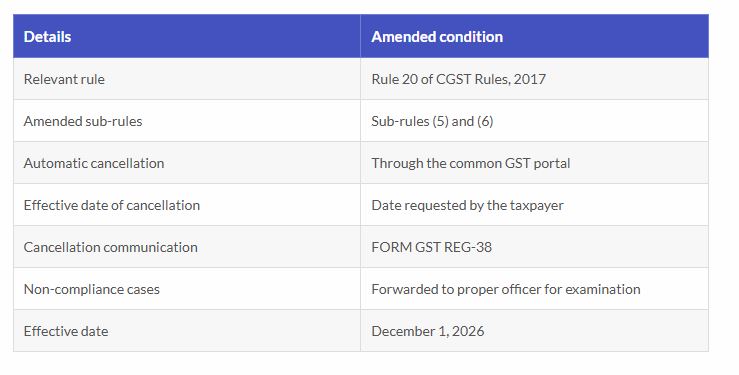
After such conditions are met, the GST registration will be cancelled electronically wef the date from which the cancellation was asked by the taxpayer.
The notice of cancellation will be sent to the taxpayer electronically, in Form GST REG-38.
Application Directed to the Proper Officer in Cases of Non-Compliance
The amended sub-rule (6) outlines a different procedure for cases where the taxpayer has not met the required compliance conditions.
If the returns or statements in FORM GST CMP-08, as mentioned in sub-rule (3), have not been submitted, or if there are any outstanding amounts due, including tax, interest, fees, penalties, or other payable amounts, the cancellation application will be forwarded to the appropriate officer for review.
This indicates that automatic electronic cancellation will not be possible in such situations, and the application will need to be examined by the relevant GST officer.
Crucial Revisions Rolled Out via Notification No. 08/2026-Central Tax
What GST Taxpayers Need to Understand?
The amendment emphasises the importance of timely compliance for taxpayers who are planning to surrender or cancel their GST registration.
Prior to submitting a cancellation application, taxpayers must ensure that they have filed the required returns and statements within the specified deadlines. Additionally, all outstanding tax dues, interest, fees, penalties, and other payable amounts must be fully cleared.
Recommended: CBIC Introduces Automatic GST Registration Cancellation, Substitutes Rule 20
Businesses registered under the composition scheme should verify their filing requirements for FORM GST CMP-08.
If these conditions are not met, then it may result in the application being referred to the proper officer instead of being automatically processed via the GST portal.
Effective Amendment Date
Based on the recommendations of the GST Council, the Central Government has notified these changes under Section 164 of the CGST Act, 2017—via Notification No. 08/2026-Central Tax, issued on November 25, 2026.
The Central Goods and Services Tax (Second Amendment) Rules, 2026, will come into effect from 1 December 2026.
Read Central Tax Notification No. 08/2026