

The Delhi High Court has stated that if the remaining limitation period for issuing an income-tax reassessment notice, after excluding the time granted to the taxpayer to respond to a ‘show-cause notice’, is less than seven days, the Income Tax Department is entitled to an additional seven-day period (a statutory extension) to complete the proceedings.
A division bench comprising Justice Dinesh Mehta and Justice Aditi Chaudhary clarified that the seven-day grace period under Section 149 of the Income Tax Act, 1961, must be observed.
This requirement applies both when passing an order under Section 148A(d) and when subsequently issuing a reassessment notice under Section 148.
While quashing the reassessment proceedings initiated against the petitioner, the court observed that the notice had been issued beyond the prescribed time limit.
The bench stated that where the remaining limitation period is less than seven days, the legal extension ensures that the Assessing Officer (AO) has at least seven days to complete the remaining proceedings.
“The said statutory provision is intended to ensure that, notwithstanding the exclusion of the period during which the assessee is entitled to respond, the Assessing Officer has a minimum period of seven days available for completing the remaining statutory exercise, including passing an order under Section 148A(d) of the Act of 1961 and issuance of the consequential notice under Section 148 of the Act of 1961,” the Court stated.
In this case, the original reassessment notice was issued on June 30, 2021. This date also marked the final day of the extended limitation period under the ‘Taxation and Other Laws (Relaxation and Amendment of Certain Provisions) Act, 2020’ (TOLA).
Thereafter, on May 26, 2022, the Assessing Officer issued an SCN u/s 148A(b) and granted the taxpayer time until June 24, 2022, to file a response.
On June 24, 2022, the taxpayer filed its reply. However, the assessing officer had issued the reassessment notice on July 23, 2022.
The applicant contested the proceedings, claiming that only one day of the extended limitation period was available for the assessing officer and that the impugned notice was time-barred.
The court directed the decision of the Apex Court in Union of India v. Ashish Agarwal and Union of India v. Rajeev Bansal, which dealt with reassessment notices issued under the previous income tax regime and the calculation of the surviving limitation period.
It is observed that the Supreme Court has said that the limitation period for the Revenue Department begins only after the taxpayer’s response to a ‘show-cause notice’ is received.
Read Also: Karnataka HC: 7 Days Should Be Granted for Responding to an Income Tax Notice Issued U/S 148a(b)
Subsequently, the Assessing Officer must consider that response, pass an order under Section 148A(d), and issue the relevant notice within the remaining limitation period.
Applying this principle, the Court noted that after the assessee filed their response on June 24, 2022, the Assessing Officer was left with only one day.
Because the surviving period was less than 7 days, the statutory extension considered under the fourth proviso to Section 149(1), as it stood in 2021, became applicable.
“Consequently, even after granting the benefit of the said extension to the Revenue, the Assessing Officer had a maximum period of seven days from 24.06.2022 to complete the remaining proceedings till 01.07.2022,” the Court stated.
On July 23, 2022, the reassessment notice was issued after the regulatory due date of July 1, 2022.
Therefore, the Court said that the reassessment proceedings were initiated after the limitation period and set aside the order passed u/s 148(d).
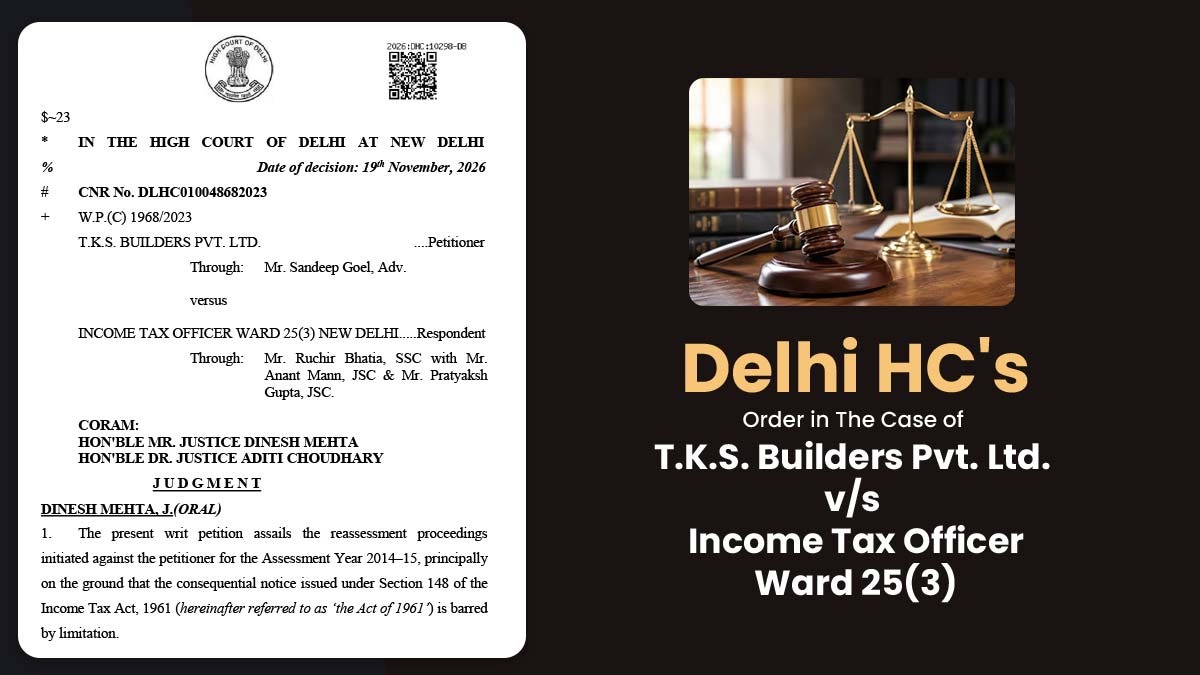
| Case Title | T.K.S. Builders Pvt. Ltd. vs. Income Tax Officer Ward 25(3) |
| Case No. | W.P.(C) 1968/2023 |
| For Petitioner | Mr. Sandeep Goel |
| For Respondent | Mr Ruchir Bhatia, Mr Anant Mann, and Mr Pratyaksh Gupta |
| Delhi High Court | Read Order |