

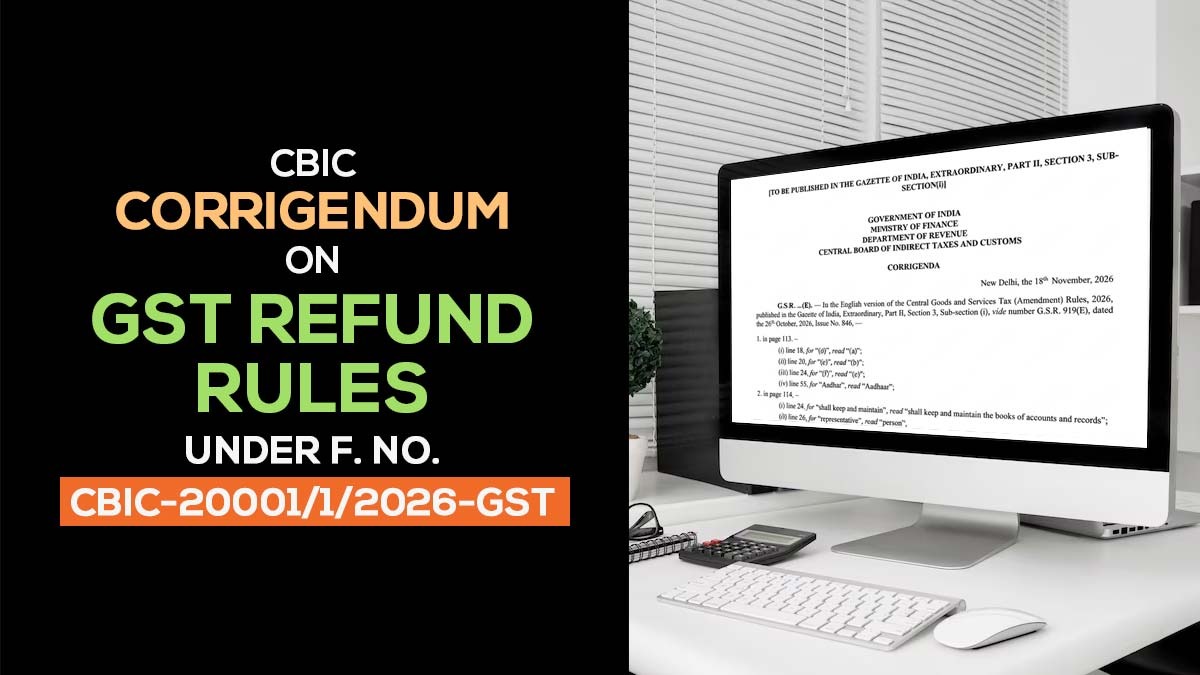
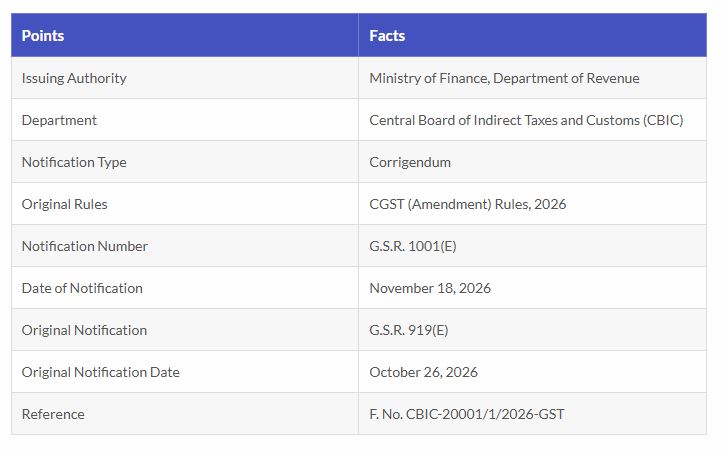
The Central Board of Indirect Taxes and Customs (CBIC) has issued a corrigendum to the Central Goods and Services Tax (Amendment) Rules, 2026, notified on October 26, 2026. The Ministry of Finance, through notification number G.S.R. 1001(E) dated November 18, 2026, has rectified errors in the English version of the amended GST rules, while also incorporating changes related to wording, numbering, and procedures.
This corrigendum resolves various norms for GST registration, refund processing, documentation requirements, application forms, and other compliance-related procedures. A crucial clarification is related to the verification of the refund orders issued in Form GST RFD-06 and payment orders in Form GST RFD-05.
Important Provisions of CGST Amendment Rules Corrigendum, 2026
- Rectifications have been made to the list and numbering of the documents, including property tax receipts, municipal khata copies, property identification documents, electricity bills, and water bills.
- Revalidation of the orders that are issued in Form GST RFD-06 will not be needed. However, the payment orders in Form GST RFD-05 should be revalidated if the refund is not disbursed within the same fiscal year in which the order was issued.
- Various rectifications have been made in the application numbering, references to sub-rules, and procedural wording.
- The word permission has been substituted with consent at specific places in the revised norms.
- Clarifications have been made in the declaration related to the ineligible ITC u/s 17(5) and ITC for the nil-rated or completely exempt supplies.
- The term seven days has been rectified to seven working days in the corresponding norms.
CBIC Clarifies the Requirements for Revalidating GST Refund Orders
An important rectification is for the validity of the refund concerned with the orders issued under the GST structure. The corrigendum inserts two provisions in the pertinent provisions for refund processing:
Form GST RFD-06 – No Revalidation Required
An order issued in Form GST RFD-06 will not need revalidation by the proper officer.
Form GST RFD-05 – Revalidation mandated in certain cases
A payment order issued in Form GST RFD-05 will need revalidation where the refund is not given within the same fiscal year in which the payment order was issued.
This distinction is significant for both taxpayers and GST officials involved in refund processing, as the requirement for revalidation now relies on the nature of the order and the timing of the refund payment.
Also Read: GST Refund Rules Amended to Enable Automated Processing & Faster Approvals
Amendments to GST Registration Documentation Rules
The corrigendum also introduces improvements to the documentation-related requirements specified in the amended CGST rules.
Related changes include improvements to the number and details of documents required for property-related verification.
The rectified document references are:
- Latest Property Tax Receipt
- Copy of Latest Water and Electricity Bill
- Municipal Khata and Property Identification Copy
These amendments are set out in the revised text of the English version of the rules and are relevant to taxpayers involved in GST registration and related documentation.
‘Permission’ Substituted with ‘Consent’ in Several Locations
A significant correction in the amended Rules is the replacement of the word “permission” with “consent” in several locations.
This adjustment occurs in multiple provisions, including references on pages 114, 156, and other relevant sections of the amended Rules. Additionally, the term “representative” has been replaced with “person” in specified locations.
These changes address terminology inconsistencies in the amended provisions and should be taken into account when referring to the revised text.
Also Read: How to File GST Refund Claims Manually? Step-by-Step Guide
Seven Days Revised to Seven Working Days
The corrigendum particularly changes the phrase “seven days” to “seven working days” in the relevant provision. This amendment can be found on page 149 of the English version of the updated Rules.
Understanding the difference between calendar days and working days is crucial for accurately calculating procedural timelines. Taxpayers and professionals should refer to the corrected wording when interpreting the relevant requirements.
Clarification Regarding GST ITC Refund Declaration
CBIC has updated the declaration stipulated in the refund application documentation.
The revised declaration cites:
“I/We hereby declare that the refund of input tax credit claimed in the application does not include ITC not available under section 17(5) and ITC availed on goods or services used for making ‘nil’ rated or fully exempt supplies.”
This correction states the wording of the declaration concerning ineligible ITC and GST input tax credit (ITC) related to nil-rated or fully exempt supplies.
This is important for taxpayers submitting refund applications that involve accumulated ITC.
Other Technical and Editorial Amendments
In addition to the aforementioned changes, the corrigendum includes several other corrections across the amended CGST Rules.
It consists of-
- Correction of references relating to Aadhaar.
- Changes in wording concerning GST registration and enrolment.
- Correction of incorrect references to clauses, sub-rules and form numbering.
- Changes in the numbering of various entries in annexures and application forms.
- Corrections in the provisions relating to refund applications and declarations.
- Deletion and insertion of specified lines in different pages of the amended Rules.
- Correction of references to earlier notifications and amendment dates.
This corrigendum rectifies specific references related to the original CGST Rules, 2017, including details of their latest amendment made via Notification No. 20/2025-Central Tax, dated December 31, 2025.
Key Details of Notification
Closure
On November 18, 2026, the CBIC issued a corrigendum that contains several corrections to the English version of the CGST (Amendment) Rules, 2026, which were notified on October 26, 2026.
While many changes pertain to drafting, numbering, and cross-references, some corrections have significant implications for GST compliance. This includes updates related to refund order revalidation, registration documentation, and the ITC refund declaration.
Taxpayers, chartered accountants, and GST practitioners should review the corrigendum alongside the original amendment rules to ensure they adhere to the corrected provisions and terminology while conducting GST-related procedures.
Read CBIC Corrigendum