

The Goods and Services Tax Appellate Tribunal (GSTAT), Hyderabad, has stated that businesses cannot be denied Input Tax Credit (ITC) only because the credit claimed on the purchases is more than the amount shown in records generated from the supplier’s invoices.
A bench comprising Judicial Member A.P. Ravi and Technical Member Duvvuri Krishna Srinivas stated that while discrepancies between the credit claimed by a buyer and the information provided by suppliers may necessitate verification, this alone does not prove that the credit was claimed incorrectly.
Relying on a GSTAT Bengaluru bench’s ruling, “We are in agreement with the observation of the Bengaluru Bench that a difference between Form GSTR-2A and Form GSTR-3B may justify verification, but cannot, without more, be treated as conclusive proof that the ITC has been wrongly availed.”, it stated.
For clarification, Form GSTR-3B is the return where a business declares the ITC it claims towards its purchases. Form GSTR-2A is an automatically generated statement that shows purchase invoices uploaded by its suppliers.
A mismatch arises when the credit claimed by the buyer does not match the information declared by the suppliers.
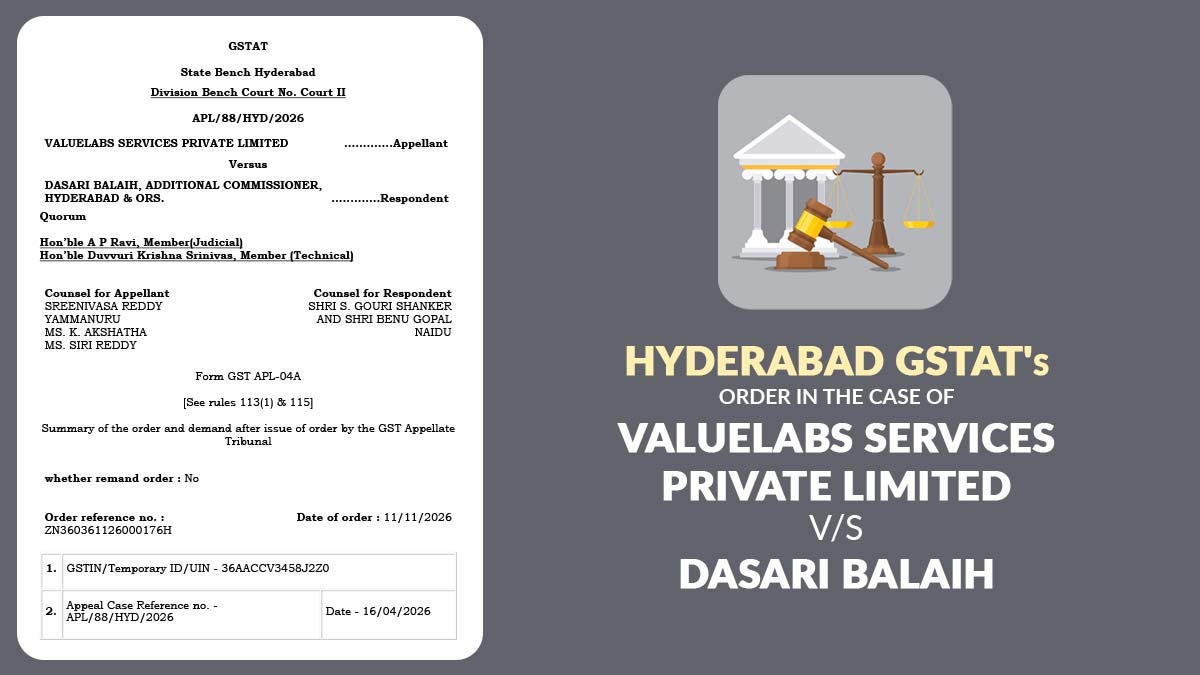
The tribunal was hearing a petition filed by ‘ValueLabs Services Private Limited’ against a GST demand of ₹41.10 lakh for the year 2017-18.
The department had raised this demand upon discovering that the Input Tax Credit (ITC) claimed by the company exceeded the amount reflected in the filings of its suppliers.
The company stated that some suppliers had provided invoice details under its old GST registration. To substantiate its claim, the company also submitted supplier certificates, invoices, and ledger records.
The tribunal said that the department did not comply with the verification process specified under CBIC Circular No. 183/15/2022-GST. It discovered that the appellate authority had denied the certificates without furnishing reasons or undertaking the required verification.
Taking a stance distinct from the Supreme Court’s judgment in the case of ‘State of Karnataka v. Ecom Gill Coffee Trading Private Limited’, it observed that, in the present case, there is no dispute regarding the genuineness of the transactions or the existence of the suppliers.
The tribunal also cited that a mismatch could not establish fraud, wilful misstatement or suppression of facts to invoke Section 74 of the GST Act.
It quashed Rs 40.90 lakh of the demand but kept Rs 20,430 for which the company did not provide proof that the supplier had paid the tax to the government.
The department was directed to calculate the interest applicable to the outstanding demand and determine the penalty amount within four weeks.
| Case Title | ValueLabs Services Private Limited vs. Dasari Balaih |
| Case No. | APL/88/HYD/2026 |
| Counsel for Appellant | Sreenivasa Reddy Yammanuru, Ms K. Akshatha, and Ms Siri Reddy |
| Counsel for Respondent | Shri S. Gouri Shanker and Shri Benu Gopal Naidu |
| Hyderabad GSTAT | Read Order |