

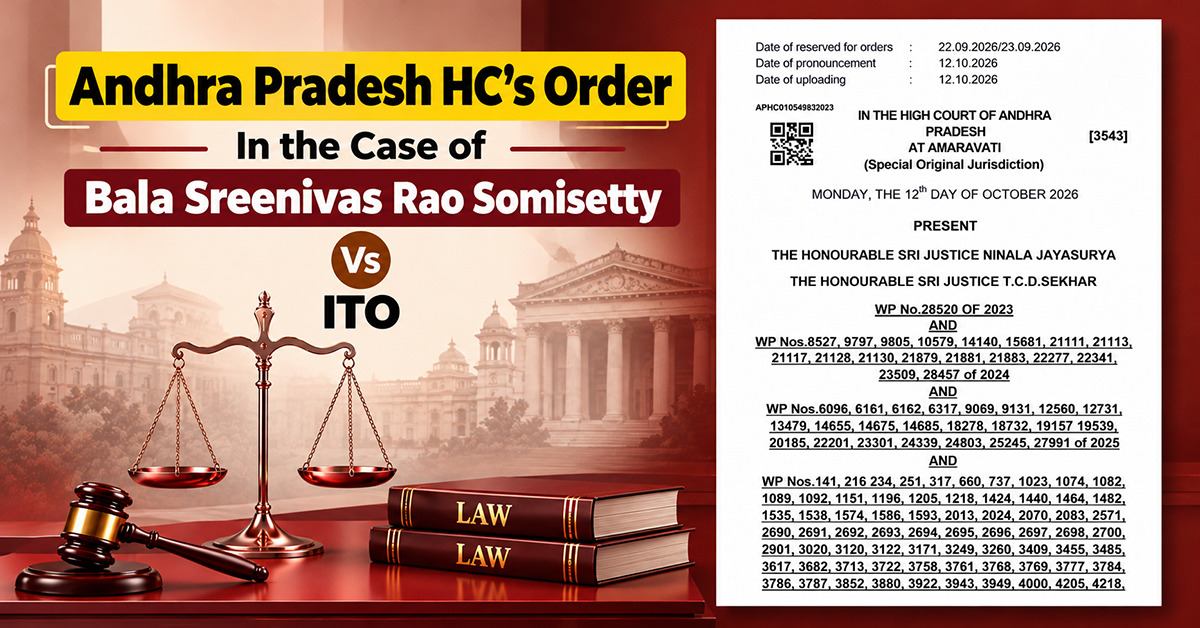
The Andhra Pradesh HC on Monday declared Section 147A of the Income Tax Act, 1961, unconstitutional. Introduced on a retroactive basis through the Finance Act, 2026, the statutory clause sought to clarify that Jurisdictional Assessing Officers (JAOs) can act as Assessing Officers to issue reassessment notices under Sections 148 and 148A, rather than leaving that role solely to assessment units or the National Faceless Assessment Centre.
A division bench composed of Justice Ninala Jayasurya along with Justice T.C.D. Sekhar ruled that the statutory modification failed to erase the basic foundation of previous High Court decisions, which had repeatedly affirmed that JAOs lack proper legal jurisdiction to issue notices under Sections 148 and 148A. Furthermore, the court pointed out that inserting Section 147A into the 1961 enactment after its formal repeal was legally flawed.
“Without amending the said scheme, any clarification or validation through amendment cannot be permitted, especially when the basis is not removed. Therefore, by introducing Section 147A of the Act, the Legislature is trying to overreach the judgments rendered by various High Courts in this regard, in direct conflict with the Doctrine of separation of powers, which is the basic structure of the Constitution,” the bench stated in its ruling.
The root cause of this litigation traces back to reassessment notices issued directly by JAOs, bypassing the e-Assessment of Income Escaping Assessment Scheme, 2022 (notified under Section 151A on March 29, 2022).
Designed to enforce automated allocation and faceless reassessment proceedings, the scheme’s binding nature led a coordinate High Court bench on October 28, 2025, to invalidate multiple orders and notices under Sections 148, 148A(b), and 148A(d) for violating Section 151A and the corresponding 2022 notification. Seeking relief, the Revenue Tax Department appealed these adverse decisions to the Supreme Court.
While these special leave petitions remained pending before the apex court, Parliament enacted Section 147A under the Finance Act, 2026, applying it retroactively to April 1, 2021. This addition sought to specify that, for Sections 148 and 148A, an Assessing Officer covers officers outside of an assessment unit or the National Faceless Assessment Centre referenced in Section 144B(3).
Taking note of this statutory change, the Supreme Court on April 10, 2026, set aside the earlier High Court rulings on the sole ground that the enactment shifted the legal baseline, remanding the cases back to the High Courts for reconsideration. However, the top court explicitly reserved all questions regarding the amendment’s scope, validity, retroactive applicability, and legal effect for thorough review.
Argued by the petitioners, Section 147A represented an unconstitutional attempt to overturn judicial precedents without correcting the specific legal infirmity highlighted by courts. Conversely, the Revenue argued that the change was merely clarificatory, contending that JAOs held full power to execute pre-assessment queries and serve notices while leaving the eventual reassessment to faceless units. Unpersuaded by the Revenue’s arguments, the High Court emphasised that Section 148 was never removed from the Section 151A scheme.
Because the executive branch failed to amend the underlying notification to exclude such notices after creating Section 147A, the existing framework remained binding.
“A plain reading of the scheme would make it clear that no discretion is given to the authorities manning the Act to conduct proceedings in a non-faceless manner,” noted the court. The bench added: “Therefore, the amendment brought in through Section 147A with retrospective effect without excluding Section 148 from the scheme is not sustainable under law.”
Relying on the classic precedent set by the Supreme Court in Shri Prithvi Cotton Mills Ltd. v. Broach Borough Municipality, the High Court emphasised that any retrospective validating statute must eliminate the precise defect that prompted the judicial invalidation.
“In such circumstances, without amending the scheme made under Section 151A of the Act, insertion of Section 147A into the Income Tax Act, 1961 in the name of clarification or validation cannot be permitted,” held the court.
Furthermore, it noted, “Admittedly, even as on today, Section 148 remains in the scheme and without making amendment to the scheme, incorporation of any provision to nullify the judgments rendered by various High Courts, is beyond Legislative competence and legally impermissible.” “Such acts of Legislature overreach which unsettle the decisions of Courts and lead to chaos cannot be allowed,” the bench remarked.
In a separate branch of its legal analysis, the High Court examined the repeal of the Income Tax Act, 1961, which coincided with the implementation of the Income Tax Act, 2025 on April 1, 2026.
Even though presidential assent for the Finance Act, 2026 was secured on March 30, 2026, the specific statutory clauses were scheduled to take effect only on April 1. Turning down the Revenue’s contention that presidential assent before the repeal date saved the provision, the court observed:
“Since the Finance Act, 2026 has expressly provided 1st day of April, 2026, it cannot be said that the same has come into force on 30.03.2026, the date on which it received the assent of the President.”
It determined, “Any amendment/insertion made to the Repealed Act is not sustainable under law, and it has no legal sanctity; accordingly, the same is liable to be struck down from the date of its inception or nativity.”
Ultimately, the High Court ruled Section 147A unconstitutional and concluded that reassessment proceedings launched by JAOs under Sections 148 and 148A lacked legal authorisation. The writ petitions were allowed, nullifying all challenged orders and notices, with no order as to costs.
Prior to this, the Punjab and Haryana High Court had similarly struck down Section 147A as unconstitutional in Jyoti Sareen v. Union of India on September 10, 2026. Nevertheless, on September 18, the Supreme Court issued a stay on that ruling, directing all related reassessment and assessment matters to stay frozen pending final resolution of the central government’s appeal.
The Andhra Pradesh High Court clarified that it reached its conclusion independently and set out its own reasoning for voiding Section 147A in the judgment rendered on October 12, 2026.
| Case Title | Bala Sreenivas Rao Somisetty Vs ITO |
| Case No. | WP No.28520 of 2023 |
| For Petitioner | A.V.A. Siva Kartikeya, Kondala Rao Kotapati, P.Pavan Kumar Rao, Vivek Chandra Sekhar |
| For Respondent | N. Venkataraman, T.Niranjan, Y.N.Vivekananda, Anup Koushik Karavadi |
| Andhra Pradesh High Court | Read Order |