

The Supreme Court has said that a product should be categorised for tax purposes in the form in which it is sold and not on the basis of what a consumer may later turn it into.
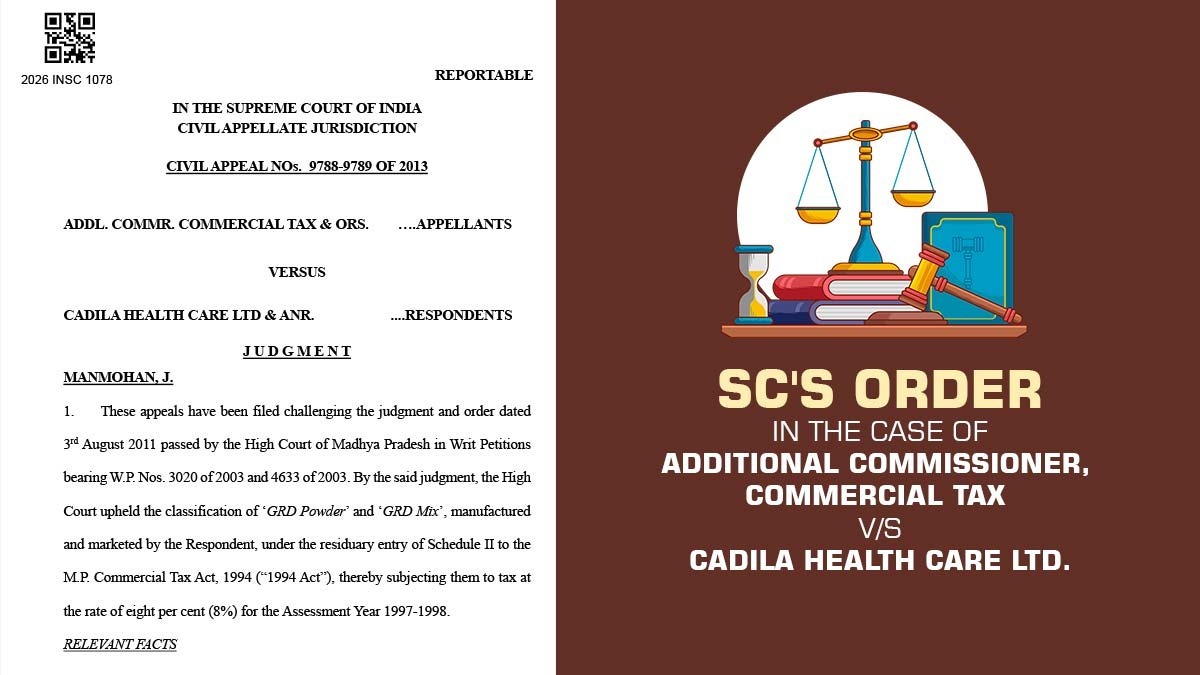
While dismissing the Madhya Pradesh Commercial Tax Department’s appeals over the classification of Cadila Health Care Ltd.’s ‘GRD Powder’ and ‘GRD Mix’, a Bench of Justice Manmohan and Justice Arun Palli said that “The tax authorities are bound to look at what is supplied and not at what is the ‘end use’ of the good.”
“The tax authorities are bound to look at what is supplied and not at what is the ‘end use’ of the good. For instance, if a powder mix such as protein powder is sold, the tax applicable to powders alone can be levied. Conversely, if a ready-to-drink beverage such as bottled cold coffee or a packaged protein shake is sold, the tax applicable to beverages must be imposed…..The subsequent use by the consumer in mixing the powder with water or milk to prepare a drink does not alter the taxable event, for liability is determined at the point of supply”, the court stated.
The dispute is related to the tax treatment of the two products for the AY 1997-98. The revenue wanted them categorised as “non-alcoholic drinks and beverages”, where 10% tax is drawn under Entry 20(ii) of Part IV of Schedule II to the Madhya Pradesh Commercial Tax Act, 1994.’
Cadila claimed that the products were sold across the counter in powder and biscuit form and thus counted under the residuary entry, which covered goods not included in Schedule I or any other part of Schedule II and draws 8% tax.
Entry 20(ii) was the specific tax entry for non-alcoholic drinks and beverages. It covered syrups, cordials, distilled juices, ark, and essences. The residuary entry covered other goods that were not included in Schedule I or another part of Schedule II. The difference specifies that the Revenue’s classification draws a higher 10% tax rather than 8%.
Also Read: SC Overturns HC Order on Section 148A(b) Notice to Deceased, Shifts Onus to Legal Representatives
The Revenue said that the packaging informed consumers to mix the products with milk or water, whereas the images depicted them as health drinks rather than health foods. They also based their arguments on common usage, functional characteristics, and common parlance, noting that tea and coffee are considered beverages even when sold in powder form.
However, the Court stated that these tests could not be used to classify the products under the ‘beverage’ category based on their end-use. The Court observed that the basis for taxation was the supply process, and the tax classification was determined by the form in which the goods were sold.
The Court observed that a powder could be mixed with milk or water and consumed as a drink. For example, Protein powder could be utilised to prepare a solid food like barfi. The subsequent option for the consumer could not revise the classification of the product at the time of sale.
The court analysed the language of Entry 20(ii). The items listed alongside “beverages” are liquids or liquid preparations. The court distinguished the Revenue’s reliance on Pioma Industries and S. Samuel M.D. In Pioma, the relevant statutory entry expressly covered powders, tablets and concentrates used to prepare non-alcoholic drinks.
In S.Samuel, the problem was whether tea was a foodstuff, and the court failed to determine whether tea leaves existing in granule or powder form could be categorised as a beverage.
The Court determined that the goods existed in powder and biscuit form during taxation. Afterwards, they could be used to make a beverage or a solid preparation; that subsequent use did not bring them within the beverage entry.
Therefore, the appeals were dismissed.
| Case Title | Addl. Commr. Commercial Tax & Ors. vs. Cadila Health Care Ltd. & Anr. |
| Case No. | Civil Appeal Nos. 9788-9789 Of 2013 |
| For the Appellant | Akraj Kumar, Advocate |
| For the Respondent | Vivek Sarin, Senior Advocate |
| Supreme Court | Read Order |