

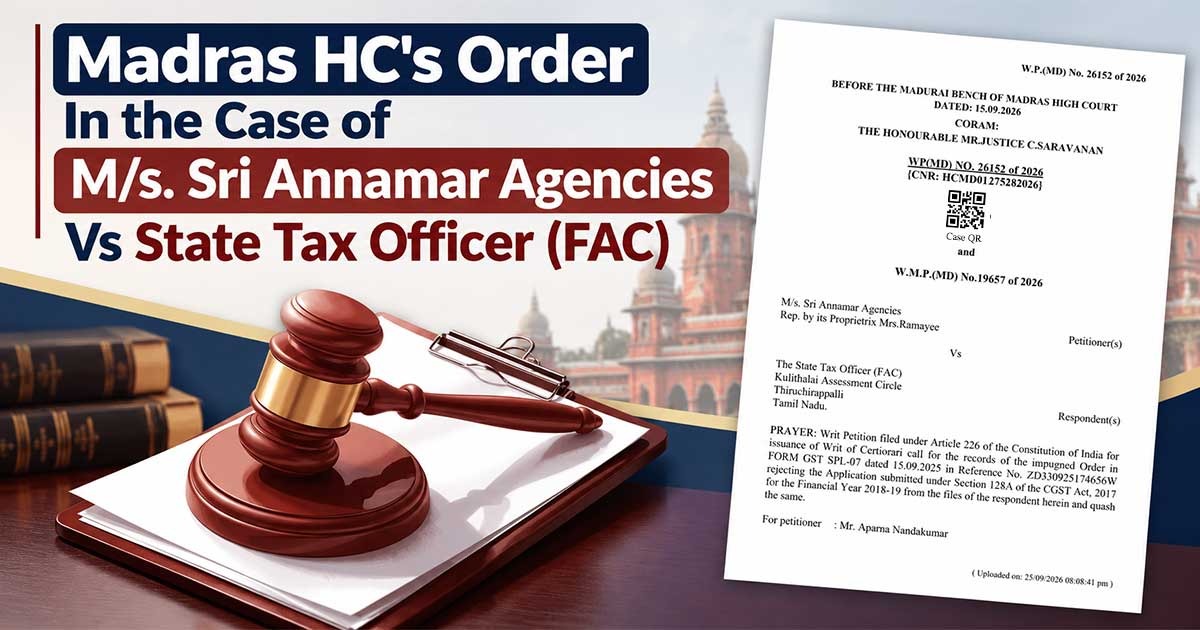
The Madras High Court has quashed an order denying a taxpayer’s application for exemption from GST interest and penalty u/s 128A because the taxpayer had paid the tax via Form GST DRC-03 but did not submit Form GST DRC-03A to link that payment to the demand.
The bench of Justice C. Saravanan noted that the omission was procedural, subject to verification that the amount had not been utilised for another liability.
The bench noted that failure to submit DRC-03A under Rule 142(2B) was procedural in nature, given that the amount paid had not been debited for another tax obligation. The court said the tax officer must analyse the status of the amount.
The Court stated that the tax officer should verify the status of the amount. If the payment is available as specified in the order, permission to file Form DRC-03A post-facto may be granted.
The taxpayer receiving an adverse order u/s 73 for the 2018–19 tax period. The business paid an amount equal to the tax obligation via Form GST DRC-03. It subsequently applied for relief u/s 128A.
The application had been cancelled by the State tax officer via an order in Form GST SPL-07. The reason behind it was that the taxpayer had not generated Form GST DRC-03A. The taxpayer contested that denial before the Madurai Bench of the Madras High Court.
Section 128A provides for the exemption of interest, penalty, or both in eligible cases, which includes demands under section 73, subject to the mentioned conditions. Rule 164 specifies the process for applying for that relief.
Towards an application related to an order u/s 73, Rule 164(2) mandates payment of the demanded tax to be credited against the relevant entry in the electronic liability register. Where the taxpayer has paid via DRC-03, the rule mandates a DRC-03A application to credit that payment against the demand before filing Form GST SPL-02.
In this case, the tax had been paid before making the application under Section 128A, but the taxpayer had not completed the step involving Form DRC-03A. The question before the court was whether it was correct to reject the application for a waiver due to this omission, despite the tax having already been paid.
Thus, the court set aside the SPL-07 rejection and sent the case back to the state tax officer for a fresh decision. Exemption under Section 128A has not been granted directly in this case; the taxpayer’s eligibility and payment status are yet to be verified.
The taxpayer can submit a response in Form GST SPL-04 before the notice is issued in Form GST SPL-03 within 30 days of receiving a copy of the court’s order. If the taxpayer files, then the officer should determine the case on its merits and in accordance with law, specifically within 3 months of the response. The officer should deliver the taxpayer due notice before passing the fresh order.
| Case Title | M/s. Sri Annamar Agencies Vs State Tax Officer (FAC) |
| Case No. | W.P.(MD) No. 26152 of 2026 |
| For Petitioner | Mr Aparna Nandakumar |
| For the Respondent | Mr R.Parthiban |
| Madras High Court | Read Order |