

The Delhi High Court has mentioned that the denial of permission to a taxpayer to rectify an accidental double taxation of the same income shall amount to “unjust enrichment” on the part of the Union of India.
The Division Bench of Justices Dinesh Mehta and Rajneesh Kumar Gupta said that the Government can levy tax only once on a particular income.
Read Also: Delhi HC: Successor AO Cannot Reopen IT Assessment Solely Due to a Different Opinion from Original
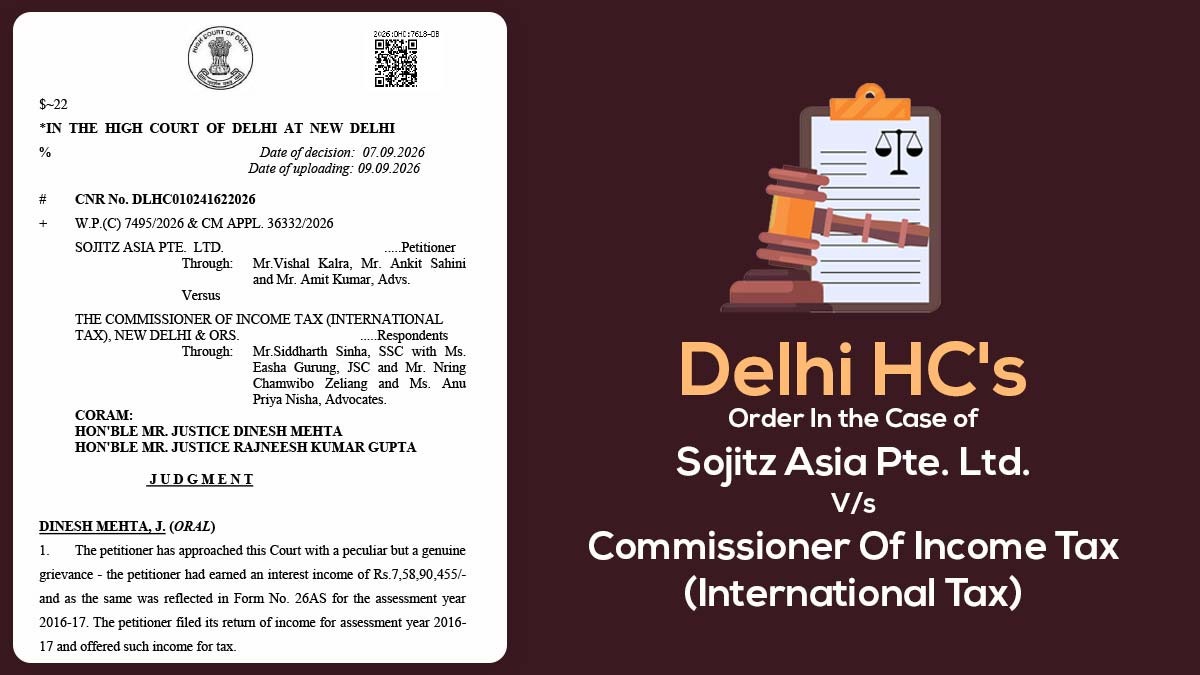
The Court observed while permitting a petition where the applicant had accidentally proposed the same interest income of Rs 7,58,90,455 to be taxed in two assessment years.
The Court set aside the order of the Commissioner of Income Tax (International Taxation), which had denied the application of the company u/s 119(2)(b) of the Income Tax Act, 1961, seeking permission to file a revised return for AY 2016-17.
The dispute arose when the company’s deductor initially reported an interest income of ₹7.58 crore in Form 26AS for the Assessment Year (AY) 2016-17. As a result, the company included this amount in its tax filings for that year.
Later, the deductor revised Form 26AS, indicating that the same income should be reflected for AY 2018-19. Unaware that the income had already been taxed, the company once again reported the income for AY 2018-19.
Thereafter, the company understood that it had paid tax on the same income twice.
Subsequently, it submitted three rectification applications u/s 154 of the Act in March, June and July 2019. These were pending for nearly 3 years before the assessing officer denied the final application in December 2022, holding that he did not have the authority to reduce the returned gross total income.
The company’s subsequent applications for revision under Section 264 were rejected, including for reasons related to the statute of limitations.
Thereafter, it approached the authorities u/s 119(2)(b) to seek permission to file a revised return that excluded the income from the assessment year 2016-17, as tax had already been paid on this income in assessment year 2018-19.
In December 2025, the application was denied because the company failed to demonstrate any “special circumstances” that would justify the exercise of discretionary power under section 119(2)(b). Additionally, the six-year delay in filing remained inadequately explained.
In this background, the High Court said that-
“Special circumstances cannot be confined in a predefined formula or limited expression,” the Bench observed, adding that “Tax is required to be paid only once qua one income.”
Also, the government can have only one chance to impose tax once in an assessment year on a particular income. It mentioned that denial of relief had consequences in “unjust enrichment on the part of the Union of India”.
Read Also: ITAT Jaipur Remands ₹76.31 Lakh Addition Case, Grants Taxpayer Another Chance
The court observed that the assessee had acted with “utmost promptitude” upon discovering the mistake. It noted that the delays and non-cooperative attitude of the respondents forced the assessee to “roam from pillar to post” for nearly six years.
As a result, the court granted the petition, set aside the order dated December 9, 2025, and allowed the petitioner to file a revised return-either online or offline-for the assessment year 2016-17 by October 31, 2026.
Additionally, the court directed the Assessing Officer (AO) to review the revised income tax return according to the law and issue an appropriate order within three months of its submission.
| Case Title | Sojitz Asia Pte. Ltd. Vs Commissioner Of Income Tax (International Tax) |
| Order No | W.P.(C) 7495/2026 |
| For the Petitioner | Mr Vishal Kalra, Mr Ankit Sahini, Mr Amit Kumar |
| For the Respondent | Mr Siddharth Sinha, Ms Easha Gurung, Mr Nring Chamwibo Zeliang, Ms Anu Priya Nisha |
| Delhi High Court | Read Order |