

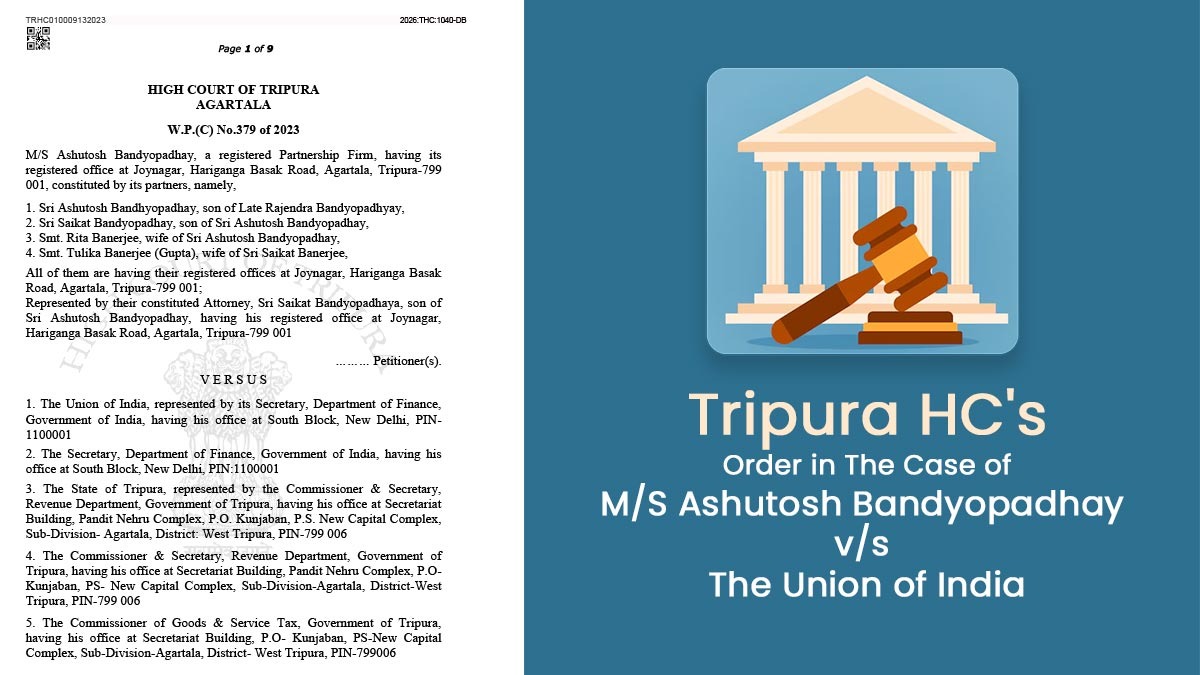
On 27 July, the Tripura High Court stated that a taxpayer cannot be denied Input tax credit due to a genuine mistake in reporting invoices under the incorrect Goods and Services Tax Identification Number (GSTIN), provided the error does not result in any loss of revenue to the Government.
A Division Bench, including Chief Justice M.S. Ramachandra Rao and Justice Biswajit Palit, permitted the writ petition of Ashutosh Bandyopadhay and asked the GST authorities to allow correction of the Forms GSTR-1 and GSTR-3B for the period from 1 May 2019 to 5 February 2020, either via the online portal or via manual means, within 4 weeks. It stated that-
“..there is only the issue of filing of the invoices in the correct GSTIN. Instead of filing it in the regular GSTIN, the petitioner had filed it in the wrong GSTIN i.e. GST TDS GSTIN. There is no loss of revenue to the respondents at all…”
The dispute arose post accidental upload of invoices by the taxpayer under its GST Tax Deduction at Source (TDS) GSTIN instead of its regular GSTIN during GST returns filing. However, the department checked the invoices and taxes had been filed; the taxpayer could not pass on the ITC as the invoices were shown against the wrong Goods and Services Tax Identification Number (GSTIN).
The taxpayer asked for the error correction, but the GST authorities had not accepted the request, citing that entries filed on the GST portal could not be changed and that jurisdictional officers did not have the authority to revise the returns.
The HC did not accept the department’s stand and placed reliance on the decisions of the Bombay High Court in Star Engineers (I) Pvt. Ltd. v. Union of India and Aberdare Technologies Pvt. Ltd. v. Central Board of Indirect Taxes & Customs, which acknowledged that bona fide human errors in GST return filings must be allowed to be rectified.
It noted that the matter involved merely a wrong reporting of invoices under the GST TDS GSTIN and not the regular GSTIN and that the mistake did not cause any loss of revenue to the Government.
It mentioned that the department’s claim that entries made on the GST portal could not be rectified was no longer sustainable in view of the binding judicial precedents.
The Bench highlighted the retrospective insertion of Section 16(5) of the CGST Act, 2017 via the Finance (No. 2) Act, 2024 (effective July 1, 2017), which relaxed time limits for claiming Input Tax Credit (ITC).
The Court noted that Parliament explicitly extended the ITC timeline for FYs 2017-18 through 2020-21, confirming that the taxpayer’s claim for FY 2019-20 fell squarely within the scope of this amendment.
Therefore, the HC asked the GST authorities to permit the taxpayer to revise or correct Forms GSTR-1 and GSTR-3B for the pertinent period within 4 weeks.
| Case Title | M/S Ashutosh Bandyopadhay vs. The Union of India |
| Case No. | W.P.(C) No.379 of 2023 |
| For the Petitioner | Mr Somik Deb, Ms Rinku Roy Barman, Ms Sara Tripura, and Ms Dolly Rupini |
| For Respondent | Mr Bidyut Majumder, Mr Biplaben |
| Tripura High Court | Read Order |