

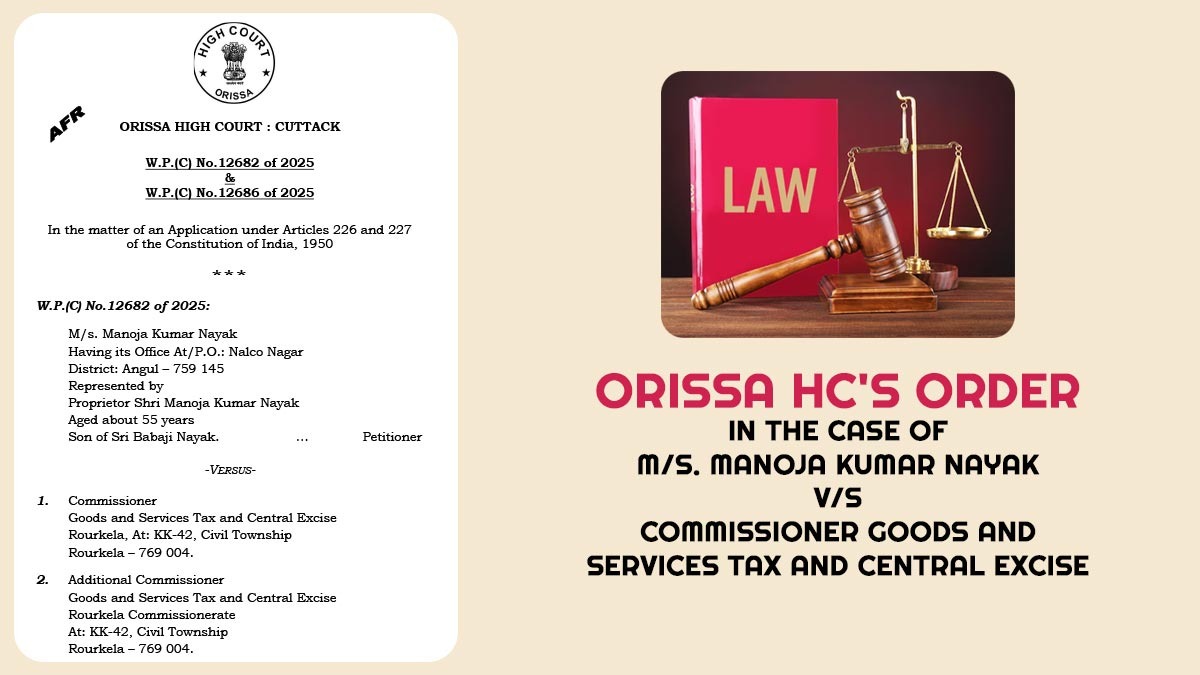
The Cuttack Bench of the Orissa High Court has held that a GST demand raised under Section 74 of the CGST Act, 2017, cannot be sustained where the disputed Input Tax Credit (ITC) had already been voluntarily reversed by the taxpayer before the initiation of anti-evasion proceedings.
Observing that there was no basis for continuing the demand, the Court quashed the Order-in-Original as well as the consequential Form GST DRC-07 issued against the taxpayer.
The ruling was reached in deciding petitions submitted by M/S Manoja Kumar Nayak and M/S Babamani Roadways & Borewells, challenging proceedings initiated by the Superintendent (Anti-Evasion), CGST and Central Excise, Rourkela Commissionerate.
In the first case, the department alleged that the applicant had incorrectly claimed input tax credit of Rs 4.39 lakh on invoices issued by a non-existent supplier, M/s Auxesia Traders, Kolkata.
Although the applicant notified the authorities that the disputed ITC had earlier been voluntarily reversed via GSTR-3B returns before the anti-evasion action started, and that its Electronic Credit Ledger consistently maintained a balance of more than the disputed amount.
The department, even after this, issued an SCN u/s 74 and thereafter confirmed tax, interest and an equivalent penalty via an Order-in-Original dated February 3, 2025.
The applicant claimed that section 74 is applicable where fraud, wilful misstatement, or suppression of facts with the intent to evade tax is established, and that the adjudicating authority provided no proof other than a DGGI alert.
Read Also: Officer Barred from Relevying Covered Demand: Orissa HC Quashes GST Order as Double Taxation
A Division Bench, including Chief Justice Harish Tandon and Justice Murahari Sri Raman, stated that the adjudicating authority had acted mechanically based on the DGGI alert without checking the applicant’s engagement. The Court said that placing reliance only on a third party’s statement is not enough to invoke section 74.
The Bench, referring to CBIC Circular No. 192/04/2023-GST and Rule 88B of the CGST Rules, said that no interest u/s 50(3) was liable to be paid because the Electronic Credit Ledger always had an adequate balance. Since there was no net tax obligation, demanding tax already reversed and levying a penalty would lead to double taxation.
Subsequently, the High Court permitted the writ petitions and dismissed the GST demand, interest, and penalty, as well as the related Form GST DRC-07.
| Case Title | M/S. Manoja Kumar Nayak vs. Commissioner Goods and Services Tax and Central Excise |
| Case No. | W.P.(C) No.12682 of 2025 & W.P.(C) No.12686 of 2025 |
| For Petitioner | Mr Rudra Prasad Kar, M/s. Aditya Narayan Ray, Asit Kumar Dash and Abhishek Dash |
| For the Opposite Parties | Mr Sujan Kumar Roy Choudhury and Mr Mukesh Agarwal |
| Orissa High Court | Read Order |