

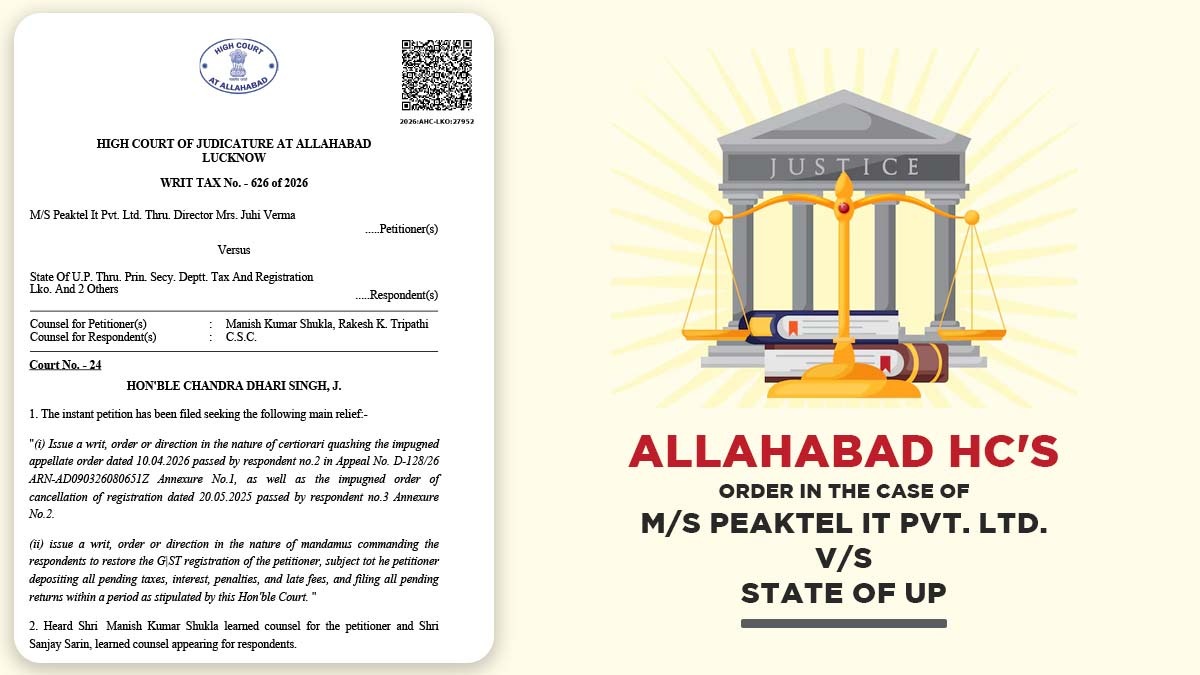
A writ petition has been dismissed by the Allahabad High Court, holding that GST registration cannot be restored as the appeal was filed after the maximum allowable period of four months (3 months + 1 month condonable).
The bench led by Justice Chandra Dhari Singh has noted that tax laws, such as the GST Act, provide a detailed framework that includes specific norms designed to streamline the resolution of tax-related issues.
Section 107 of the GST Act functions as a comprehensive code by itself, clearly outlining the time limits for filing appeals and implicitly excluding the general limitation provisions found in Section 5 of the Limitation Act.
The petition was submitted contesting two key orders: first, the appellate order on April 10, 2026, and second, the original order dated May 20, 2025, cancelling the petitioner’s GST registration. The applicant asked for directions to restore registration in compliance with pending regulatory provisions.
The applicant in the hearing considered that the appeal u/s 107 of the Central Goods and Services Tax Act, 2017 was submitted after the specified limitation period. But, reliance was placed on a Calcutta High Court judgment to claim that Section 5 of the Limitation Act, 1963, should apply, permitting delay condonation on adequate cause.
The court, rejecting the claim of the applicant, reaffirmed that the GST Act is a special statute and a self-contained code, which excludes the applicability of Section 5 of the Limitation Act.
Read Also: Allahabad HC Rejects Plea to Quash GST Fraud Notice, Orders Tax Department to Reveal Evidence
The court put reliance on binding precedents of the Supreme Court, including: Singh Enterprises v. Commissioner of Central Excise and Commissioner of Customs v. Hongo India Pvt. Ltd.. Such judgments specified that when a statute mentions a limitation period, including a limited condonation window, delays after that could not be accepted.
Thereafter, the Court observed that Section 107(4) permits merely one additional month beyond the initial three-month limitation period. In the existing case, the appeal was submitted nearly 66 days after the lapse of the condonable period, making it lawfully untenable.
Important: A New Guide for Clarifying Main GST Registration Issues
The applicant had put reliance on the decision in S.K. Chakraborty & Sons; the court categorically held that the cited judgment does not regard binding Supreme Court precedents and thus does not have precedential value.
The Court outlined the significance of strict compliance with limitation periods in taxation statutes, marking that tax statutes need certainty and timely resolution of disputes, limitation provisions confirm efficiency in tax administration, and permitting delays after statutory limits would erode the legislative intent
The Court determined that the appeal was submitted after the maximum allowed period of four months (three months plus one month that can be condoned). It ruled that the appellate authority lacked the jurisdiction to excuse this delay.
Recommended: How GST Software Helps Protect Your Business from Cancellation
Under the GST law, it is imperative to strictly comply with the limitation period established by the statute, and any delay that exceeds the condonable period cannot be justified by referring to general principles of limitation.
| Case Title | M/S Peaktel IT Pvt. Ltd.vs. State of UP |
| Case No. | WRIT TAX No. – 626 of 2026 |
| Counsel for Petitioner | Manish Kumar Shukla, Rakesh K. Tripathi |
| Counsel for Respondent | C.S.C. |
| Allahabad High Court | Read Order |