

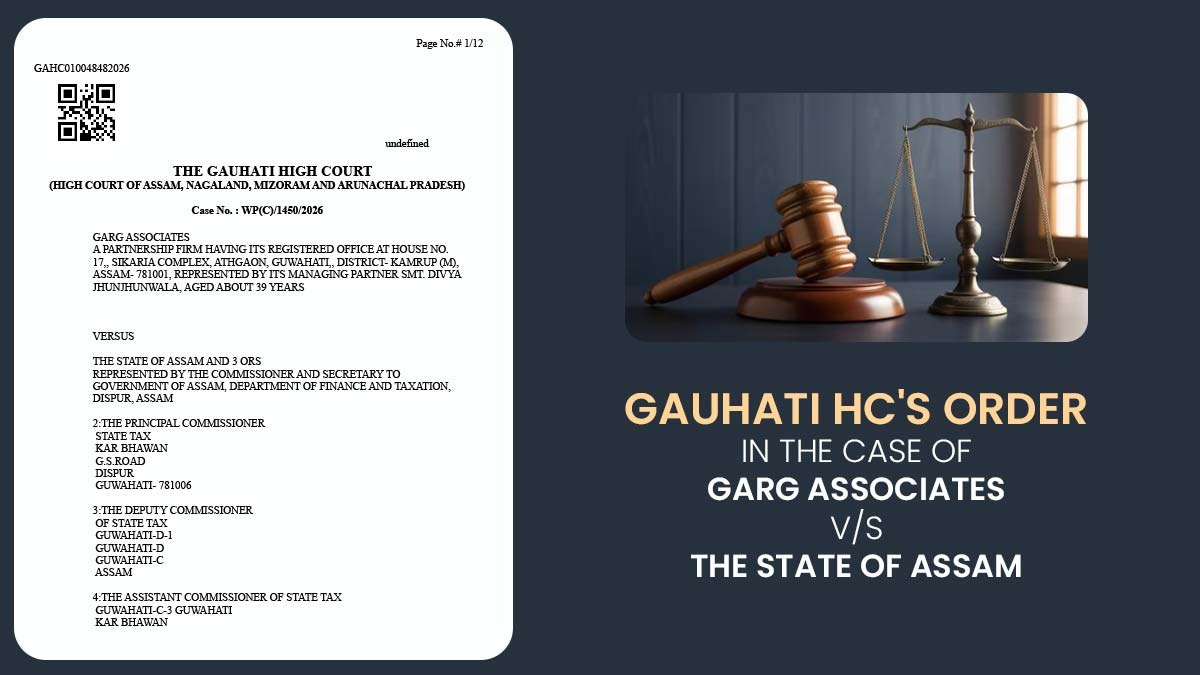
In the matter of Garg Associates versus The State of Assam, a Summary of the Show Cause Notice in Form GST DRC-01 was issued for the tax period encompassing July 2017 to March 2018. The notice alleged tax obligations under Section 73 of the Central Goods and Services Tax (CGST) and State Goods and Services Tax (SGST) Act. Accompanying the summary was an attachment titled “Determination of Tax,” which the department regarded as the official show cause notice.
The applicant mentioned that no proper SCN was ever issued, and hence no response was filed. Thereafter, an order was passed in Form GST DRC-07 based on the fact that the payment was not incurred within 30 days. The applicant contested the proceedings on various grounds that the attachment was an invalid SCN, both the attachment and the order were unsigned and unauthenticated, and no chance of a personal hearing was provided.
The department considered that no separate SCN was issued apart from the attachment and that the documents did not bear signatures, though they claimed that portal authentication was adequate.
The problem
Whether a valid SCN u/s 73(1) was issued before passing the order? Whether the absence of authentication invalidates such documents.
Had that
The Court held that an SCN summary in Form GST DRC-01 is only supplementary and could not supersede the obligatory issuance of a proper SCN u/s 73(1).
A tax determination statement to the summary does not fulfil the regulatory requirements, as the law distinguishes between a show cause notice and a statement of determination. Hence, proceedings initiated without a valid SCN are lawfully not sustainable and opposite to Section 73 read with Rule 142(1)(a).
The Court on authentication ruled that statutory notices and orders should be issued and authenticated via the proper officer. In the absence of authentication norms under the demand and recovery chapter, Rule 26(3) applies by default, directing a digital signature/e-signature. Unsigned documents do not have legal sanctity and are unenforceable. The same defect could not be resolved by portal uploading only.
The Court ruled that a personal hearing is mandatory under Section 75(4) whenever an adverse decision is considered, regardless of whether the taxpayer requests one. Failing to fill in the hearing column and moving forward with an adverse order undermines the statutory safeguard and disregards the principles of natural justice.
Thereafter, the impugned order was set aside.
| Case Title | Garg Associates Versus The State of Assam |
| Case No | WP(C)/1450/2026 |
| For Petitioner | Mr R S Mishra, Ms M Dey, Ms B Sarma |
| For Respondent | SC, Finance and Taxation |
| Gauhati High Court | Read Order |