

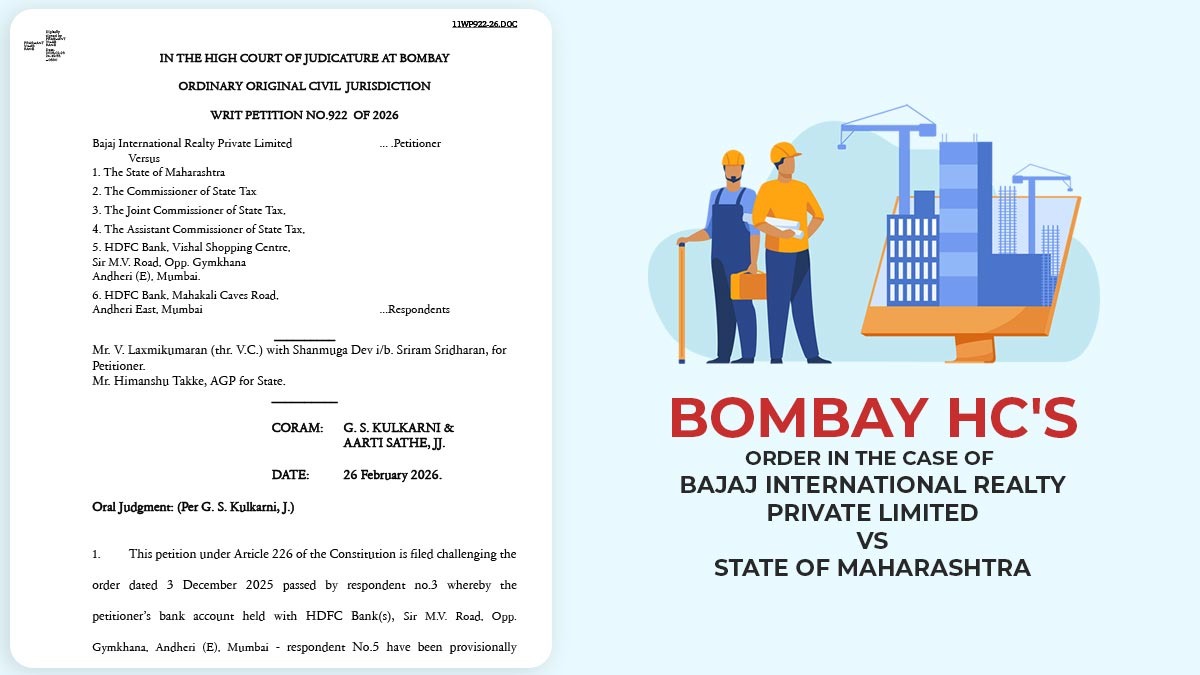
The Bombay High Court has overturned temporary orders that allowed tax officials to freeze bank accounts under the Maharashtra Goods and Services Tax (MGST) Act of 2017. The court ruled that tax authorities must provide valid reasons and take the taxpayer’s concerns into account before taking such actions.
The Bench of Justice G. S. Kulkarni and Justice Aarti Sathe put reliance on the Supreme Court’s ruling in Radha Krishan Industries v. State of Himachal Pradesh, which stated that provisional attachment powers are in nature and need to be exercised in compliance with statutory safeguards.
The applicant, Bajaj International Realty Private Limited, is in the redevelopment and construction of residential buildings, especially projects concerning cooperative housing societies. The dispute stemmed from a redevelopment project undertaken for Nityanand Nagar Vibhag IV Co-operative Housing Society.
Pursuant to a redevelopment agreement dated 9 May 2011, the developer undertook to construct residential units and provide 168 flats to the existing members of the society without consideration. Furthermore, 12 flats were allocated to the Maharashtra Housing and Area Development Authority (MHADA), which held occupancy rights over certain tenements in the said society.
After getting the approvals, construction began in 2015. Between December 2022 and February 2024, occupancy certificates for different sets of flats were issued, and flats were handed over to current members and MHADA between November 2022 and June 2025. Also, 128 free-sale flats constructed in the project were sold to buyers, subject to GST compliance.
GST authorities in June 2025 started an investigation u/s 67 of the MGST Act and alleged that GST was subject to be paid on the construction services furnished before the society members and MHADA, even though the flats were transferred without consideration.
The department, thereafter, issued a pre-show cause notice dated 26 August 2025 estimating a tax obligation of nearly Rs 42.68 crore, including interest and penalty. The demand was as per the alleged taxable supply of construction services concerning flats handed over to the existing members and MHADA.
The company refused the obligation and submitted detailed responses, claiming that the flats were transferred free of cost and hence did not include a taxable supply.
At the time of pendency of proceedings, an order was passed dated 3 December 2025 by the Joint Commissioner of State Tax, provisionally attaching the bank account of the applicant u/s 83 of the MGST Act, which authorises attachment of property to protect government revenue.
In Form GST DRC-22A, the developer submitted objections asking to release the bank account. In December 2025, a hearing was conducted; however, the authority refused the objections via an order on 29 December 2025. Afterwards, a second attachment order on 9 January 2026 was issued attaching the applicant’s other bank account.
The developer, dissatisfied with such measures, approached the HC under Article 226 of the Constitution, contesting the legality of the attachment orders. The HC said that section 83 grants an authority which should be exercised carefully and only after the execution of an appropriate viewpoint that this attachment is required to secure the revenue of the government.
The court discovered that the attachment orders did not record any reasons. The authority loses the ability to deal with the detailed objections submitted by the applicant. The order refusing the objections did not elaborate why the taxpayers’ filings were not acknowledgeable.
The Court said that a taxpayer whose property is attached has a legal right under Rule 159 of the GST Rules to file objections and obtain a reasoned order after a hearing.
The Bench stated that the applicant specified replies contesting the attachment and explaining why no tax obligation emerged on flats handed over free of cost. However, the tax authority denied the objections without furnishing any reasoning.
The Court held that the same method breaches the basic principles of natural justice and procedural safeguards under GST law. Multiple directions are furnished by the Bombay High Court. The provisional attachment orders on 3 December 2025 and 9 January 2026 were quashed.
For reconsidering the issue, the case was remanded to the Joint Commissioner of State Tax. The applicant should be given a fresh hearing by the authority and pass a reasoned order within the law. The Court mentioned that it did not analyse the merits of the GST demand or the pre-Show cause notice, leaving those issues open for determination via the tax authorities.
| Case Title | Bajaj International Realty Private Limited vs. State of Maharashtra |
| Case No | WRIT PETITION NO.922 OF 2026 |
| For Petitioner | Mr. V. Laxmikumaran, Shanmuga Dev, Sriram Sridharan |
| For Respondent | Mr. Himanshu Takke |
| Bombay High Court | Read Order |