

The applicant in the case was transporting goods accompanied by a valid tax invoice and e-way bill when the vehicle was intercepted by the GST authorities. Forms GST MOV-01, MOV-02, and MOV-04 were issued for inspection under Section 68 of the CGST Act, read with the procedure prescribed in Circular No. 41/15/2018-GST issued under Section 168.
Subsequently, without issuing any formal detention order under Section 129(1), the authorities issued a notice in Form GST MOV-10 proposing confiscation under Section 130 of the CGST Act and demanded a fine instead of confiscation.
Aggrieved by the continued retention of the goods and vehicle without a formal detention order, the applicant approached the High Court.
Problem-
Whether Section 130(2) of the CGST Act allows provisional release of goods pending adjudication of confiscation proceedings. Whether Section 130(2) of the CGST Act allows provisional release of goods pending adjudication of confiscation proceedings. Whether the prohibitory direction included in Form MOV-02 can supersede a statutory detention order under section 129.
Held That:
The Court analysed the regulatory scheme under sections 67, 68, 129, and 130 of the CGST Act, including the procedural framework under Circular No. 41/15/2018-GST. It said that earlier, in Sales Tax Officer v. Y. Balakrishnan, the Court had interpreted Section 130 to allow release of goods upon payment of a fine in place of confiscation even during adjudication.
The Court stated that after the amendments in the Finance Act, 2021, the regulatory scheme of detention and confiscation underwent revision. Section 130(2) does not contemplate the provisional release of goods pending adjudication.
The provision delivers a chance to pay a fine in place of confiscation only after a final order of confiscation is passed, which is evident when read along with Section 130(7), specifying payment within 3 months from the date of confiscation order. The word “authorised” in Section 130(2) refers to confiscation adjudged by a final order, not a mere proposal in MOV-10.
Important: How GST Software Helps Transport & Logistics Businesses
The Court determined that Section 130 does not grant authority to detain goods pending confiscation. Instead, the detention of goods in transit is regulated by Section 129, which requires the issuance of a formal detention order and compliance with statutory timelines.
Without such an order, the continued retention of goods breaches Article 300A of the Constitution. Additionally, the prohibitory direction in MOV-02 cannot replace a statutory detention order, as any exercise of power needs to be rooted in a clear statutory source that aligns with constitutional principles.
Read Also: Kerala HC: Confiscated Goods Under GST Can Be Returned if Not Auctioned
As per that, the Court concluded that Section 130(2) does not allow provisional release pending adjudication. Only the start of confiscation proceedings does not authorise retention of goods. Possession of goods by the authorities becomes illegal in the absence of a valid detention order u/s 129.
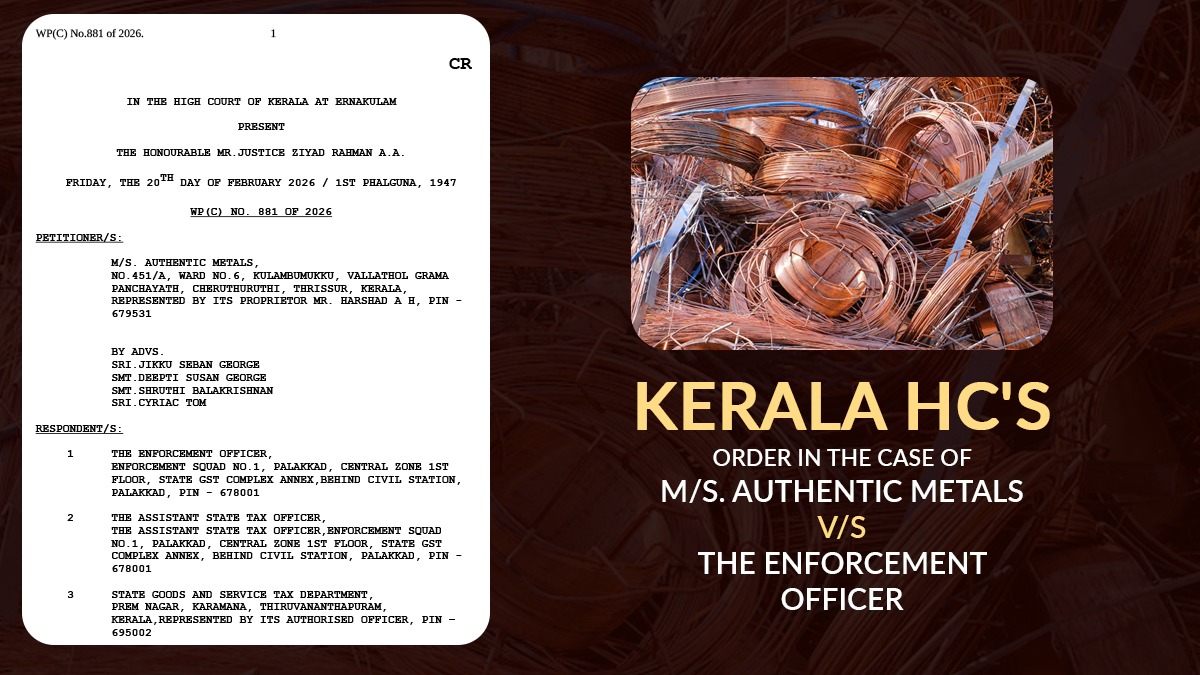
| Case Title | M/s. Authentic Metals vs. The Enforcement Officer |
| Case No | WP(C) NO. 881 OF 2026 |
| For Petitioner | Jikku Seban George, Deepti Susan George, Shruthi Balakrishnan, Cyriac Tom |
| For Respondent | Mohammed Rafiq |
| Kerala High Court | Read Order |