

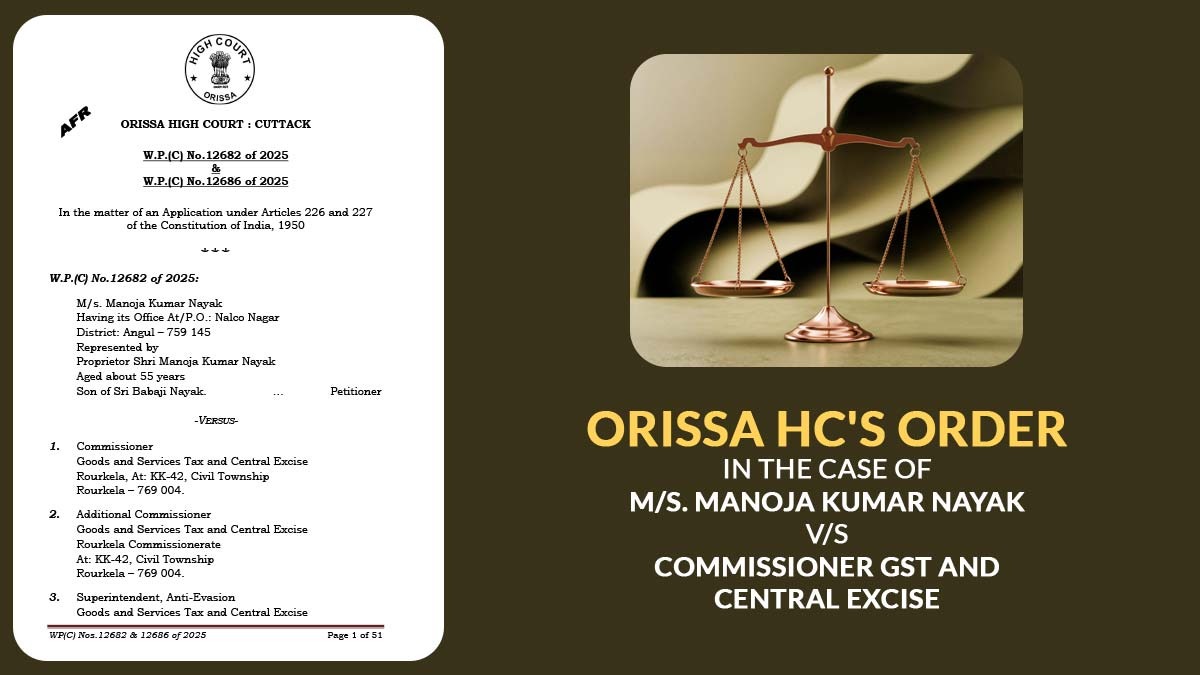
The Orissa High Court has set aside GST proceedings against a taxpayer, holding that the Revenue cannot raise a duplicate tax demand once the amount has already been accounted for through the reversal of Input Tax Credit (ITC). The Court clarified that whether the ITC is reversed voluntarily or otherwise, the Department cannot seek to recover the same amount again without giving due credit for such reversal.
“Once it is conceded by the Revenue that the amount of input tax credit for a sum of Rs.4,39,970/- has been reversed, raising demand to the same without giving due credit to such reversal is unethical and without authority of law. In such an event, since net tax effect would be ‘zero’, thereby no penalty would be imposable. This Court, therefore, would show indulgence in the matter as the Adjudicating Authority has traversed his jurisdiction by acting at his whims and fancies,” the Court stated.
A Bench of Chief Justice Harish Tandon and Justice Murahari Sri Raman held that the same action shall cause penal consequences twice for the same transaction and cannot be sustained in law.
Read Also: Orissa HC Dismisses Petition on GST ITC Claims for a Non-Existent Entity and Fake Invoices
The case of Manoja Kumar Nayak, who was prosecuted on allegations of incorrect claim of ITC based on invoices issued via a non-existent supplier.
After being alerted by the authorities, Nayak reversed the ITC of Rs 4,39,970 in his returns. He argued that since the credit had already been reversed and no benefit was retained, raising a demand for the same amount would effectively mean recovering that amount again.
Even after this, the department issued a show-cause notice invoking provisions of fraud and suppression, and proceeded to confirm demand, interest, and penalty.
Nayak claimed that he had voluntarily reversed the ITC even before the issuance of the notice and that there was no material to establish any intent to evade tax. He stated that once the reversal was shown in returns, no other documents were needed to explain the claim.
The Court, accepting such submissions, stated that the input tax credit (ITC) reversal was not disputed by the Revenue, though its correlation with the disputed was questioned, and discovered that there was no proof of fraud, wilful misstatement, or suppression.
The court then mentioned that once the credit stood reversed, stressing that the production of other documents to explain the original claim was not required.
“The petitioner has voluntarily reversed input tax credit of Rs.4,39,970/-; and the Adjudicating Authority in the Order-in-Original demanded input tax credit (IGST) of Rs.4,39,970/-. This apart, he imposed penalty of Rs.4,39,970/-. In such event the petitioner is subjected to penalty twice for the self-same transaction,” the Court stated.
Important: How GST Software Handles Input Tax Credit (ITC) Tracking
The bench discovered fault with the invocation of the extended limitation period, holding that the same provisions cannot be applied mechanically in the absence of material showing fraud or intent to evade tax.
As a result, the High Court set aside the proceedings, determining that the demand made without properly crediting the reversed ITC was legally invalid.
| Case Title | M/s. Manoja Kumar Nayak vs. Commissioner GST and Central Excise |
| Case No. | W.P.(C) No.12682 of 2025 & W.P.(C) No.12686 of 2025 |
| For the Petitioner | Mr. Rudra Prasad Kar, M/s. Aditya Narayan Ray, Asit Kumar Dash and Abhishek Dash |
| For the Opposite Parties | Mr. Sujan Kumar Roy Choudhury, and Mr. Mukesh Agarwal |
| Orissa High Court | Read Order |