

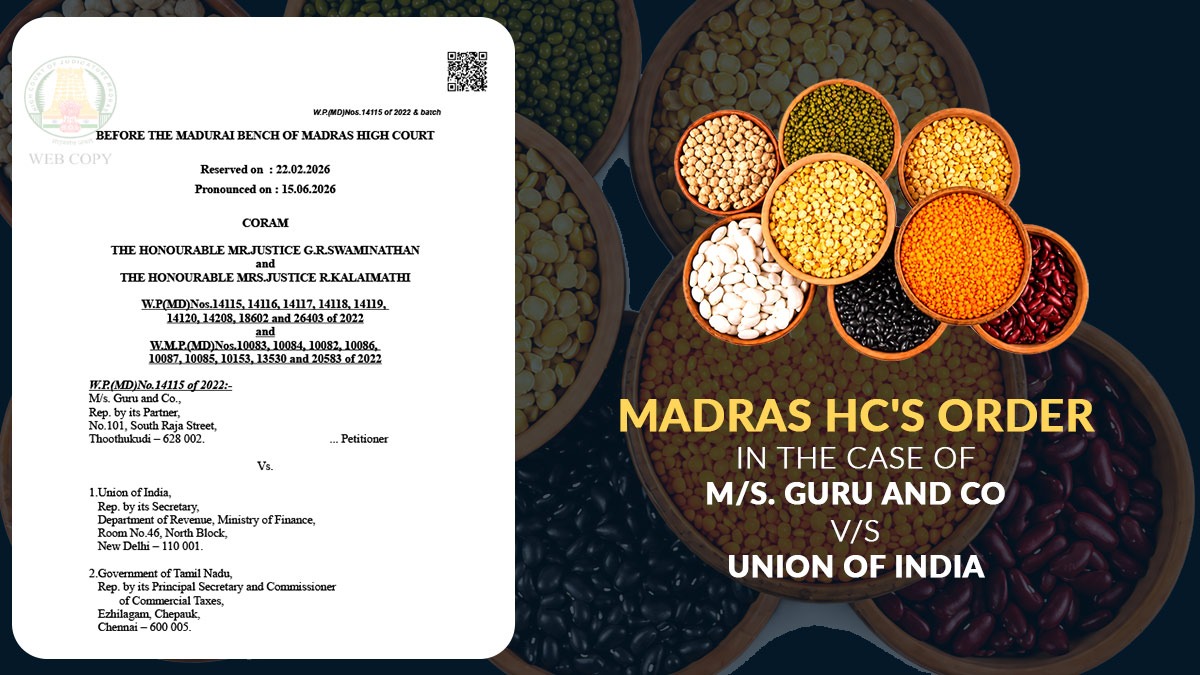
The Madras High Court ruled that the GST (Goods and Services Tax) Council lacks the authority to approve notifications issued by the Central Government without a prior recommendation.
While keeping ratification of the GST notifications by the GST Council in its 22nd GST Council meeting, Justice G.R. Swaminathan and Justice R. Kalaimathi said that “Neither the Constitution nor any statute has invested the GST Council with the power of ratification.”
The bench was reviewing a series of petitions filed by a group of pulse traders. They raised two key issues: first, whether the Notifications issued by the Central Government under Sections 9 and 11 of the CGST Act, 2017, can extend beyond the recommendations made by the GST Council; and second, whether the GST Council has the authority to ratify any Notifications issued by the Central Government under either Section 9 or Section 11 of the CGST Act, 2017.
The petitioners were contesting the validity of two notifications, 27/2017 and 28/2017, which were issued under the GST framework by the government without the recommendation of the council. However, these notifications were subsequently ratified by the council in its 22nd meeting, raising further challenges regarding the council’s ratification powers.
On the first issue, the court stated that the central government cannot go beyond the recommendations of the GST Council. The bench observed that “The Government had gone over and above what was recommended by the GST Council. It is not a case where the Government disregarded the recommendations of the GST Council. The Notifications reflect the recommendations but also go beyond.” Therefore, the court declared the notification ultra vires to the extent that it overrode the council’s recommendations.
Concerning the second issue, the centre stated that although specific drafting revisions in the notifications were not exhibited in the recommendations made during the 21st GST Council Meeting, the GST Council in its 22nd meeting had allowed these notifications on 6 October 2017.
The revenue mentioned that these ratifications cured any defect in the issuance of the notifications and showed the correct intent of the Council.
The division bench denied the claim of the revenue and said that “The power of the GST Council is traceable to Article 279A of the Constitution of India. Article 279A empowers the GST Council to make recommendations with respect to the matters set out in Article 279A(4). The power to ratify has nowhere been conferred.”
The Madras High Court observed the decision of the Telangana High Court in Brunda Infra (P) Ltd. v. Commr. of Central Tax, 2025, on the ratification issue. For the same case, it was said that ratification cannot be equated to recommendation and that “ratification” accomplished after issuance of the Notification will not make the Notification empowered
Read Also: How GST Software Fixes Common Mistakes in SCN Replies
The Court then said that the ratification made by the council in its 22nd meeting is without jurisdiction and could not be carried out. Therefore, the Court dismissed the impugned SCNs issued to the applicants. The department was asked to issue fresh SCNs if issued as per the impugned notifications within the scope in which they have been held valid. Therefore, the petition was disposed of.
| Case Title | M/s. Guru and Co vs Union of India |
| Case No. | W.P.(MD)No.14115 of 2022 |
| For Petitioner | Mr.J.V.Niranjan |
| For Respondent | Mr.AR.L.Sundarasean |
| Madras High Court | Read Order |