

In a ruling examining the interplay of limitation periods under the GST regime, the High Court of Kerala allowed a writ petition. It ruled that the limitation period mentioned u/s 16(4) of the CGST Act to claim ITC cannot substitute the grace period provided u/s 16(5), overturning an order that denied credit to a taxpayer who submitted within the extended time duration.
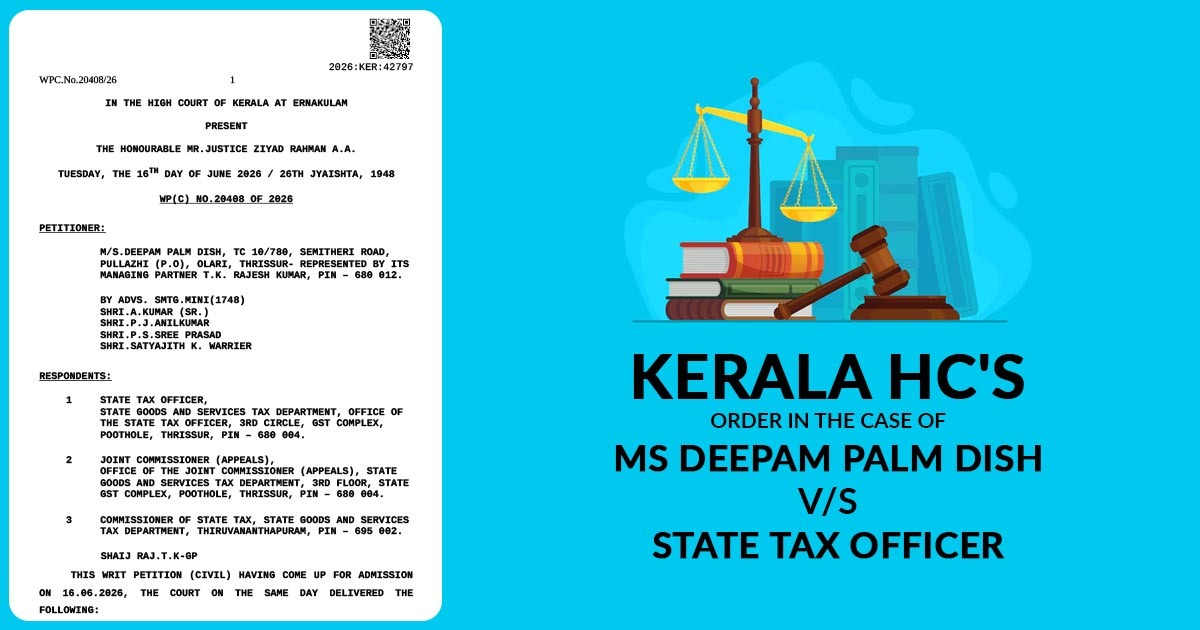
M/s. Deepam Palm Dish submitted a petition contesting an order issued by the State Tax Officer denying the Input Tax Credit (ITC) claimed by the applicant for the tax periods of April 2018 and March 2019.
The controversy emerged when the department issued an order under Section 73 of the CGST Act denying the applicant’s ITC claim. The refusal was due to the fact that the applicant did not file the concerned returns within the time limit mentioned u/s 16(4) of the CGST Act.
The applicant was not satisfied with this and approached the High Court, citing that it must be provided the benefit of the credit. The applicant’s stand was grounded on Section 16(5) of the CGST Act, which fixes a precise cut-off date, November 30, 2021, for submitting returns and taking credit of prior transitional periods. Applicant added that he was qualified for the credit because the returns were submitted in February 2021, prior to the last date.
Justice Ziyad Rahman A.A. examined the record and considered the applicant’s submission. The Court said that the impugned order recorded that the returns for April 2018 and March 2019 were filed on February 15, 2021 and February 27, 2021, respectively. These dates were before the 30.11.2021 deadline provided u/s 16(5).
The Court said that the legislative objective behind sec. 16(5) and noted that it contained a ‘non-obstante’ clause. Section 16(5) overrules Section 16(4). The judgment affirmed that if a taxpayer files the return within the precise cut-off date contemplated u/s 16(5), the timelines mentioned u/s 16(4) become inconsequential and cannot be a bar to claiming the credit.
Subsequently, the Court held that the ITC refusal as per the timeline mentioned u/s 16(4) was unsustainable in law. The assessment order (Ext.P4) was overturned, and the writ suit was disposed of.
Read Also: How GST Software Resolves GSTR-3B & 2A/2B ITC Mismatches
The Court asked the first respondent, the State Tax Officer, to compute the case afresh and furnish the benefits of Section 16(5) of the CGST Act to the applicant, if otherwise entitled to it.
| Case Title | Ms Deepam Palm Dish V/S State Tax Officer |
| Case No. | WP(C) NO.20408 OF 2026 |
| Counsel For Petitioner | ADVS. Smtg.mini(1748) Shri. A. Kumar (Sr.) Shri. P.J. Anilkumar Shri. P.S.Sree Prasad Shri. Satyajith K. Warrier |
| Kerala High Court | Read Order |