

The Kerala High Court has made an important ruling regarding the Central Goods and Services Tax (CGST) Act of 2017. It was determined that Section 16(5) serves as a non-obstante provision, which means it can override the time limits stipulated in Section 16(4).
The Court emphasised that as long as taxpayers file their returns by the specified cut-off dates outlined in Section 16(5), they are not bound by the usual time restrictions for claiming Input Tax Credit (ITC). This clarification could significantly impact the taxation process for eligible businesses.
According to Section 16(4) of the CGST Act, 2017, there are specific time limits that registered individuals must adhere to when claiming Input Tax Credit (ITC).
A registered person may not claim ITC on any invoice or debit note after the earlier of two key dates: either the due date for submitting the return for November of the following financial year, or the actual date on which the relevant annual return is filed. Businesses need to be aware of these deadlines to ensure compliance and maximise their eligible credit.
Section 16(5) of the CGST Act, 2017, represents a significant legislative change that was implemented retrospectively, effective from July 1, 2017. This provision was specifically designed to provide relief to taxpayers by extending the statutory time limit for claiming Input Tax Credit (ITC) during the early years of the GST regime, covering the financial years from 2017-18 to 2020-21. This amendment aims to facilitate better compliance and support for businesses navigating the new tax framework established by GST.
Justice Ziyad Rahman A.A. mentioned that Section 16(5) starts with the wording “notwithstanding anything contained in Subsection 4.” It shows that, once the taxpayer files the return within the stipulated period in Section 16(5), the time limit contemplated u/s 16(4) of the CGST loses its importance.
For the same case, the applicant was not satisfied with the order of the assessment related to the year 2018-19, in which the ITC claimed by the taxpayer was declined.
The claim denying cause was that the taxpayer was not able to file the returns related to May 2018 to March 2019 within the duration mentioned u/s 16(4) of the CGST Act.
The taxpayer’s case was that, concerning Section 16(5), which was rolled out in the CGST Act, the taxpayer is qualified to obtain the ITC, for the fact that the taxpayer had filed the returns related to the appropriate period before the cut-off date contemplated u/s 16(5) of the Act.
The department cited that previously, the taxpayer had filed a writ petition before the Court, contesting the constitutional validity of Section 16(4) of the CGST Act, and as per the common judgment, the Court denied the said contention, and the writ petitions were dismissed.
As per the department, the taxpayer could not claim the relief in the same writ petition without asking for a revision in the said ruling, either by contesting or seeking a review of the same.
The bench does not agree with the claim of the department and cited that the taxpayer’s claim is on the foundation of a statutory provision introduced thereafter, which provides for the ITC, subject to the norms that the returns are submitted before November 30, 2021.
Beyond the fact that the returns are required to be submitted within the said cut-off date, no other norms are levied in section 16(5), and it is to be noted that Section 16(5) starts with the wording “notwithstanding anything contained in Subsection 4.”
Read Also: Calcutta HC: GST Relief Late Filing Not a Bar, Orders Consideration of Cess Details
It is mentioned that once the taxpayer files the return within the duration mentioned in section 16(5), then the time limit contemplated u/s 16(4) of the CGST loses its importance. Hence, the same being a separate statutory provision which is rolled out subsequently, it directs a fresh cause of measure for the taxpayer to claim the relief sought in the same writ petition, the bench cited.
As per the bench, the taxpayer previously approached the court contesting section 16(4) of the CGST Act, and obtained an adverse order; this cannot be a cause not to entertain the writ petition.
As per the bench, the taxpayer can take the benefit of Section 16(5) of the CGST Act.
The bench in the above view has permitted the petition.
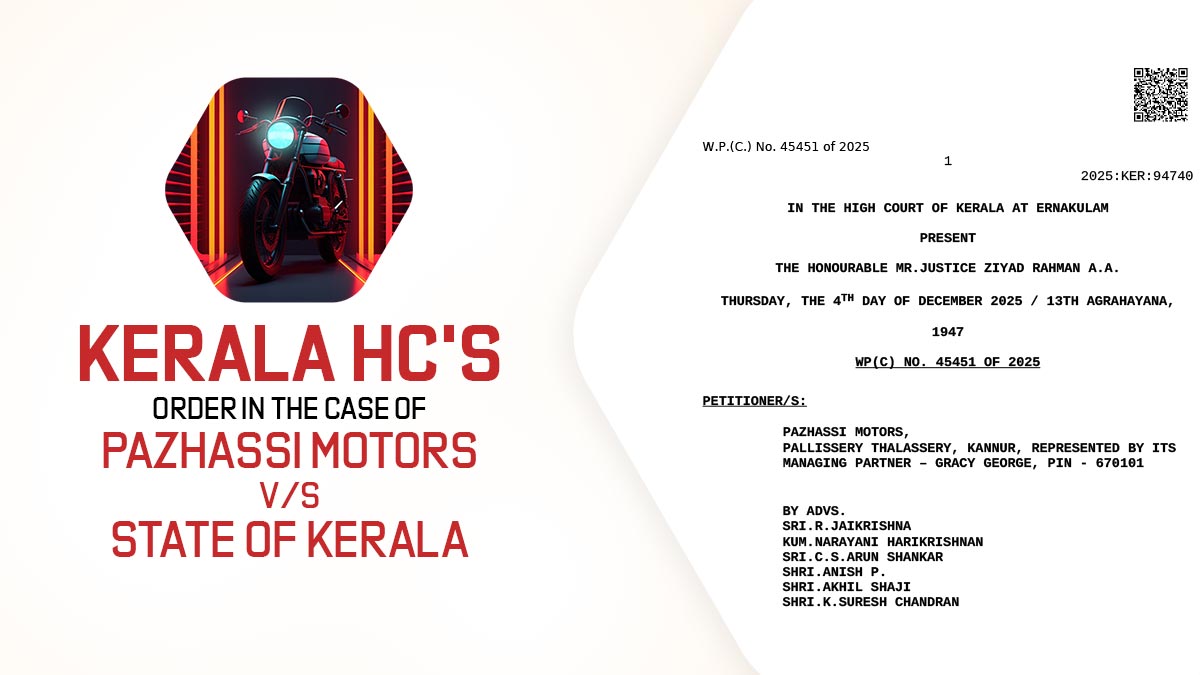
| Case Title | Pazhassi Motors vs. State of Kerala |
| Case No. | WP(C) NO. 45451 OF 2025 |
| Kerala High Court | R. Jaikrishna, Kum. Narayani Harikrishnan, C.S. Arun Shankar, Anish P., Akhil Shaji, K. Suresh Chandran |
| Kerala High Court | Read Order |