

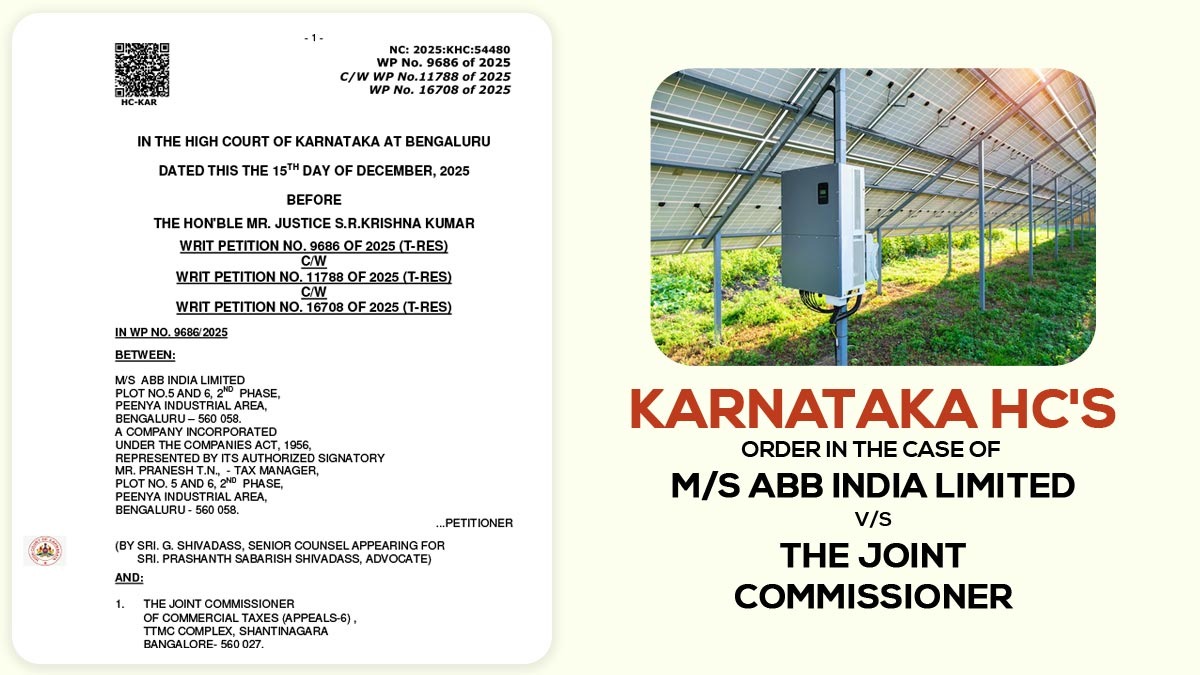
The Karnataka High Court has held that solar inverters supplied for solar power projects are eligible for the concessional Goods and Services Tax (GST) rate of 5%. The court ruled that solar inverters constitute an integral component of a solar power-generating system and therefore qualify for the concessional tax rate.
Tax demands surpassing Rs 120 crore raised against ABB India Limited by the state tax authorities have been quashed by the bench of Justice S.R. Krishna Kumar.
ABB India Limited, a manufacturer of switchgear, industrial electronic controllers, drives, and other electrical equipment, supplied solar inverters for use in solar power projects across India. These inverters play a crucial role in converting direct current (DC) generated by solar panels into alternating current (AC), making the electricity suitable for grid connectivity and industrial use.
The company categorised these inverters as parts of solar power generating systems, thereby filing GST at the concessional 5% rate under Entry No. 234 of Notification No. 1/2017 Central Tax (Rate), which includes renewable energy devices and parts utilised in their manufacture.
As per the tax department, after an audit, the authorities imposed an SCN u/s 73 of the CGST/KGST Act, alleging that the products were general electrical devices under HSN 8504, drawing an 18% GST.
Before the Court, the question was whether solar inverters used in solar projects must be charged to tax as general electrical devices at 18% or treated as components of a solar power generating system eligible for the concessional 5% GST rate.
The HC analysed the functioning and role of solar inverters in renewable energy systems. The Court said that a typical solar power-generating system includes various elements along with solar panels, inverters, controllers, and batteries.
Read Also: GST AAR: No ITC on Goods and Services Used to Operate 10.2 MW Solar Plant
Solar panels generate electricity in direct current, which requires conversion into alternating current for practical use. The conversion is accomplished by solar inverters, making them a crucial and essential part of the system.
The Court mentioned that the inverters supplied via ABB were made for solar projects and were supplied to companies involved in constructing solar power plants. The court, while interpreting Entry 234 of Notification No. 1/2017-CT(R), maintained that the concessional GST rate applies to the whole renewable energy system as well as to the parts utilised in its manufacture.
The judge outlined that a system inherently comprises various parts operating together to produce a desired outcome. As solar inverters must convert solar-generated DC electricity into usable AC power, they consist of integral elements of a solar power-generating system.
Therefore, the Court concluded that the inverters supplied via the company come under the scope of the concessional entry. The Court addressed the claims of the department that the company didn’t establish actual use of the inverters in solar projects.
The court denied the same contention and put reliance on judicial precedents to specify that tax exemptions grounded on intended use do not need to establish the actual use. If goods are supplied for a specific purpose, the benefit cannot be rejected simply because authorities question the ultimate use.
Invoices, purchase orders, and other documents produced by the company show that the inverters were supplied before entities that are in solar power projects.
Also, the tax department put reliance on GST Circular No. 163/19/2021, which specifies that only goods designed as parts of solar power generating systems qualify for concessional GST.
HC said that the circular dealt with valuation issues under EPC contracts and did not change the eligibility of concessional GST rates for renewable energy components.
It was concluded by the Karnataka High Court that solar inverters supplied for solar projects are integral parts of solar power-generating systems. Under Entry 234 of Notification No. 1/2017-CT(R), the supplies must be levied with 5% GST. The tax authorities had made a mistake in categorising them as general electrical devices taxable at 18%.
The Court furnished a chance to the company to pursue statutory appeals before the appellate authority or tribunal concerning other unresolved matters.
| Case Title | M/S ABB India Limited vs. The Joint Commissioner |
| Case No | IN WP NO. 9686/2025 |
| For Petitioner | G. Shivadass |
| For Respondent | Jyoti .M.Maradi |
| Karnataka High Court | Read Order |