

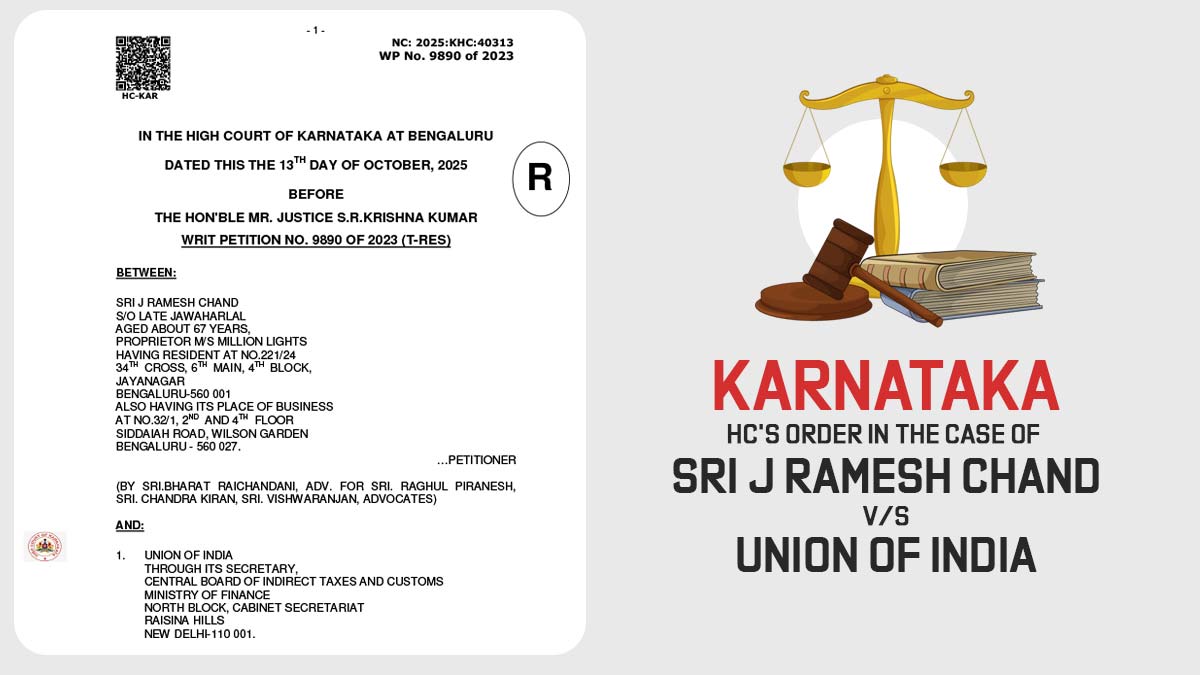
The Karnataka High Court has ordered the refund of a Rs 10 crore GST payment made by a businessman in Bengaluru. The court noted that the payment, which the GST authorities claimed was voluntary, was not voluntary.
Justice S. R. Krishna Kumar passed an order dated October 13 and made public this week after the businessman alleged that the payment was extracted under pressure at the time of the investigation.
Search, Seizure and Claims of Coercion
The applicant, a trader dealing in electronics and footwear and registered under GST since 2017, was subjected to a raid in March 2023 by officials of the GST West Commissionerate under the Inspector of Central Tax. Officers seized a laptop, hard drives, and other items, which were returned after some days.
The businessman in operation transferred Rs 10 crore, which was thereafter categorised by the authorities as a voluntary tax payment based on self-assessment. He also claimed before the court that the amount was filed under threat of arrest, which makes it involuntary and thus obligated for the refund.
No Proof of Voluntary Payment was Discovered by the Court
As per the applicant, no GST DRC-04 form, the mandatory acknowledgement for voluntary payments, was ever issued. The DGGI claimed that the payment was made voluntarily.
The High Court does not agree.
Justice Krishna Kumar observed that:
There was no prior notice, adjudication, or determination of tax liability.
All business records, laptops, and accounts are seized by the authorities, making it “highly improbable” for the applicant to assess tax on his own.
The absence of DRC-04 further weakened the claim of voluntariness.
The court, quoting the order, stated that- “At the time of payment, there could not have been any material, accounts, etc., available with the petitioner that would enable him to proceed with self-ascertainment… it is highly improbable that the petitioner was in a position to carry out self-ascertainment and make payment.”
Refund Amount to Be Paid With Interest
The court, after analysing legal precedents and the relevant provisions of the CGST Act, directed the authorities to refund ₹10 crore with 6% interest, holding that tax payments extracted through pressure cannot be considered voluntary.
Distinct implications might be expected from the ruling for the current GST investigations, particularly where extensive voluntary payments are received at the time of raids without appropriate documentation.
| Case Title | SRI J Ramesh Chand vs. Union of India |
| Case No. | Writ Petition No. 9890 OF 2023 (T-RES) |
| For Petitioner | By Sri.Bharat Raichandani, Adv. for Sri. Raghul Piranesh, Sri. Chandra Kiran, Sri. Vishwaranjan, Advocates |
| For Respondent | Mr R. Ramachandran, Mr By Smt. Anuparna Bordoloi.,Advocate for R-1 Sri. Jeevan Neeralagi, Advocate for R-2 & R-3 Sri. M.N. Kumar, Advocate for R-4) |
| Karnataka High Court | Read Order |