

The Jammu and Kashmir High Court has ruled that trade between Jammu and Kashmir and the Pakistan-occupied Kashmir, or PoK, across the Line of Control is intra-state trade and no GST can be imposed on it.
The trade across the LoC has remained suspended because of hostilities between India and Pakistan since 2019. The ruling by a division bench reaffirms the government’s stand that PoK is part of Jammu and Kashmir and an integral part of India.
Despite the scrapping of Article 370, the J&K assembly continues to have 24 vacant seats reserved for the PoK. As per the former constitution of Jammu and Kashmir, the entire J&K, including PoK, is an integral part of India. The separate constitution of J&K was scrapped with the revocation of Article 370.
Read Also: GST: Economic Effects on Govt, Companies and Individuals
HC, acknowledging the petitions from traders across the Line of Control, cited that cross-LoC trade between Jammu and Kashmir and the PoK was intra-state as the PoK is part of Jammu and Kashmir.
“Therefore, the location of suppliers and the place of supply of goods were within the then State of Jammu Kashmir (now the Union Territory). The cross-LoC trade affected by the petitioners during the relevant tax period was nothing but intra-state trade,” said the division bench of Justice Sanjeev Kumar and Justice Sanjay Parihar.
The SCNs had been contested by the applicants, which the Superintendent CGST has issued under the Central Goods and Services Tax Act, 2017. They asserted that when the trade started in 2008, intra-state sales tax was regulated via the Jammu and Kashmir Value Added Taxes Act, which exempts cross-LoC trade from tax.
But, in 2017, when the GST regime was enforced, the authorities started investigating the applicants to estimate if they had paid GST on their outward and inward supplies, and SCNs were issued before them.
Also Read: J&K High Court: Home Dept Must Reimburse GST on Requisitioned Hotel Rentals
The notices have been contested by the applicants, claiming that the cross-LoC trade governed by the Government of India’s SOP issued on October 20, 2008, includes intra-state trade and is thus exempt from the provisions of the CGST Act. They claimed that even if intra-state trade were considered, then the tax demand would be invalid as it consists of a barter system with no monetary exchange.
In 2008, the enhanced relations mentioned below between India and Pakistan, as confidence-building measures, both governments had consented to allow free cross-LoC trade between them under precise terms and conditions.
The cross-LoC trade was suspended by the Indian government on April 9, 2019, based on the fact that the trade routes were being misused to funnel illegal weapons, narcotics, and counterfeit currency.
The Ministry of Home Affairs issued a statement when revealed that a probe by the National Investigation Agency had determined the concerns that cross-LoC trade was operated via individuals who are associated with restricted terrorist organisations.
The cross-LoC bus service and cross-LoC trade were the two significant CMBs between India and Pakistan.
On April 7, 2005, the first cross-LoC bus service, Karwaan-e-Aman or Peace Caravan, connecting Srinagar to Muzaffarabad, was inaugurated by then Prime Minister Dr Manmohan Singh.
Thereafter, on October 21, 2008, across two routes, Salamabad (Uri) – Muzaffarabad and Poonch-Rawalakot, a barter trade started. Both the traders on either side of the LoC were authorised to exchange 21 mutually agreed items.
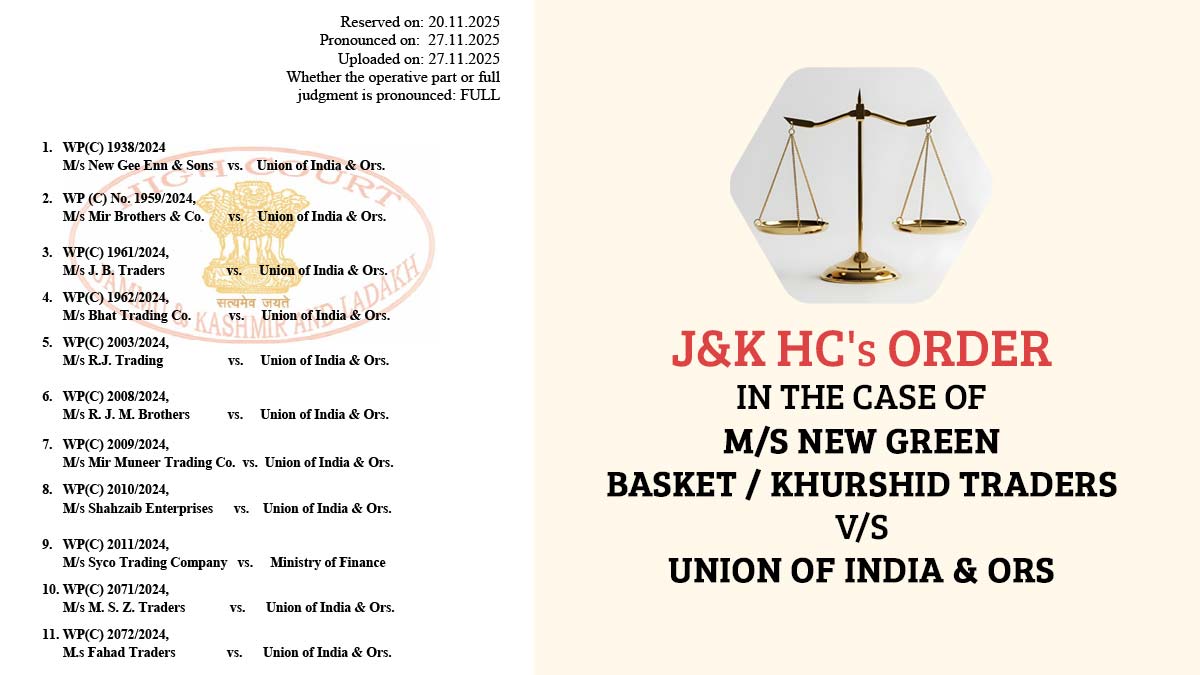
| Case Title | M/s New Green Basket/ Khurshid Traders vs. Union of India & Ors |
| Case No. | WP(C) 2480/2025 |
| For Petitioner | Mr Tahir Majid Shamsi, Ms Rehana Qayoom, Mr Waseem Gul, Mr Mohd Younus Hafiz, AC & Ms Nowhabar Khan |
| For Respondent | Mr S. F. Qadiri, Mr. Numan Zargar, Ms Snober Sameer, Mr Sikander Hayat Khan |
| J&K High Court | Read Order |