

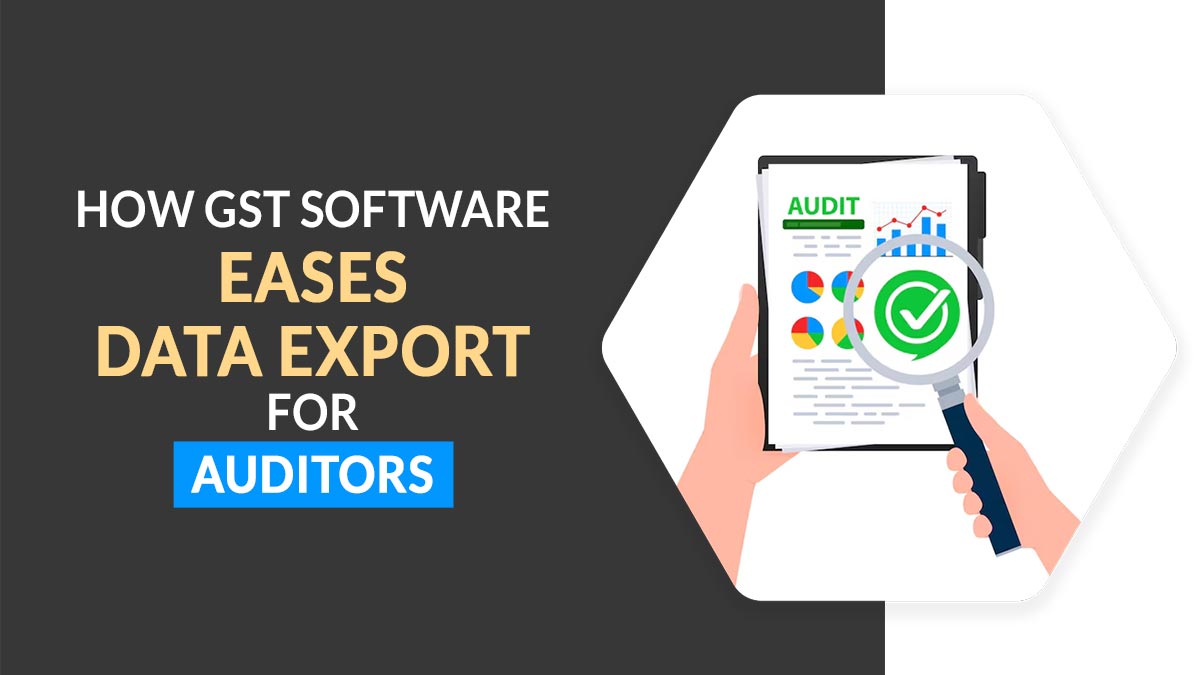
Auditors in today’s fast-paced compliance environment face constant pressure to generate accurate reports within strict deadlines. Manual data handling has become impractical, as GST compliance requires multiple returns, numerous invoices, e-way bills, and reconciliation data.
Modern GST software secures a useful feature that is its ability to export data in structured formats that are simpler for auditors to operate. The single feature can save time and errors for auditors and improve the quality of audits.
Challenge of Data Handling in GST Audits
A GST audit needs auditors to analyse a distinct range of records, which includes sales and purchase registers, ITC claims, GSTR-1, GSTR-3B, GSTR-2B, e-invoices, e-way bills, and payment challans. The auditor’s task becomes intricate and time-consuming if such records are spread across multiple spreadsheets, portals, or accounting systems.
The chances of errors will surge from manually copying and pasting data from the GST portal, reconciling figures, and formatting reports for working papers.
In this, the GST software can improve the audit process. Auditors, rather than handling multiple files, can access a centralised database from which all GST-pertinent information can be exported with just a few taps.
Understanding GST Data Export
In GST software, data export is concerned with the tax details and making the same into easy-to-read formats such as Excel, CSV, PDF, or JSON. Such files are valuable for tasks such as checking that everything adds up, comprehending tax details, preparing for audits, and fulfilling legal requirements. If an individual requires a summary of tax returns or a detailed list of invoices, the software delivers the required details quickly.
Making Audits Shorter and Quicker
Checking and confirming the records of business matches with the official tax data is one of the difficult tasks of a GST audit. Auditors would be required to compare the recorded information by businesses with the available data on the tax website, particularly documents known as GSTR-1, GSTR-3B, and GSTR-2B. An effective GST software can automatically fetch these documents and align them with the records of the businesses.
Auditors with easy data export are enabled to download two separate lists- one exhibiting what matches, and another specifying what doesn’t. For example, they could get a list of invoices recorded via the business that are not present on the official document. The same sort of work that can take days could just be accomplished in a few minutes.
Lowering Errors and Developing Trust
Serious inaccuracies could be the result of mistakes in data entry, like wrong numbers in invoices. The GST software makes sure that the exported information is the same as the records within the system and what has been filed online. Hence, the auditors are using the appropriate and reliable data.
As the data export is automated, the same supports in avoiding mistakes and duplication surging the confidence of the auditors in their findings and enhancing their reports.
Distinct Formats for Various Requirements
The needs of the auditors vary at multiple phases of their work. Initially, they desire a broad overview of income and taxes. Subsequently, they may require detailed invoice data. GST software provides various formats to fulfil such requirements.
For instance, exporting the data to Excel permits detailed analysis with the use of filters and computations, and PDF exports are effective for sharing the final reports. Specific advanced software can export in JSON format, which operates effectively for deeper analysis or integrating with other tools.
Effective Collaboration B/W Auditors & Clients
An additional significant advantage of simple data export is the enhanced communication between auditors and the companies they collaborate with. Instead of requiring businesses to prepare complex reports or manage multiple spreadsheets, the system can request specific data directly from the GST software. In specific cases, auditors can access client information with proper authorisation, streamlining the entire process.
The same method can enhance transparency by allowing clients to see what data is shared, which promotes trust and accelerates the audit.
Maintain an Effective Record for Future Use
GST audits do not just get finished after submission of the report. The auditors would be required to maintain effective documentation if there are future reviews or investigations. GST software facilitates the same by permitting all exported files to be saved and retrieved whenever required.
As the data is organised and clearly labelled, it becomes simpler to elaborate on the audit findings if required in the future. The same record-keeping is valuable for large businesses and audit firms that work with various clients.
Closure: Assuring compliance with GST needs precision, speed, and accountability for auditors. A user-friendly GST software with easy data export features plays a crucial role in achieving these objectives. By providing straightforward and ready-to-use data for checks and reports decreases the manual effort and the possibility of errors.
In an era of rapidly expanding tax data, having straightforward data export features is essential. It supports auditors’ work efficiently furnish insights, and ensures their clients stay compliant with tax norms.