

The Gauhati High Court, in a ruling addressing one of the most litigated issues under the Goods and Services Tax regime, has held that input tax credit (ITC) cannot be denied to a bona fide purchaser merely because the supplier failed to upload invoices or file appropriate returns.
The Court observed that shifting the consequences of a supplier’s default onto the buyer is arbitrary and contrary to the architecture of GST.
The Court emphasised that under Section 16(2)(aa), a purchaser must be afforded a fair opportunity to establish their bona fides before any Input Tax Credit (ITC) is denied. This ensures that the statutory framework is not used to arbitrarily penalise genuine buyers for the compliance failures or defaults of their suppliers.
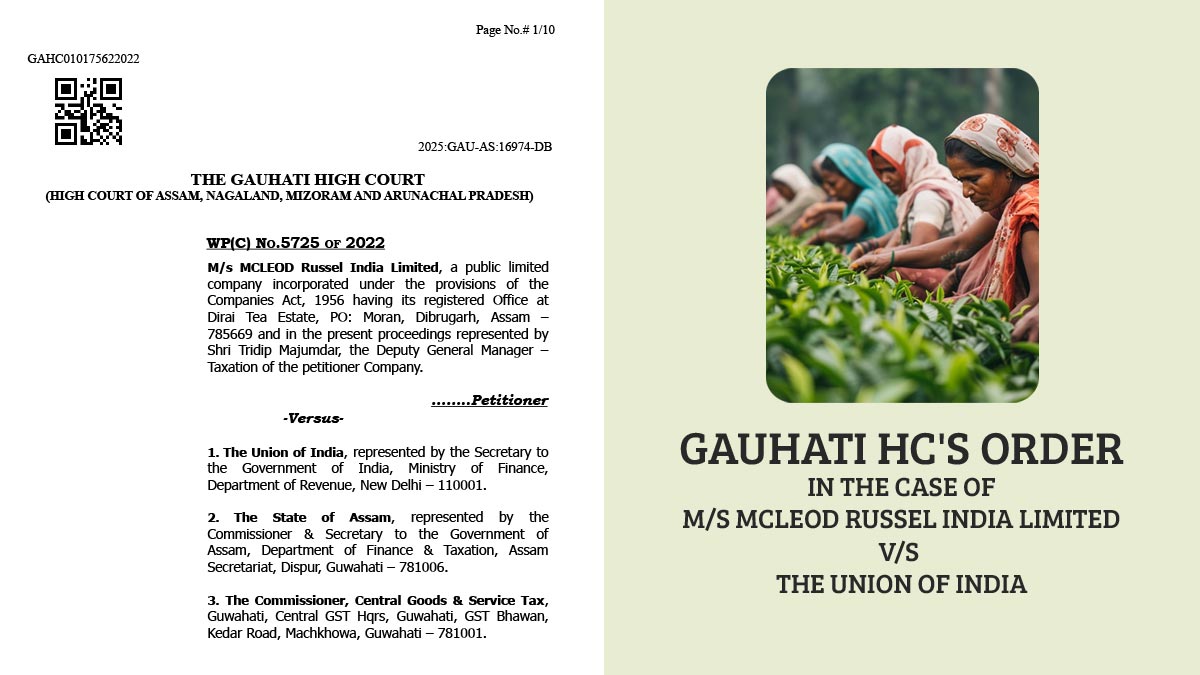
The judgment, delivered dated 9.12.2025 by a bench of Chief Justice Ashutosh Kumar and Justice Arun Dev Choudhury, has been contested filed by M/s McLeod Russel India Limited, which claimed that the statutory condition demanding the purchaser to ensure that the supplier duly uploads invoice details in GSTR-1 is not possible to fulfil and results in the refusal of ITC despite full compliance by the buyer.
The grievance of the applicant has been recorded by the court that Section 16(2)(aa) makes the buyer’s entitlement to ITC contingent upon the supplier’s actions; however, the buyer has no procedure under the Act to compel the supplier to file GSTR-1 correctly or on time.
The company, a purchaser who has obtained goods or services and paid GST to the supplier, cannot regulate whether the supplier uploads the invoice in its outward supplies return u/s 37.
Denying Input Tax Credit (ITC) even after tax already paid results in double taxation of the same transaction, creating an impermissible cascading effect that refutes the fundamental structure of GST.
The court said that legal purchasers encounter refusal of ITC routinely where the supplier either fails to file GSTR-1, makes errors in reporting, or delays filing, and that the statutory framework at present proposes no remedial procedure to buyers, even in cases where the suppliers have filed the tax via GSTR-3B but not uploaded the related invoices.
The provision, as it currently exists, places an “onerous burden” on purchasing dealers and subjects legitimate recipients to tax liability solely due to the non-compliance of suppliers.
The Bench acknowledged that the resulting cascading effect undermines the fundamental principle of taxing only value addition, which is the foundation of the GST system.
The applicant, in support of reading down the provision, put reliance on previous precedents along with the decision of the Calcutta High Court in Suncraft Energy. Subsequently, confirmed by the Apex court and decisions acknowledging that ITC refusal could not emerge where the buyer has acted in good faith, obtained goods or services, and filed GST to a registered supplier.
The Bench drew support from the Supreme Court’s affirmation of the Delhi High Court’s landmark judgment in Shanti Kiran India (P) Ltd. This precedent reinforces the principle that bona fide recipients must be shielded from adverse tax consequences in cases where the supplier has successfully collected the tax amount but failed to remit it to the government exchequer.
The CGST authorities on the government’s opposite side have defended the amendment as required to curb the bogus ITC and legislate the compliance of the supplier, claiming that ITC is a concession as per the legal norms and that linking credit to reflection in GSTR-2A/2B is an intended policy decision.
The court acknowledged that fighting fraud is a legitimate legislative purpose. But, it specifies that these objectives could not explain penalising honest purchasers for conduct completely outside their control.
The court said that, as GST is a destination-based consumption tax therefore the incidence is ultimately borne on the buyer with the seller acting as a collection conduit. Hence, when the buyer has released the tax to the seller and holds valid documentation, then the State cannot refuse the ITC because of the mismatches emerging from supplier-side lapses.
The Court, finding the restriction iniquitous, held that although the Legislature can impose conditions for taking ITC, those norms should not conquer the objective of the act itself.
Thus, it refused to invalidate Section 16(2)(aa) but read it down to specify that ITC could not be mechanically refused. If a supplier defaults, the buyer should be allowed to provide proof through invoices and supporting records.
Read Also: Calcutta HC: Buyer’s ITC Can’t Be Denied Due to Supplier’s Retrospective GST Cancellation
The court’s reading down shall remain in effect until the CBIC develops a workable procedure to prevent punishing buyers for supplier-side non-compliance.
The judgment provides relief to taxpayers in various sectors who have encountered repeated ITC refusals due to supplier mismatches, and is likely to influence the broader national debate on striking a balance between fraud prevention and protecting bona fide recipients.
| Case Title | M/S McLeod Russel India Limited vs. The Union of India |
| Case No. | WP(C) NO.5725 OF 2022 |
| For the Petitioner | Mr. A. Kanodia |
| For the Respondent | Mr S.C. Keyal, Ms R. Hussain |
| Gauhati High Court | Read Order |