

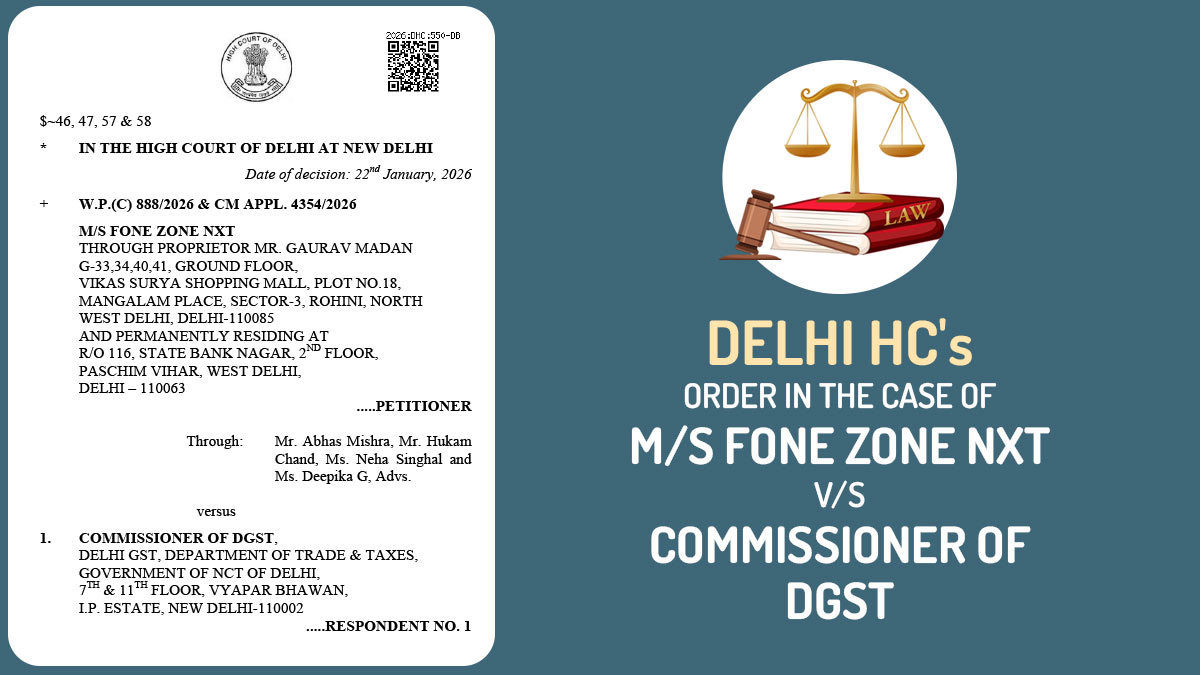
The Delhi High Court has thrown out several petitions from taxpayers who were contesting certain decisions related to the Goods and Services Tax (GST). These decisions were made without the taxpayers being present, and some of their bank accounts had been temporarily frozen. The court emphasised that taxpayers cannot escape the effects of these decisions by blaming their Chartered Accountant (CA) for not replying to official notices sent through the GST system.
The Division Bench, comprising Justice Nitin Wasudeo Sambre and Justice Ajay Digpaul, denied the request for relief. They stated that the applicant had prior knowledge of the suspension of the GST registration and the email configuration on the GST portal. Additionally, the applicant failed to provide sufficient evidence to demonstrate that only the Chartered Accountant was at fault.
The applicant has not taken any action against the Chartered Accountant, which raises questions about the claim of professional negligence. It is inadequate to hold a professional accountable who is not present in court to seek judicial relief. Furthermore, the previous ruling cited by the applicant was founded on different circumstances and cannot be applied mechanically.
The applicant, a proprietorship firm, is in the sale of mobile phones and allied accessories, and has received GST registration on 1 July 2017. The firm’s GST registration, over time, was suspended at its own request, after which the Delhi GST Department issued multiple SCN for assessment years starting 2017-18 onwards. The notice is concerned with a mismatch in Input Tax Credit (ITC) claims and ITC availed from suppliers whose GST registrations were thereafter cancelled retrospectively.
Since the applicant neither submitted responses nor appeared for personal hearings, the department proceeded to pass ex parte orders u/s 73 of the Delhi GST Act, raising tax demands. A provisional attachment of the petitioner’s bank accounts emerged, leading the applicant to approach the High Court.
The taxpayer before the court said that all GST communications were sent to the email ID of the CA, as shown on the GST portal. The CA does not notify the applicant concerning Show Cause Notices (SCN) and hearing reminders. The applicant must not be penalised for the professional lapse of its consultant.
The taxpayer asked to quash the orders and asked for a fresh hearing, particularly since the applicant wants to deposit 50% of the outstanding demand. The applicant relied on a recent decision of the Division bench in Ms Walsons Services Pvt. Ltd., where relief was provided on equitable considerations.
The GST department countered the petitions, claiming that the department must comply with the statutory procedure under the GST law. The applicant has the information about the GST registration, and communications were associated with the email of CAs. Taxpayer is liable to remain vigilant and ensure timely compliance. A mere willingness to deposit a portion of the total demand cannot replace statutory defaults.
Read Also: Free Download Chartered Accountant Software for Tax Firms
The Court stated that even if the applicant is ready to deposit 50% of the liability, this alone does not compel the Court to deviate from the established statutory procedures. The Delhi High Court dismissed all the writ petitions, thereby keeping the ex parte GST assessment orders and the subsequent provisional attachment of bank accounts.
| Case Title | M/S Fone Zone NXT vs. Commissioner of DGST |
| Case No. | W.P.(C) 888/2026 & CM APPL. 4354/2026 |
| For Petitioner | Mr. Abhas Mishra Mr. Hukam Chand Ms. Neha Singhal Ms. Deepika G, Advs. |
| For Respondent | Ms. Urvi Mohan, Adv. |
| Delhi High Court | Read Order |