

The Delhi High Court instructed the GST Department to ensure accuracy when specifying the financial year and other relevant dates in the show cause notices and orders issued to taxpayers.
A division bench of Justices Prathiba M. Singh and Renu Bhatnagar cautioned for the case where the authority accidentally cited the deadline for filing the response to the SCN issued before the applicant as 28th August, 2025, instead of 28th August, 2024.
On 21st January 2025, the impugned order, raising demand against the applicant, was passed, mentioning its failure to answer the SCN.
The applicant said that it had the time to answer the SCN till 28th August 2025; however, the impugned order was passed before that, refusing it a proper hearing and thereby breaching the principles of natural justice.
The applicant is not allowed to rely on the Department’s typographical error, the High Court mentioned.
“Clearly, the same was merely an error which cannot be taken advantage of by the ld. Counsel for the Petitioner…CGST Department is advised to exercise caution in future while mentioning financial years, due dates for replies and such material particulars in the show cause notices and orders,” it mentioned.
Before the Chief Commissioner of Central Tax, a copy of this order has been sent for the crucial information and compliance.
HC also mentioned that even if it is presumed that the time to submit the response was till 28th August, 2025, then nothing was there on record to show that the applicant ever filed any response concerning the case.
The case is pertinent to the alleged bogus claim of the ITC, which comprises 79 fake entities that have transferred substantial amounts of ITC (Rs 122 crores approx) through GSTR filing. According to the impugned order, the applicant is liable for Rs 23,20,171.
The Court, in this factual backdrop, denies to intervene in the case, citing, “This Court has consistently taken the view that in cases involving fraudulent availment of ITC, ordinarily, the Court would not be inclined to exercise its writ jurisdiction. It is routinely seen in such cases that there are complex transactions involved which require factual analysis and consideration of voluminous evidence.”
Reliance was placed on Mukesh Kumar Garg v. Union of India & Ors., where the High Court said that in many cases encountered, where the ITC facility has been misused, even when the output tax is not deposited. “Such misuse, if permitted to continue, would create an enormous dent in the GST regime itself.”
The case of M/s MHJ Metal Techs v. Central Goods and Services Tax Delhi South is pertinent here. The High Court ruled that when addressing cases related to the fraudulent use of Input Tax Credit, it is essential to strike a balance between protecting the interests of traders and considering the financial burden on the state treasury caused by tax evasion.
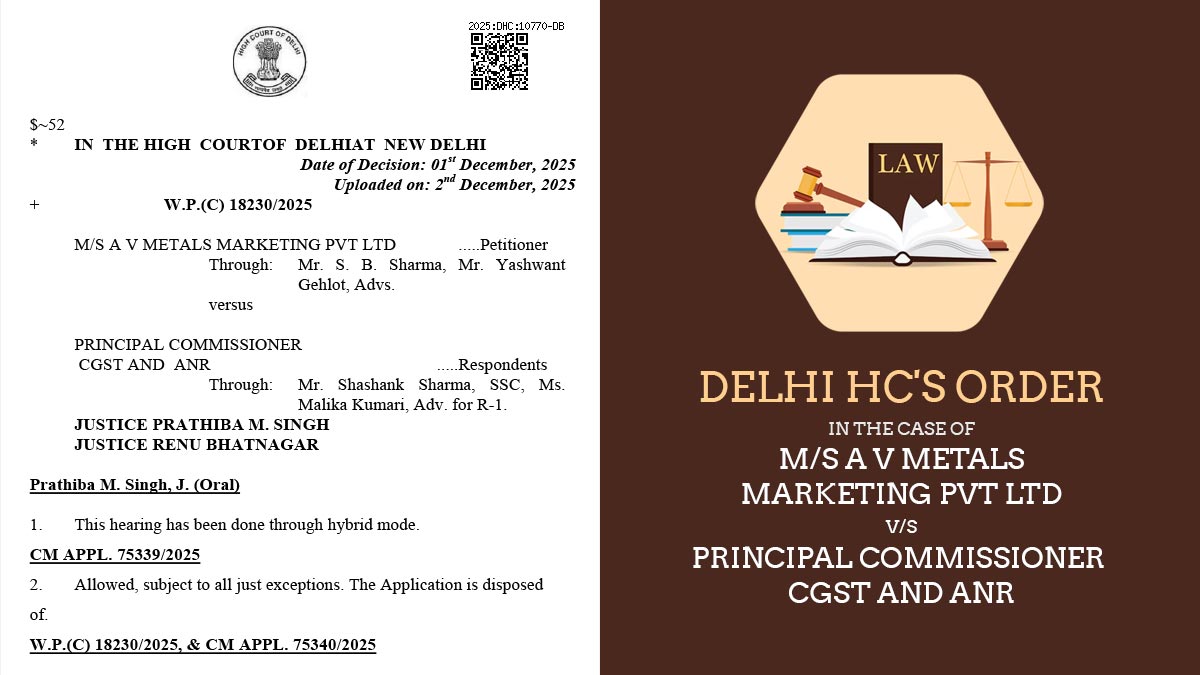
| Case Title | M/S A V Metals Marketing PVT LTD vs. Principal Commissioner CGST and ANR |
| Case No. | W.P.(C) 18230/2025 |
| For Petitioner | Mr. S. B. Sharma Mr. Yashwant Gehlot, Advs. |
| For Respondent | Mr. Shashank Sharma, SSC Ms. Malika Kumari, Adv. for R-1 |
| Delhi High Court | Read Order |