

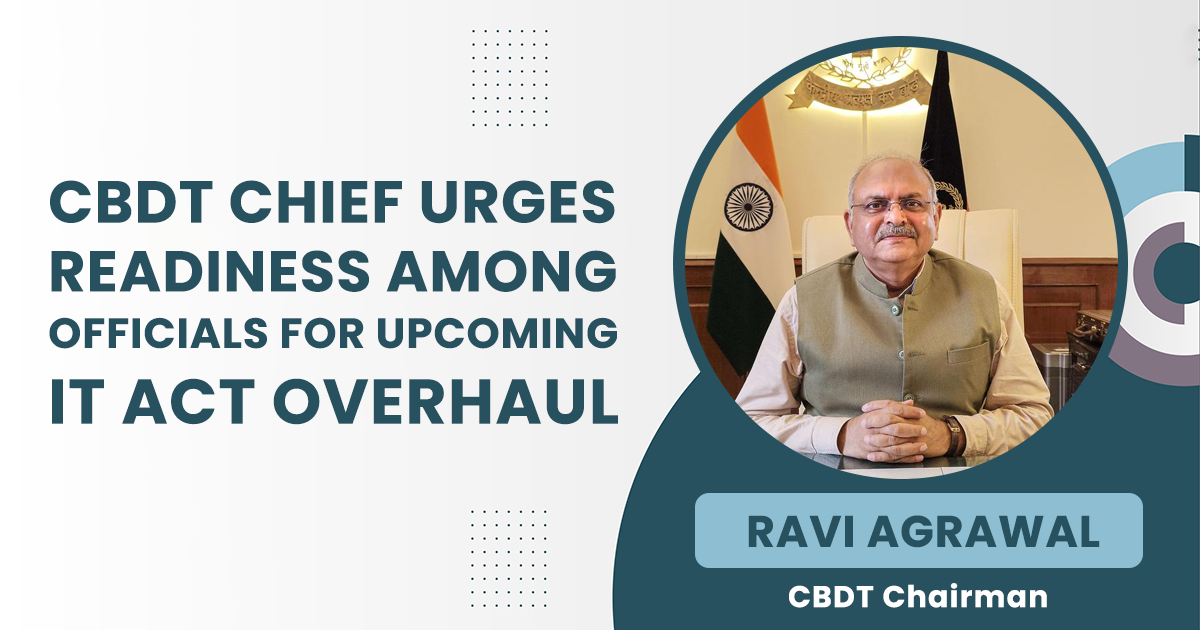
CBDT Chairman Ravi Agrawal has directed the Income Tax Department to adopt a proactive stance in preparation for the upcoming transition to the new direct tax law.
With implementation slated for April 1, the Chairman urged officials to execute their duties with ‘clarity and purpose’ to ensure a seamless shift for taxpayers and the administration alike.
In his annual New Year address to the department, the CBDT Chairperson announced that the formulation of new rules, procedures, and statutory forms is currently underway to ensure a seamless legislative transition. As the apex administrative authority for the Income Tax Department, the CBDT is prioritising the creation of a streamlined framework to support the upcoming changes.
The current Income Tax Act of 1961 has been superseded by the new Income Tax Act, which has been in effect for more than 6 decades.
Mr Agrawal, mentioning 2026 as a year of special significance for the department, urged the officials to ensure their readiness, understanding of the law and shared confidence in its execution.
Mr Agrawal wrote in his January 1 letter to officials, “This year carries special significance. With the Income Tax Act 2025 notified and scheduled to take effect on 1 April 2026, we are preparing for the shift to the Income Tax Act 2025. New rules, procedures and forms are under formulation and training and capacity building are already underway.”
The CBDT chief mentioned that the upcoming months shall need the active involvement in training and familiarisation so that we comprehend the purpose and structure of the new law and can guide taxpayers with clarity.
He specified that, “Your involvement and curiosity will shape how smoothly we make the transition.”
Also, Mr Agrawal mentioned that the method of tax administration was evolving.
The department’s role, apart from the collection [of revenue and taxes] and enforcement, is increasingly centred on facilitation, trust, and service. Technology will be central as systems evolve to align with the new structure.
Read Also: Income Tax Dept Targets Fraudulent Deduction Claims in New Verification Operation
He cited that familiarity with data platforms and automated mechanisms shall become integral, especially for younger officers and staff who shall lead the department in the forthcoming years.
The CBDT Chairman, recalling 2025, mentioned the organisation operated with close oversight on issues, rectification of orders, and pending appeals.
Lauding the “sincerity” of tax officials, He cited even when their efforts were “unseen”, that anticipations were high and timelines demanding, but colleagues all over the nation showed resilience and delivered.
Changing business and transaction patterns had brought new “financial complexities,” but they also proposed opportunities to build sharper insight and capability, he mentioned, specifying the need for continuous learning.
Mr Agrawal sought officials to make “behavioural” administration stronger via the NUDGE framework, or Non-intrusive Usage of Data to Guide and Enable, to foster voluntary compliance through better use of data.
These values are reflected in our decisions, whether they are big or small. Every member plays a crucial role in upholding the integrity of the tax system, and the work we do each day quietly supports the nation’s financial framework, he wrote.
As we move into 2026, let us work together with diligence, clarity, and purpose, he added.