

The Agra bench of the Income Tax Appellate Tribunal (ITAT) has overturned an income tax addition of ₹3.69 crore imposed on a woman from Firozabad. Her bank accounts were used to ease payments between bangle traders across India and suppliers in the Uttar Pradesh town.
The tribunal ruled that the Income Tax Department could not classify the entire amount deposited in her accounts as unexplained income without proving that the money actually belonged to her.
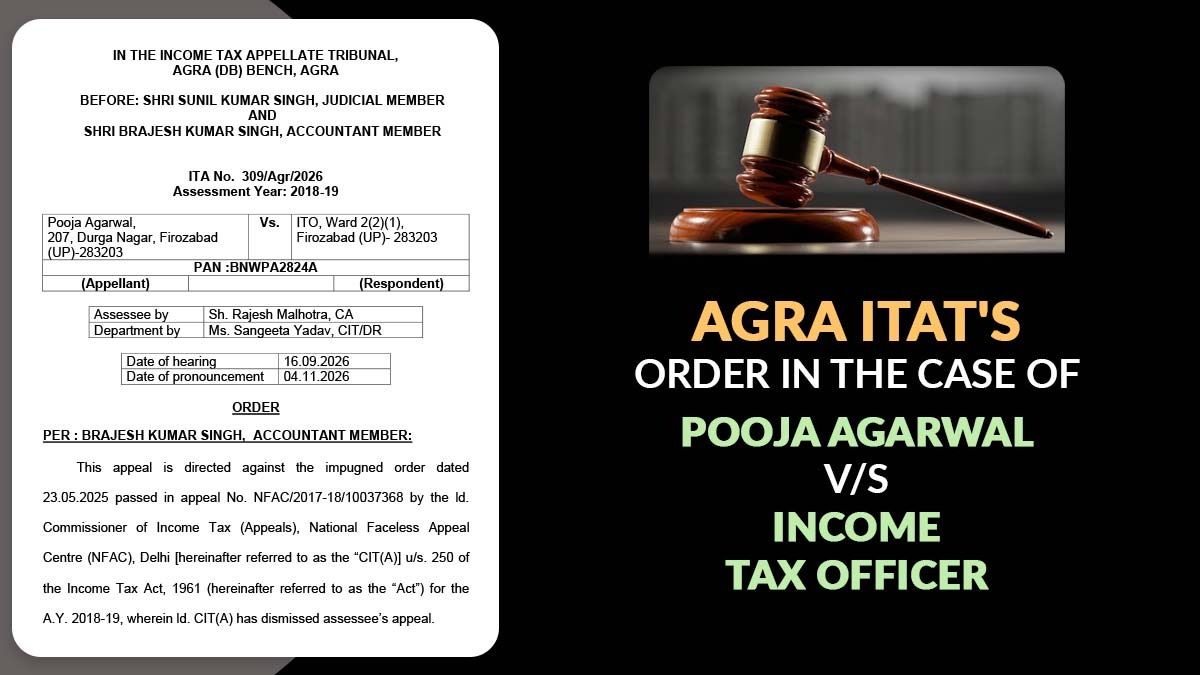
In its order dated November 4, 2026, in the case of Pooja Agarwal vs. Income Tax Officer, ITA No. 309/Agr/2026, the tribunal favoured the taxpayer, nullifying the addition made under section 69A of the Income Tax Act, 1961.
This case pertains to the AY 2018-19, during which Agarwal filed her ITR reporting a total income of ₹3.20 lakh. Upon scrutiny, the assessing officer (AO) discovered that ₹3.69 crore had been deposited into her two bank accounts, an amount significantly higher than the turnover of ₹4.98 lakh reported in her return.
Agarwal explained that she runs a commission-based business through which she streamlined the payments between bangle buyers located in various parts of the country and traders in Firozabad. Buyers would deposit cash into her bank accounts, after which she would withdraw the money and make payments to the local suppliers.
She stated that she charged a commission of ₹500 for every ₹1 lakh handled and reported a commission income of ₹1.85 lakh under the presumptive taxation scheme outlined in Section 44AD.
However, the assessing officer did not accept her explanation. The department asked why buyers from different parts of the country would deposit cash into her accounts rather than making payments to the traders. It stated that she had not provided the party-wise information, which includes the names, addresses, and other details that can support validating the transactions.
The tax officer noted that the taxpayer had not kept sufficient documentary proof to specify the identity of the parties or the genuineness of the transactions. Thereafter, the entire Rs 3.60 crore was considered as unexplained money u/s 69A.
The Commissioner of Income Tax (Appeals) upheld this addition, following which Agarwal approached the ITAT.
What ITAT says?
The tribunal analysed the bank transactions and found that large amounts of cash were withdrawn following the deposits made. The total amount deposited was ₹3,69,92,943, while the cash withdrawals from the accounts amounted to ₹3,73,69,422.
It considered the assessment order for the preceding AY 2017-18, in which the assessing officer had admitted that Agarwal earned income via commission.
The Tribunal noted that the tax department had not presented any evidence on record to prove that Agarwal was engaged in any independent business capable of generating such a large amount of undisclosed income.
It is also stated that the explanation provided regarding their role in facilitating transactions between bangle traders in various cities and suppliers in Firozabad cannot be entirely dismissed, especially when considering the nature of these transactions and the department’s previous assessments.
Recommended: ITAT Jaipur Quashes Rs. 31.40 Lakh Unexplained Money Addition U/S 69A on Gifts Received from Parents
Therefore, the Tribunal stated that these deposits could not be considered as the taxpayer’s undisclosed income u/s 69A solely based on the amounts deposited. It deleted this additional sum of ₹3,69,92,943 and ruled in the taxpayer’s favour.
Direction of Income Tax Section 69A for taxpayers
Section 69A permits the assessing officer to consider money, bullion, jewellery, or other valuable assets as unexplained income if a taxpayer is determined to be their owner but cannot elaborate on their source.
However, the deposit of a large sum into a bank account does not, by itself, prove that the entire amount constitutes the account holder’s taxable income. The ownership of the funds, the nature of the transactions, and the available evidence must also be analysed.
This decision does not signify that taxpayers can avoid paying tax on undisclosed deposits by claiming that they were holding someone else’s money. In every case, supporting evidence and facts remain crucial.
| Case Title | Pooja Agarwal Vs Income Tax Officer |
| Order No. | ITA No. 309/Agr/2026 |
| Assessee by | Sh. Rajesh Malhotra |
| Departmen by | Ms. Sangeeta Yadav |
| Agra ITAT | Read Order |