

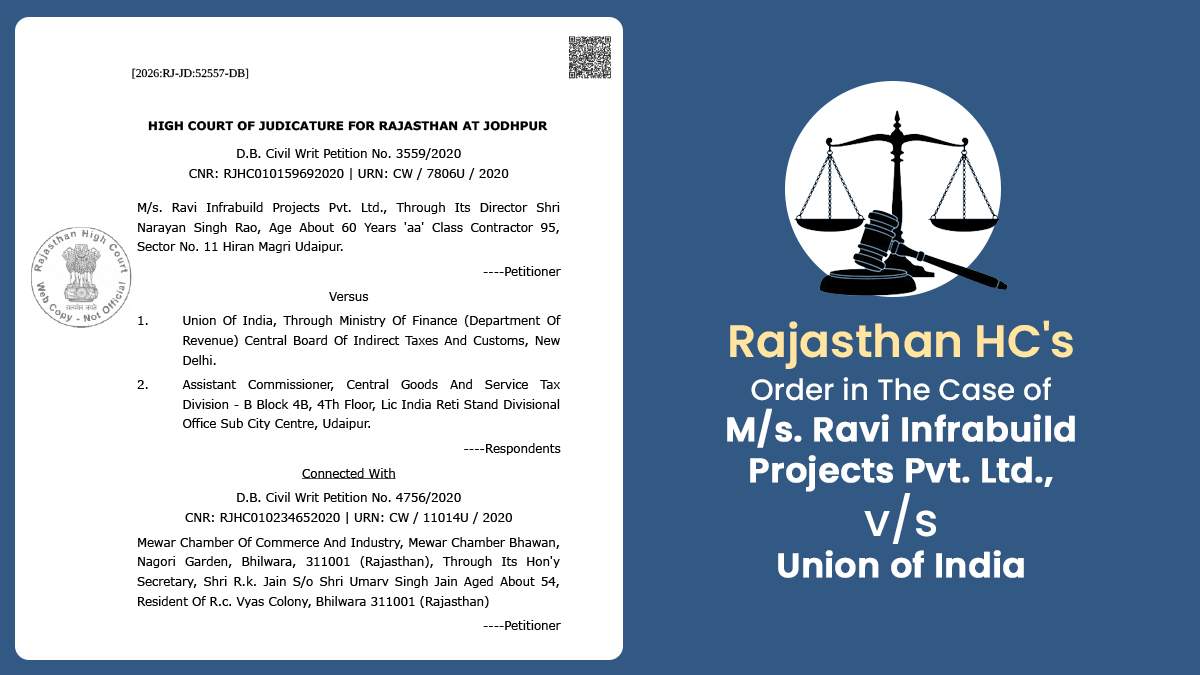
The Rajasthan High Court has upheld the constitutional validity of Rule 36(4) of the Central Goods and Services Tax (CGST) Rules, 2017, which does not allow claiming ITC on invoices or debit notes not uploaded by suppliers.
A Division Bench of Justice Arun Monga and Justice Yogendra Kumar Purohit said that there was no reason to opt for a distinct opinion from those adopted by the Gauhati, Madras, and Kerala High Courts, which had upheld the provision.
The Bench stated that, “We are in respectful agreement with the view taken therein and see no reason to take a contrary view.”
The court was hearing a batch of writ petitions that challenged Rule 36(4) and the subsequent proceedings initiated by GST authorities.
Rule 36(4) was rolled out in October 2019. It imposed a limit on claiming Input Tax Credit (ITC) for invoices or debit notes that had not been uploaded by the supplier. This limit was set at 20% of the eligible credit reflected in the invoices or debit notes that had been uploaded. Subsequently, effective from January 1, 2020, this limit was reduced to 10%.
A notice was issued by the GST authorities in Form GST DRC-01A dated February 6, 2020, asking for the reversal of ITC of Rs 1.22 crore because of the mismatch between the credit claimed by the taxpayer and the amount shown in GSTR-2A.
The petitioners claimed that Rule 36(4) levies a restriction that goes beyond the extent of the parent legislation, specifically, Section 16 of the CGST Act. They said that once the conditions stipulated u/s 16(2) are met, Input Tax Credit (ITC) cannot be denied only because the supplier didn’t upload the details of the relevant invoice.
They asserted that Sections 37 and 42 of the CGST Act already provide a legal framework for uploading returns, reconciling data, and rectifying discrepancies. According to them, this restriction was unreasonable, all the more so given that this statutory reconciliation mechanism had not even been effectively implemented.
The petitioners further argued that this provision penalises honest recipients who suffer losses due to the errors of their suppliers over whom they have no control and that it, therefore, breaches Articles 14, 19, and 300A of the Constitution.
On the other hand, the Revenue Department defended this provision, stating that it was implemented under the rule-making powers granted by Section 16 and 164 of the CGST Act, with the objective of regulating the process of availing Input Tax Credit (ITC) and curbing fraudulent claims. The Department further argued that ITC is a statutory concession, subject to the conditions and restrictions stipulated by law.
Agreeing with the Revenue Department, the High Court stated that three other High Courts have already upheld the validity of Rule 36(4) of the CGST Rules.
The Bench referred to the decision of the Gauhati High Court in M/s High Tech Ecogreen Contractors LLP v. The Joint Director & Ors., which held that the provision derived authority from Section 16 read with the general rule-making powers u/s 164 of the CGST Act.
It observed the decisions of the Madras High Court in M/s L. & T. Geostructure LLP v. Union of India and the Kerala High Court in Nahasshukoor v. Assistant Commissioner & Ors which upheld the sub-rule (4) of Rule 36 of the CGST Rules.
Concurring with these decisions, the Rajasthan High Court stated that there is no merit in the challenge to the constitutional validity of Rule 36(4).
In the matter of challenging the show-cause notices, the court said that the challenge was based on questioning the validity of the rule itself. Since that challenge failed, the court declined to quash the notices.
The bench also referred to a Supreme Court judgment in the case of ‘M/s Trillion Lead Factory Private Limited vs. Superintendent of Central Tax’. It was reiterated therein that, as a general rule, a writ petition cannot be filed merely against the issuance of a GST show-cause notice.
The Court clarified that if the proceedings related to the notices had not been completed, the petitioners are free to appear before the appropriate authorities and submit their materials.
Additionally, the Court noted that if assessment orders had already been issued, the petitioners have the right to challenge those orders in accordance with the law. If favourable orders had been issued, there would be nothing further to consider.
Accordingly, the High Court disposed of a batch of writ petitions and declined to interfere with the validity of Rule 36(4) or the impugned ‘show-cause notice’.
| Case Title | M/s. Ravi Infrabuild Projects Pvt. Ltd. vs Union Of India |
| Case No. | Writ Petition No. 3559/2020 |
| For Petitioner | Ayush Goyal, Vinay Kothari, Pranjul Mehta |
| For Respondent | Bharat Vyas, Vaibhav Bhansali, Rajvendra Saraswat, Jitesth Kumar Suthar, Rishabh Dadhich |
| Rajasthan High Court | Read Order |