

The Bombay High Court has said that the difference between the subscription price and the fair market value of proportionately allotted rights shares cannot be levied as tax u/s 56(2)(x) of the Income-tax Act when there is no change in the holding percentage of the shareholder and no disproportionate benefit is determined.
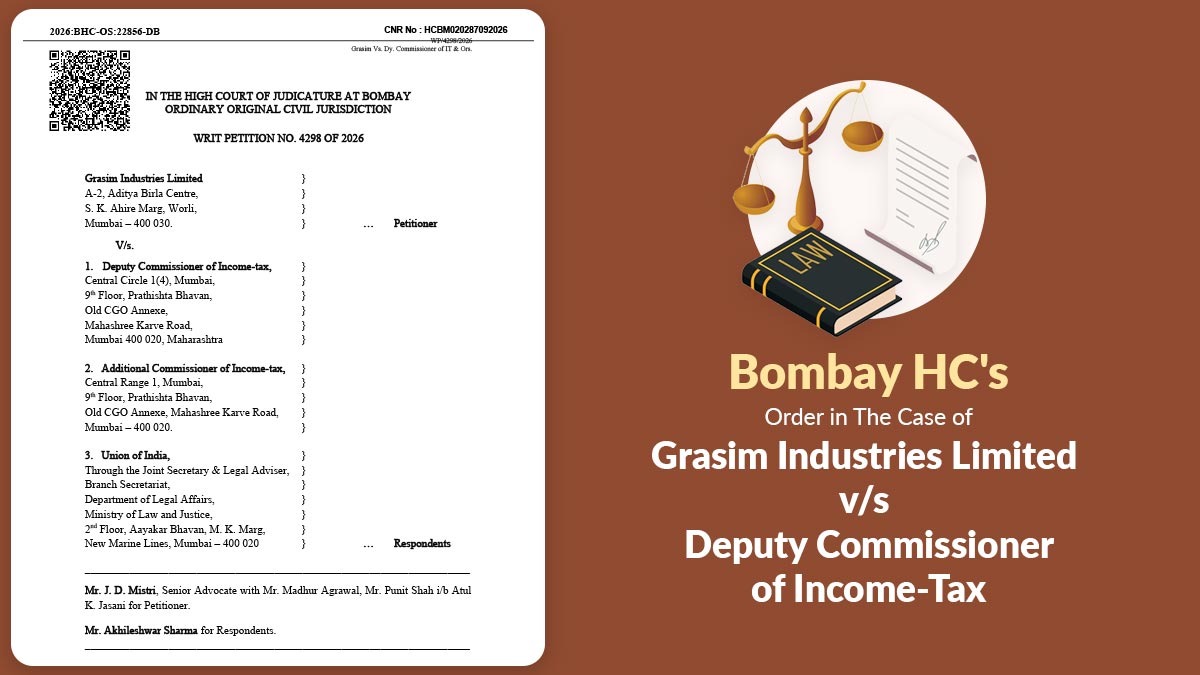
A Division Bench, Justices B. P. Colabawalla and Farhan P. Dubash, permitted the petition of Grasim Industries Limited contesting reassessment proceedings over an alleged taxable benefit of Rs 329 crore arising from its subscription to Vodafone Idea Limited’s rights shares. They stated that:
“We accordingly hold that, in the facts of this case, Section 56(2)(x) cannot be invoked merely to tax the difference between the subscription price and the fair market value of the rights equity shares proportionately allotted to the Petitioner. Our finding is confined to the allotment before us, in which the Petitioner’s percentage shareholding is stated to have remained unchanged and no disproportionate benefit has been identified. The basis for reassessment is therefore unsustainable.”
Grasim subscribed Vodafone Idea rights shares at a price of Rs 12.50 per share. The Income Tax Department has valued the shares at Rs. 13.925 per share and asked to tax the difference u/s 56(2)(x) of the Income-tax Act, which includes receipts of property without consideration or for inadequate consideration. Grasim contested the reassessment.
It was argued that Vodafone Idea had issued shares to existing shareholders in proportion to their existing holdings, and as a result, the percentage of their ownership stake remained unchanged. Furthermore, it was pointed out that the department had initiated these proceedings after the expiry of the statutory limitation period.
The Court said that a rights allotment should be analysed for the shareholder’s existing interest in the company, as issuing additional shares impacts the value of existing shares.
Read Also: Your Income Tax Queries and Our Solution by Tax Experts
It stated that the difference between the subscription price and fair market value did not specify an equivalent economic benefit. The department did not find any undue benefit accruing to Grasim and based its case solely on the price differential.
The Bench denied the claim of the department that it could analyse taxability at a subsequent phase of reassessment. Since there was no dispute regarding the nature of the transaction, the department could neither initiate proceedings on a legal basis that would not hold up, nor could it defer the determination of this matter to a later stage.
It stated that the reassessment proceedings had not been initiated validly within the regulatory limitation period.
Subsequently, the High Court set aside the Show Cause Notice (SCN), the order allowing reassessment, and the consequential reassessment notice. It left the other grounds of challenge of Grasim open.
| Case Title | Grasim Industries Limited vs. Deputy Commissioner of Income-Tax |
| Case No. | 4298 OF 2026 |
| For Petitioner | Mr J. D. Mistri, Mr Madhur Agrawal, and Mr Punit Shah |
| For Respondents | Mr. Akhileshwar Sharma |
| Bombay High Court | Read Order |