

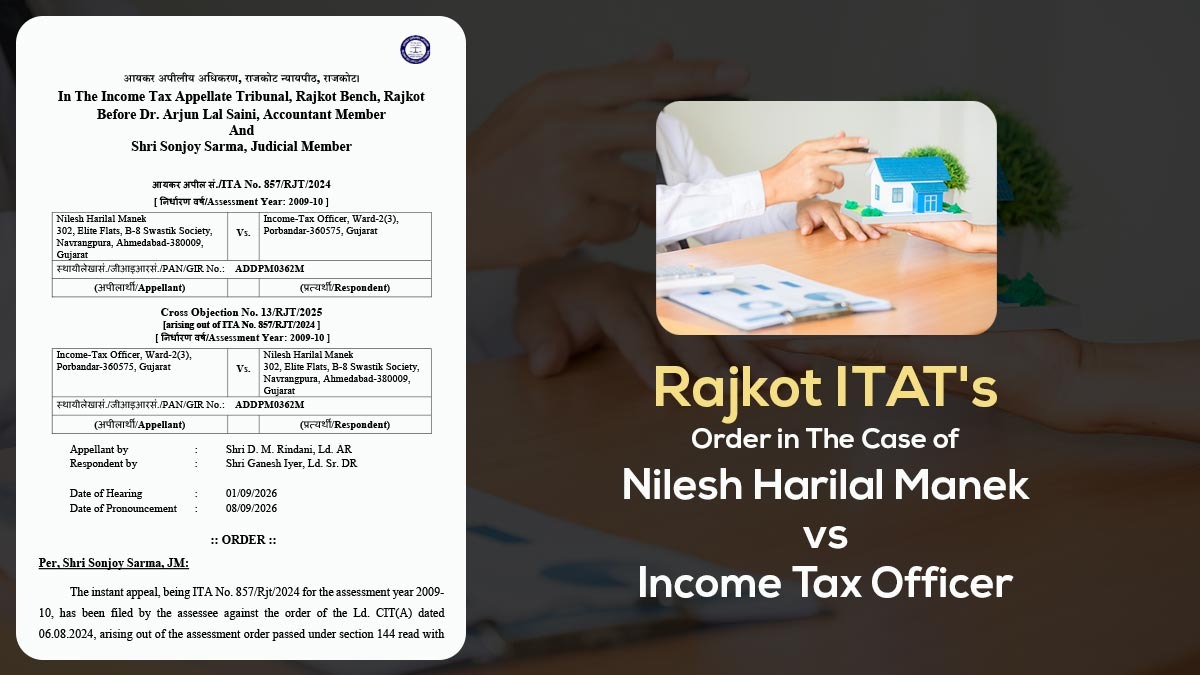
The Rajkot Bench of the Income Tax Appellate Tribunal (ITAT) held that the Income Tax Department cannot tax the entire value of a jointly purchased property in the hands of a single assessee without first establishing the assessee’s share of the investment.
The tribunal set aside the reassessment proceedings initiated by the Assessing Officer (AO) for the joint purchase of an immovable property of Rs. 50 lakhs and stated that the officer should consider the taxpayer’s share and investment before making additions wholly against the taxpayer.
According to the case facts, the taxpayer Nilesh Harilal Manek did not submit a return for AY 2009-10. During scrutiny, the AO observed that Ms Nayana J Manek purchased a property in 2008 for Rs. 50 lakhs. The AO added the consideration paid for the property as unexplained in the taxpayer’s hands.
The CIT(A) admitted additional evidence under Rule 64A of the Income Tax Rules, 1962, when the assessee filed their appeal. According to the assessee, a payment of Rs. 50 lakhs was made from the proceeds of the sale of another immovable property.
Since the sale was not reported for tax purposes, the appellate commissioner proceeded to calculate the Long-Term Capital Gain (LTCG). The commissioner upheld an addition of Rs. 11.35 lakhs under the LTCG category and removed the remaining amount from the total of Rs. 50 lakhs.
The order of the CIT(A) had been contested by the taxpayer, who asserted that the incurred brokerage charges were not acknowledged by the appellate commissioner.
The bench of Dr Arjun Lal Saini (Accountant Member) and Sonjoy Sarma (Judicial Member) in the appellate proceedings observed that the reasons recorded by the AO were confined to the taxpayer’s joint purchase of immovable property for Rs 50 lakhs. It did not record the respective share of the taxpayer and the other co-purchaser in the said property.
In a joint purchase, the investment is divided based on each party’s share. In the current situation, it is not accurate to say that the entire purchase was made by the assessee, and therefore, the entire amount paid cannot be taxed solely to them.
Read Also: Why is Buying A House Jointly More Income Tax Beneficial?
According to the bench, the officer should have considered and established the assessee’s share in the investment before taxing the amount to that extent. Without this analysis, it is not sustainable to treat the entire joint purchase amount as having escaped solely from the hands of the assessee.
Even if the entire amount is to be taxed solely on the assessee, the Assessing Officer (AO) must demonstrate that the entire payment originated from the assessee’s income alone and that the joint party was passive without making any monetary investment.
“The basic link between the information regarding the joint purchase of the property and the conclusion that Rs.50,00,000/- constituted income chargeable to tax which had escaped assessment in the hands of this particular assessee has not been properly established in the reasons recorded”, the bench stated.
Therefore, the tribunal mentioned that the jurisdiction presumed u/s 147 of the Income Tax Act, 1961 was determined to be invalid and thus, the following proceedings along with the assessment structure cannot exist.
Subsequently, the appellate tribunal permitted the appeal of the taxpayer, setting aside the assessment order and removing the additions made, specifying that this case does not require a separate addition.
| Case Title | Nilesh Harilal Manek vs Income Tax Officer |
| Appeal No. | ITA No. 857/RJT/2024 |
| For the Petitioner | Shri D. M. Rindani |
| For the Respondent | Shri Ganesh Iyer |
| Rajkot ITAT | Read Order |