

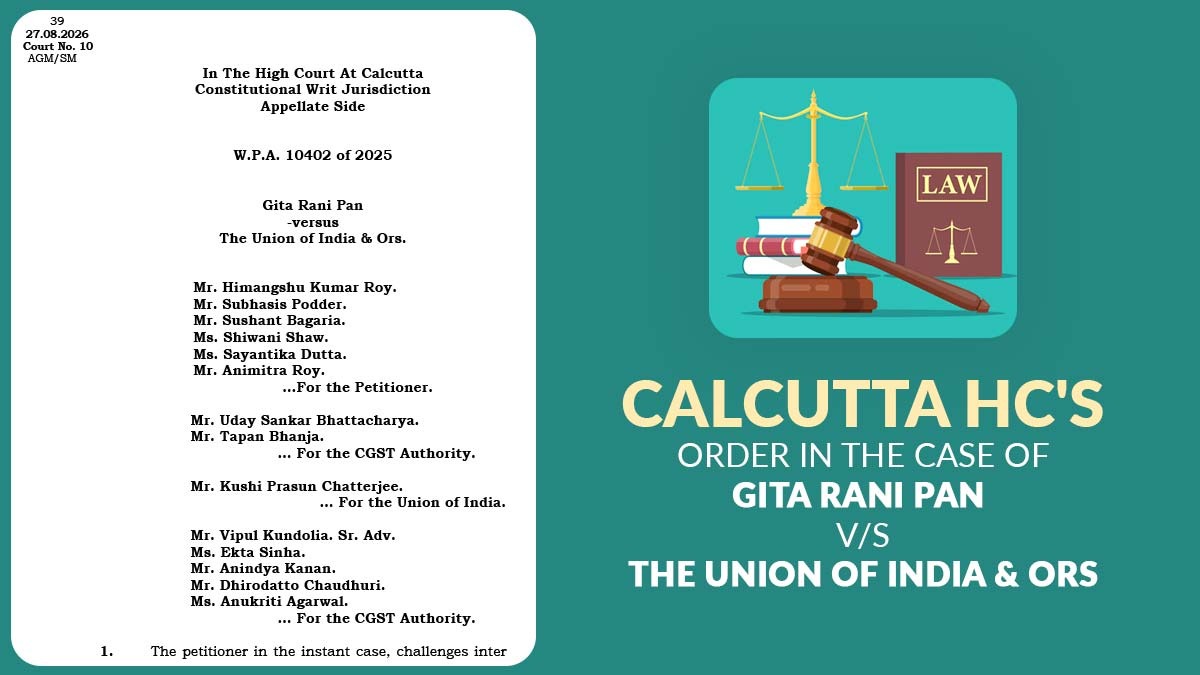
The Calcutta High Court has mentioned that GST authorities cannot issue an SCN or determine the tax obligation against a deceased individual and should issue the notice to the legal representative of the deceased in their own name.
While setting aside a Show Cause Notice (SCN) issued under Section 74 of the CGST Act, 2017, against the deceased assessee, late Haradhan Pan, Justice Smita Das De held that statutory notices issued after the assessee’s demise are legally unsustainable. Quashing the impugned SCN, along with the consequential Order-in-Original and subsequent recovery notices, the Hon’ble Bench observed:
“The machinery remains Section 73, 74, which requires issuance of show cause notice to the person liable. Therefore, the correct machinery is to issue a Show Cause Notice to legal heirs, in his own name describing him as legal heirs of deceased and to determine the liability. Department cannot issue Show Cause Notice to deceased and then direct the legal heirs to give a reply to same”
The petitioner, Smt. Gita Rani Pan, the surviving spouse of the deceased sole proprietor, submitted that the GST authorities initiated proceedings under Section 74 of the CGST Act, 2017, by issuing an SCN dated March 8, 2022, in the name of her late husband.
The petitioner contended that issuing statutory demand notices in the name of a deceased individual nearly ten months after his demise in May 2021 rendered the proceedings fundamentally defective in jurisdiction and void ab initio.
After the death of the applicant’s husband, she obtained a fresh GST registration in her name for the same trade, showing the commencement of business from 21 May 2021. She then applied to cancel the registration standing in the name of the deceased proprietor.
Important: Allahabad HC Quashes GST SCN and Judgment Order Issued Against a Deceased Person
Gita Rani said that proceedings against a deceased person were invalid and that it placed reliance upon judicial precedents, including the Supreme Court’s decision in Shabina Abraham v. Collector of Central Excise and Customs.
The GST authorities countered the petition, claiming that the applicant had not reported the proprietor’s death to the department within the stipulated time.
The Department placed reliance on Section 93(1)(b) of the CGST Act, which makes a legal representative obligated to pay tax, interest and penalty due from a deceased person out of the estate inherited by the legal representative.
The argument presented relied on Section 29(3) of the CGST Act, which states that cancelling a registration does not eliminate tax liabilities for any period before the cancellation date.
The Department contended that, even if tax liability is established after the death of the taxable person, it can still be recovered from the legal heirs to the extent of the deceased’s estate.
However, the Court distinguished between the statutory liability of legal heirs and the procedures for determining that liability. It noted that Section 93(1)(b) makes a legal representative responsible for any tax, interest, and penalties owed by the deceased, limited to the value of the inherited estate.
Nonetheless, this provision does not define the process for determining such liability. The Court emphasised this point:
“It clearly envisages from the plain reading of the Section 93(1)(b) of the CGST Act that the liability of a legal representative on account of death of the proprietor, it is a condition precedent that the Show Cause Notice must be issued to the legal representative, after seeking his response, to determine tax”
The Bench said that Sections 73 and 74 of the CGST Act furnish the machinery for evaluating tax liability and require the authorities to issue an SCN to the liable person to pay tax. It observed that “determination of taxes cannot take place against a dead person.”
It mentioned that the department cannot issue an SCN in the name of a deceased person and then require the legal heirs to answer to it. It should issue a fresh notice to the legal heirs in their own names, specifying them as the deceased’s legal representatives.
The court placed reliance on Shabina Abraham on the ruling of the Apex Court, and repeated that section 93 does not furnish the machinery for the assessment of a deceased person and that the department should give notice to the legal representative.
The show cause notice, the Order-in-Original and the recovery notice have been set aside by the Bench. It asked the GST authorities to provide a fresh SCN to the legal heirs within 3 weeks.
Read Also: Calcutta HC Quashes GST Order for Violating Mandatory Hearing Requirement U/S 75(4)
It asked the authorities to provide the legal heirs a chance of personal hearing and pass a reasoned and speaking order, considering that their obligation u/s 93(1)(b) is confined to the scope of which the deceased estate can fulfil the tax, interest and penalty obligation.
Thus, the HC disposed of the writ petition without analysing the merits of the underlying tax demand.
| Case Title | Gita Rani Pan vs. The Union of India & Ors |
| Case No. | W.P.A. 10402 of 2025 |
| For The Petitioner | Mr Himangshu Kumar Roy, Mr Subhasis Podder, Mr Sushant Bagaria, Ms Shiwani Shaw, and Ms Sayantika Dutta |
| For the CGST Authority | Mr Uday Sankar Bhattacharya and Mr Tapan Bhanja |
| For the Union of India | Mr Kushi Prasun Chatterjee |
| For the CGST Authority | Mr Vipul Kundolia, Ms Ekta Sinha, and Mr Anindya Kanan |
| Calcutta High Court | Read Order |