

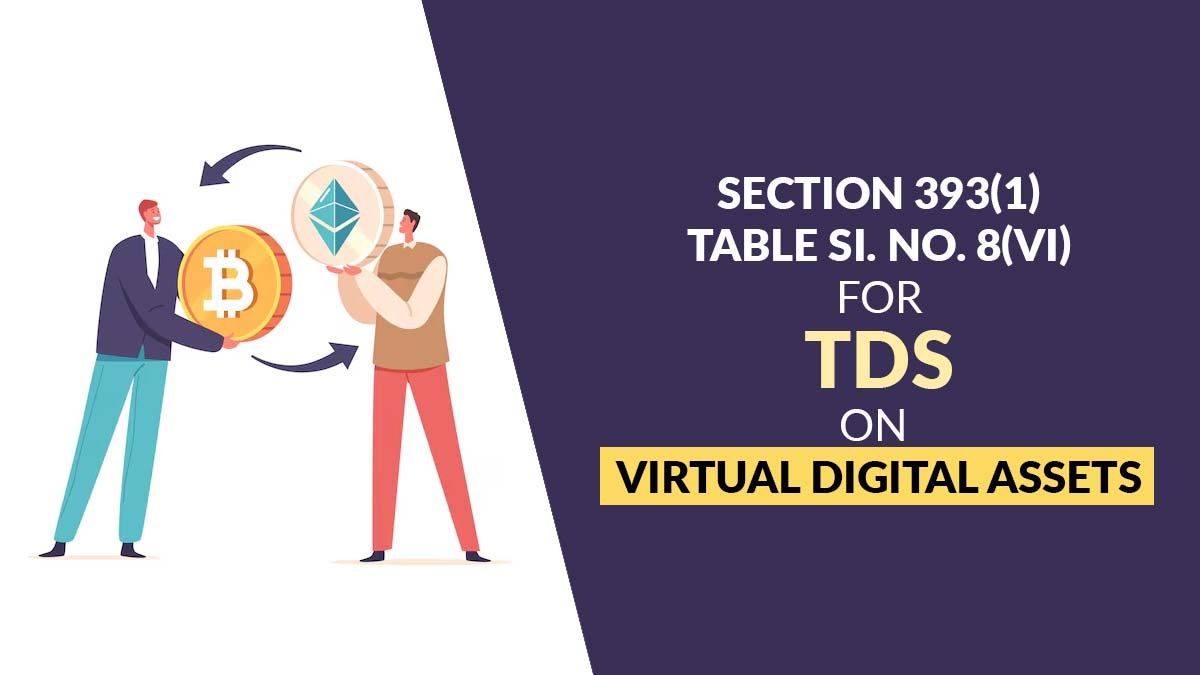
As per the Income-tax Act, 2025, the provisions of TDS on virtual digital assets (VDA) have been restructured. Now, the earlier Section 194S of the Income-tax Act, 1961 falls under Section 393(1) Table SI. No. 8(vi), effective from 1st April, 2026.
This restructuring maintains the provisions for deduction of tax at source on the transfer of virtual digital assets, including cryptocurrencies and NFTs. It also aims to ensure tax compliance in digital transactions.
TDS Section Mapping and Reporting Overview
- New Section Under IT Act 2025: 393(1)
- Table Relation: Table SI. No. 8(vi)
- Nature of Payment: Review for transfer of virtual digital assets
- Old Section Under IT Act, 1961: 194S
- Return Form: 140 / 141 (as applicable)
- Code for TDS return filing: 1037
Applicability of TDS on Virtual Digital Assets
Under the crypto tax rules in India, Tax Deducted at Source (TDS) must be deducted on payments made for the transfer of virtual digital assets (VDAs), which include cryptocurrencies and NFTs. This requirement applies to transactions involving the transfer of these assets in exchange for consideration.
Who Is a Specified Person Under Section 194S?
A specified person has:
- An individual or HUF not having income under the head “Profits and gains of business or profession”
- An individual or HUF having:
- Business T.O. up to INR 1 crore
- Professional receipts up to INR 50 lakh
This classification determines threshold limits and compliance provisions.
Tax Deductor and Deductee
- Deductor: Buyer of virtual digital asset
- Deductee: Resident seller of such asset
When Is TDS Deducted?
TDS shall be deducted at the earlier of:
- Time of payment
- Time of credit of the amount
TDS Rate
- 1% TDS on consideration paid for the transfer of Virtual Digital Assets (VDAs)
- In cases where Permanent Account Number (PAN) is not given:
- 20%, as per applicable conditions
Also Read: Complete Guide to File TDS Returns Via Gen TDS Software
TDS Threshold Limit
- INR 10,000 per financial year (FY) for:
- Individuals other than specified persons
- INR 50,000 per financial year (FY) for:
- Specified persons
TDS Compliance Responsibilities
- Exchange Transactions: Exchange may deduct and deposit TDS
- Peer-to-Peer(P2P) Transactions: Buyer is liable for TDS compliance
- Buyer Duty: Buyer must deduct TDS before making payment
- Broker/Exchange Cases: Responsibility may be shared or contractually set
Special Cases for TDS Deduction
- Barter Transactions (VDA vs VDA): Both parties must confirm TDS compliance
- Multi-party Transactions: (i) Exchange facilitating payment holds primary obligations (ii) Broker and exchange may share responsibility
- Agreement-based Deduction: (i) Broker must deduct TDS on behalf of the exchange (ii) Exchange must report in Income Tax Form 142
Practical Example Scenarios
Scenario 1: Exchange-Based Transaction
- Buyer purchases cryptocurrency worth INR 1,00,000 through an exchange
- TDS deducted = INR 1,000 (1%)
- The exchange deposits the tax and credits the balance to the seller
Scenario 2: P2P Cryptocurrency Transaction
- Buyer purchases cryptocurrency worth INR 30,000
- TDS deducted = INR 300 (1%)
- Buyer deposits tax with the government
Conclusion: For a good TDS and TCS return filing, you can use the Gen TDS software, which helps taxpayers to prepare and e-file their returns accurately with minimal effort. It simplifies the entire filing process, decreases errors and makes TDS/TCS compliance faster and more efficient.