

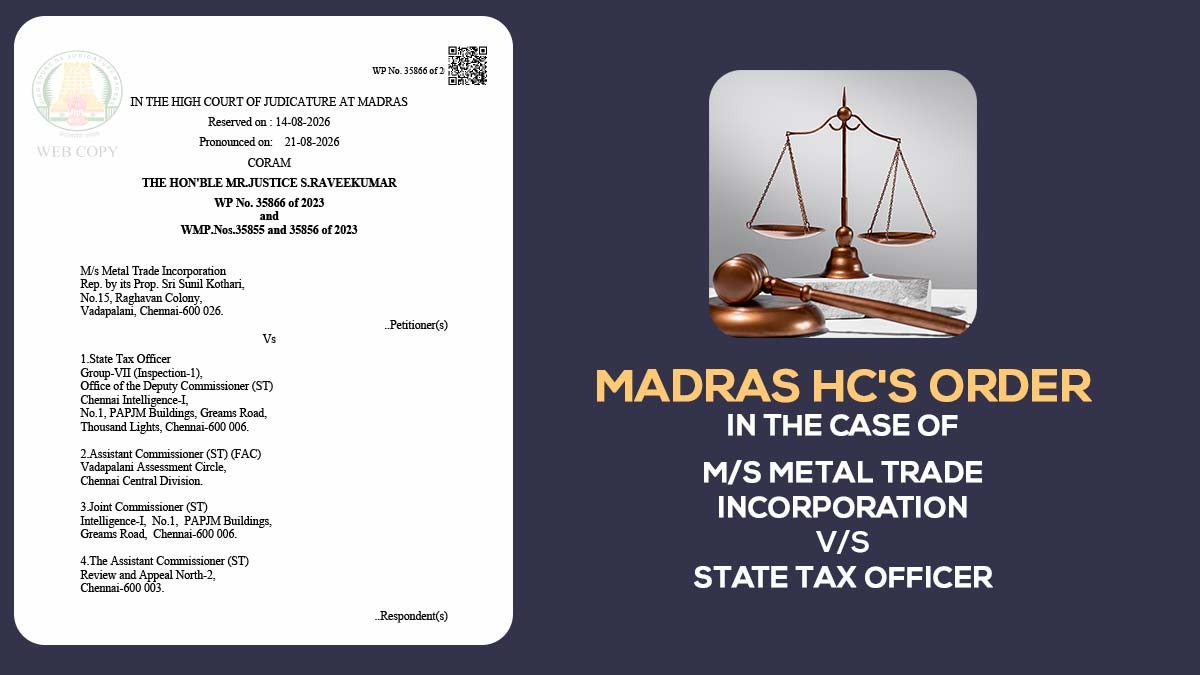
On 21 August, the Madras High Court made a significant ruling regarding the application of ITC under Rule 86A of the GST Rules. The court emphasised that any restrictions imposed on the utilisation of ITC must not extend beyond a period of one year. This decision highlights the importance of timely access to tax credits for businesses and reinforces the principle that such limitations should not be indefinite.
Justice S. Raveekumar directed the authorities to unblock the ITC on Metal Trade Incorporation, which had been blocked for over two and a half years. He said that-
“The restriction was imposed on 27.01.2023 and more than 2 ½ years have passed. In view of the same, the restrictions on the blockage ceased to have effect upon expiry of one year and therefore, cannot be continued. Just because the third respondent had passed the impugned communication on 13.09.2023, the blocking of ITC under Section 86A cannot continue beyond one year.”
The dispute emerged after issuing the summons by State tax authorities to Metal Trade Incorporation on 18 October 2022 u/s 70(1) of the GST Act. In the forthcoming proceedings, the authorities issued an intimation asking for a penalty for the period from 2017-18 to 2022-23.
The Department said that its preliminary investigation found that Metal Trade Incorporation was a non-existent dealer and bill trader. As a result, the Joint Commissioner (ST) for Intelligence issued communications directing that the Input Tax Credit for the beneficiaries of the alleged bill trader be blocked under Rule 86A.
Metal Trade Incorporation challenged the ongoing blockage of its ITC in the High Court. While it initially presented several arguments, it focused its challenge on the continuation of the restriction beyond one year.
The Court observed that the ITC of the applicant had been restricted on 27 January 2023 and that the restriction continued even after the writ petition was submitted. Rule 86A(3) states that a restriction levied under Rule 86A(1) shall become ineffective after 1 year. It said that-
“The language employed under Rule 86A(3) clearly explicates that the restriction is valid only for a period of one year and that it shall cease to have any effect upon the expiry of such period.”
Read Also: Bombay HC Quashes Extended GST ITC Blocking, Says One-Year Limit Under Rule 86A Is Mandatory
The Bench mentioned that the ITC blockage is from more than two-and-a-half years. Thus, the restriction does not produce any effect and could not continue only because the department had subsequently furnished a communication. It mentioned that-
“…The appropriate authority also does not raise the attachment or cancel the blockage even after one year, and as a result, numerous writ petitions have been filed challenging the continuation of such restriction even after the expiry of one year…”
The court also said that Rule 86A mandates the immediate completion of the assessment proceedings. The indefinite blockage of a taxpayer’s ITC carries severe civil implications and is impermissible.
U/s 79 of the GST Act, GST authorities have a separate procedure to recover the tax post completing assessment proceedings. It was argued that rather than maintaining an ITC restriction indefinitely, authorities should finalise the assessment and pursue recovery according to the law, if warranted.
The Bench instructed the relevant authority to immediately unblock the Input Tax Credit (ITC) held in the petitioner’s Credit Ledger. It said that the authorities are free to complete any pending assessment proceedings and initiate recovery proceedings in accordance with the law.
As a result, the High Court closed the writ petition with no order regarding costs.
| Case Title | M/s Metal Trade Incorporation vs State Tax Officer |
| Case No. | WP No. 35866 of 2023 and WMP.Nos.35855 and 35856 of 2023 |
| For Petitioner | Mr.M.A.Mudimannan |
| For Respondent | Mr.I.Dinesh, AGP (Tax) |
| Madras High Court | Read Order |