

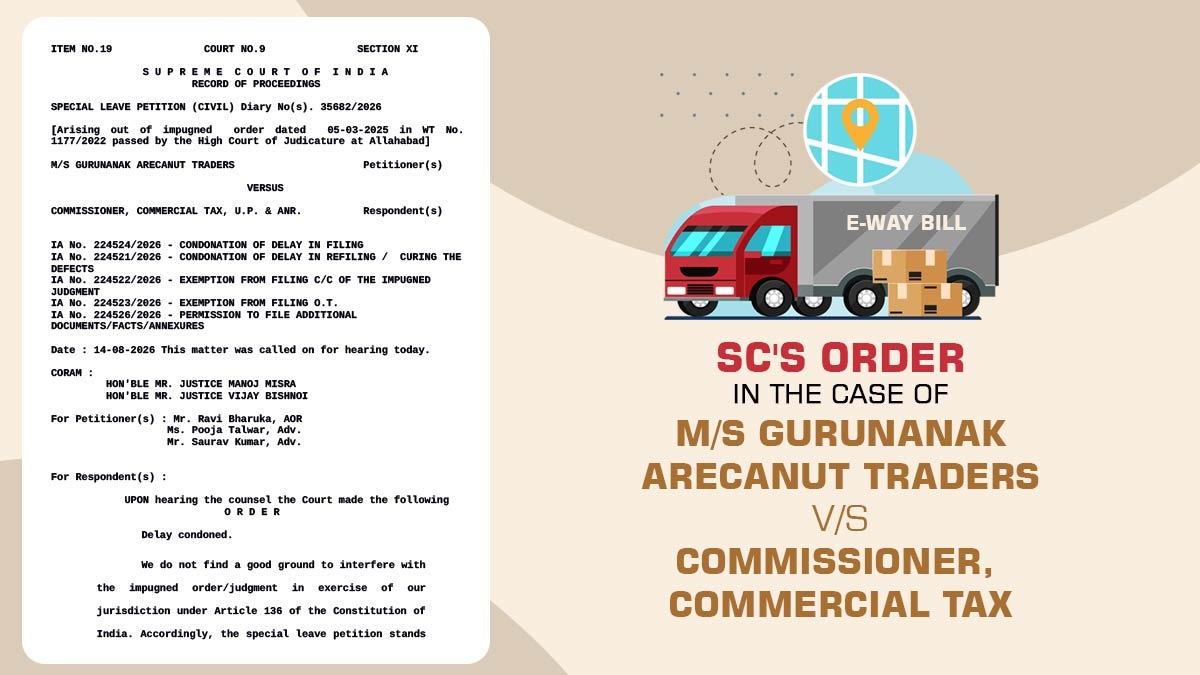
The Supreme Court, while upholding the decision of the Allahabad High Court, recently declined to interfere in a case involving a GST demand of ₹90.62 lakh imposed due to the absence of a valid e-way bill at the time of interception.
The court condoned the late filing of the SLP by the taxpayer; however, Justice Manoj Misra and Justice Vijay Bishnoi stated:
Read Also: Supreme Court: GST Cash Ledger Refund Cannot Be Blocked Without a Lawful Basis
“We do not find a good ground to interfere with the impugned order/judgment in exercise of our jurisdiction under Article 136 of the Constitution of India. Accordingly, the special leave petition stands dismissed.”
The apex bench maintained the decision of the Allahabad High Court, which stated that “It is mandatory on the part of the seller to download the e-way bill once the goods are put in transit. Subsequent downloading of e-way bill would not absolve the liability under the Act.”
M/S Gurunanak Arecanut Traders submitted an SLP before the High Court against the confirmation of GST demand and penalty u/s 129 of the GST Act.
The facts of the case are that the applicant’s vehicle, carrying arecanuts, was intercepted by the GST department at 4:28 am and found to have no e-way bill.
The applicant, after 3 hours, generated an e-way bill and produced it. Post validation of the loaded goods, the department discovered that the applicant declared the goods under “Arecanut” at 5%, but the loaded goods were “Chikni Bhuni Supari” (processed arecanut), which are taxed at 18%. The goods were confined, and a penalty and tax demand order was passed.
The applicant before the HC alleged that, before passing the penalty and tax demand order, no hearing was furnished and also claimed that the misclassification of goods cannot be the grounds for detention of goods in transit.
The applicant did not have any GST e-way bill when in transit, and there was an intent to evade tax, the department said; also, it discovered that the signature of the proprietor of the firm on the rent agreement was different from that of the tax invoice issued for the transaction.
There was no business activity found at the applicant’s business place, and registration was cancelled suo moto.
Decision of the Allahabad High Court
Concerning the issue of ‘whether carrying an e-way bill is mandatory for the movement of goods from one place to another’, the court said that after the 14th Amendment of the Uttar Pradesh Goods and Services Tax Rules, 2017, w.e.f. 01.04.2018, generation of an e-way bill is mandatory during transit.
The bench regarded the decision in the Akhilesh Traders Case, where it was considered that if the goods were not accompanied by an e-way bill, then the intent to evade tax was there. The presumption of tax evasion will be proved wrong if the owner/transporter of the goods furnishes evidence
Concerning the issue of the notice not being served to the applicant before the order dated 24th June 2022, the court does not accept this claim, citing that the notice was served upon the driver; however, the same was via email to both the seller and buyer on 6th June 2022, which was not seen by the applicant.
HC said that the intent to prove tax evasion shall not be based only on the absence of an e-way bill but also on the reason that the goods had been misclassified to benefit from a lower GST rate of 5% from 18%.
The bench dismissed the petition and said that the concessions given to taxpayers unable to generate e-way bills before April 1, 2018, because of technical issues are no longer applicable to matters beyond that date.
| Case Title | M/s Gurunanak Arecanut Traders vs. Commissioner, Commercial Tax |
| Case No. | Special Leave Petition (Civil) Diary No(s). 35682/2026 |
| For Petitioner | Mr Ravi Bharuka, Ms Pooja Talwar, Mr Saurav Kumar |
| For Respondent | N/A |
| Supreme Court | Read Order |