

The Delhi High Court has determined that a GST adjudicating authority is not required to address every point raised by an assessee in response to a show-cause notice (SCN) in detail. Therefore, the lack of a thorough discussion of each submission does not imply that the representations were not taken into account.
A division bench of Justices Anil Kshetrapal and Shail Jain said that Section 74(9) of the Central Goods and Services Tax Act, 2017 obligates the proper officer to acknowledge the noticee’s representation before determining tax, interest and penalty; the adequacy of reasons recorded by the adjudicating authority and the correctness of its findings are matters that ordinarily fall within the domain of the appellate authority.
“Merely because the Adjudicating Authority has not elaborately dealt with every submission contained in the reply would not, by itself, lead to the conclusion that the representation was not considered at all. Whether the reasoning furnished in the Impugned Order is adequate or whether the conclusions recorded therein are sustainable are matters touching upon the merits of the adjudication and are more appropriately examined in appeal,” the Court stated.
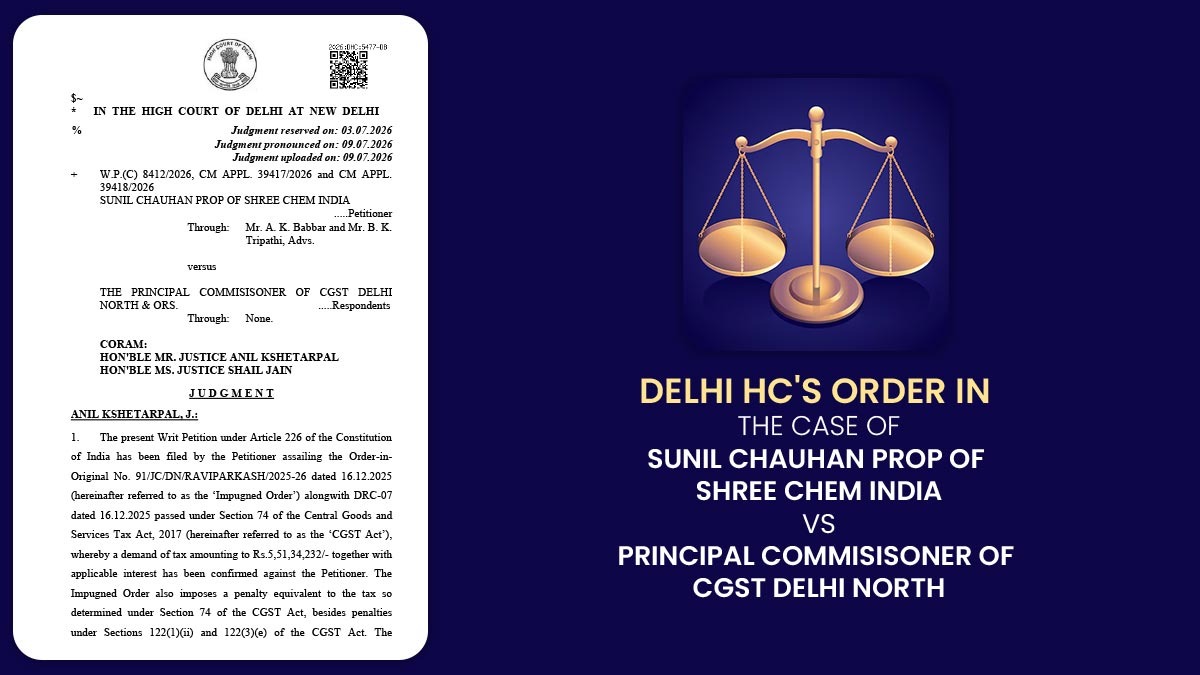
The Court was dealing with a writ petition contesting an order passed under section 74 of the CGST Act validating a tax demand of more than Rs 5.51 crore, including interest and penalties.
The applicant claimed that the adjudicating authority had breached Section 74(9) as it did not acknowledge the detailed response submitted to the SCN and had only noted that the response was not in accordance with the allegations without addressing the particular submissions raised.
The court did not accept the claim and said that Section 74(9) obligates a duty on the adjudicating authority to apply its mind to the defence raised by the noticee. But the lack of an elaborate discussion on every argument does not prove that representation is not taken into account.
The Court observed that the other reasons raised by the applicant to ignore the statutory appeal procedure u/s 107 of the CGST Act warranted adjudication on disputed questions of fact, which could not be accomplished in writ jurisdiction.
The applicants’ issue raised was that the adjudicating authority does not have the jurisdiction to charge penalties under Sections 122(1)(ii) and 122(3)(e) of the CGST Act while exercising powers u/s 74 of the Act.
The Court mentioned that the issue was settled in Patanjali Ayurved Limited v. Union of India & Others (2025), where the Allahabad High Court stated that the proper officer who adjudicates proceedings under Sections 73 or 74 of the Act is competent to identify and levy the consequential penalties specified u/s 122 of the CGST Act.
“The said view also finds support from Explanation 1(ii) to Section 74 and Rule 142 of the CGST Rules, which envisage the culmination of all consequential proceedings arising from the show cause notice by the adjudicating authority itself,” it stated.
The competence of the officer issuing the Impugned SCN or the authority passing the Impugned Order has been questioned by the applicant.
The Court stated that the issue raised questions concerning the interpretation of the regulatory system regulating the assignment of functions under the CGST Act. “Such questions can appropriately be urged before the appellate authority constituted under Section 107 of the CGST Act, which is competent to examine both questions of fact and law arising from the adjudication.”
Therefore, the Court has set aside the writ petition by granting a chance to the applicant to claim the statutory remedy of appeal under Section 107 of the CGST Act.
| Case Title | Sunil Chauhan Prop of Shree Chem India Vs Principal Commissioner of CGST Delhi NORTH |
| Case No. | W.P.(C) 8412/2026 |
| For Petitioner | Mr A. K. Babbar, Mr B. K. Tripathi |
| For Respondent | None |
| Delhi High Court | Read Order |