

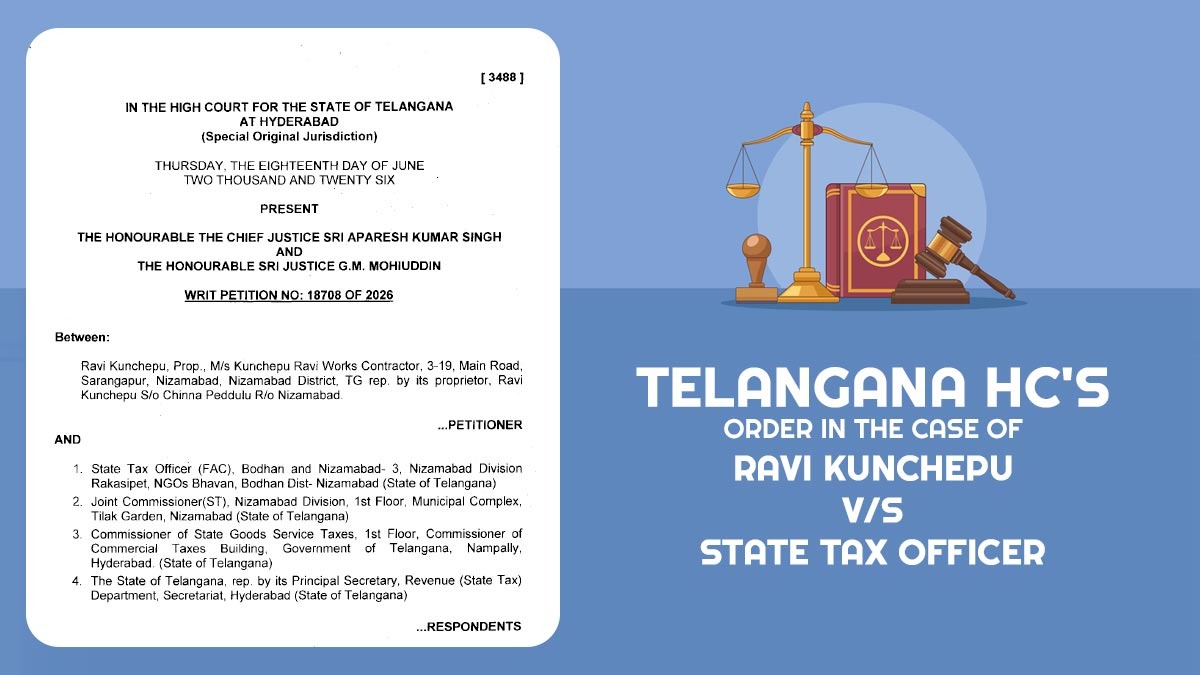
The Telangana High Court has granted a chance to a taxpayer to pursue the regulatory appellate remedy against a GST assessment order after considering the claim of the applicant that he had known about the impugned demand later, as the order had been uploaded merely under the “Additional Notices” tab on the GST portal.
The Chief Justice, Aparesh Kumar Singh, and Justice G.M. Mohiuddin directed that the appellate authority acknowledge the taxpayer’s delay condonation application on its own merits if submitted within 2 weeks, along with the statutory pre-deposit.
A works contractor submits a writ petition contesting an SCN issued under section 73 of the Telangana Goods and Services Tax Act, 2017, and the Central Goods and Services Tax Act, 2017.
The applicant argued that the proceedings were flawed due to several legal issues. They pointed out that both the show-cause notice and the assessment order were unsigned and did not have the mandatory digital signature required by Rule 26 of the CGST Rules. Additionally, these documents failed to provide transaction-wise details for the claimed excess ITC and were issued without allowing a personal hearing, as mandated by Section 75(4) of the GST Act.
The petitioner further claimed that the proceedings were also barred by the limitation period specified in Section 73 and breached the principles of natural justice, making the assessment order legally unsustainable. The disputed GST demand amounted to ₹2,44,709 for the tax period from July 2017 to March 2018.
The applicant before the court stated that the writ petition should not be considered submitted late on 30 March 2026, because he allegedly came to know about the assessment order only on 23 March 2026, when officials of the State Tax Department notified him over the phone concerning the outstanding demand.
The impugned order has only been uploaded under the Additional Notices tab of the GSTN portal, and the petitioner was clueless about it. As per that, the applicant before the Court asked to hear the writ petition even after the lapse of time.
The State Tax Department countered the writ petition at the threshold, claiming that there had been an inordinate delay in approaching the High Court. The State relied on the decision of the Supreme Court in Assistant Commissioner (CT), LTU, Kakinada v. Glaxo Smith Kline Consumer Health Care Ltd. (2020) 19 SCC 681, which outlines that writ jurisdiction must ordinarily not be exercised where the regulatory appellate remedy has become time-barred due to the taxpayer’s delay.
The petitioner requested permission to pursue the statutory appellate remedy by filing an appeal along with a delay condonation application under Sections 107(1) and 107(4) of the GST Act.
The Division Bench accepted this request but opted not to examine the merits of the challenge to the assessment order. Instead, it granted the petitioner the opportunity to approach the appellate authority within 2 weeks, provided that the statutory pre-deposit required under the GST law is made.
Also Read: Telangana HC Opens Door for GST Registration Restoration After Return Filing Default
The High Court noted that the appellate authority would independently review the reasons provided in the delay condonation application. If the authority is satisfied with the justification for the delay, it will proceed to adjudicate the appeal on its merits.
The Court said that the applicant can raise all available legal and factual grounds before the appellate authority in the appellate proceedings. The writ petition under such observations was disposed of without any order as to costs.
| Case Title | Ravi Kunchepu Vs State Tax Officer |
| Case No. | Writ Petition No: 18708 of 2026 |
| For Petitioner | Sri Tejprakash Toshniwal |
| For the Opposite Parties | Sri Swaroop Oorilla |
| Telangana High Court | Read Order |