

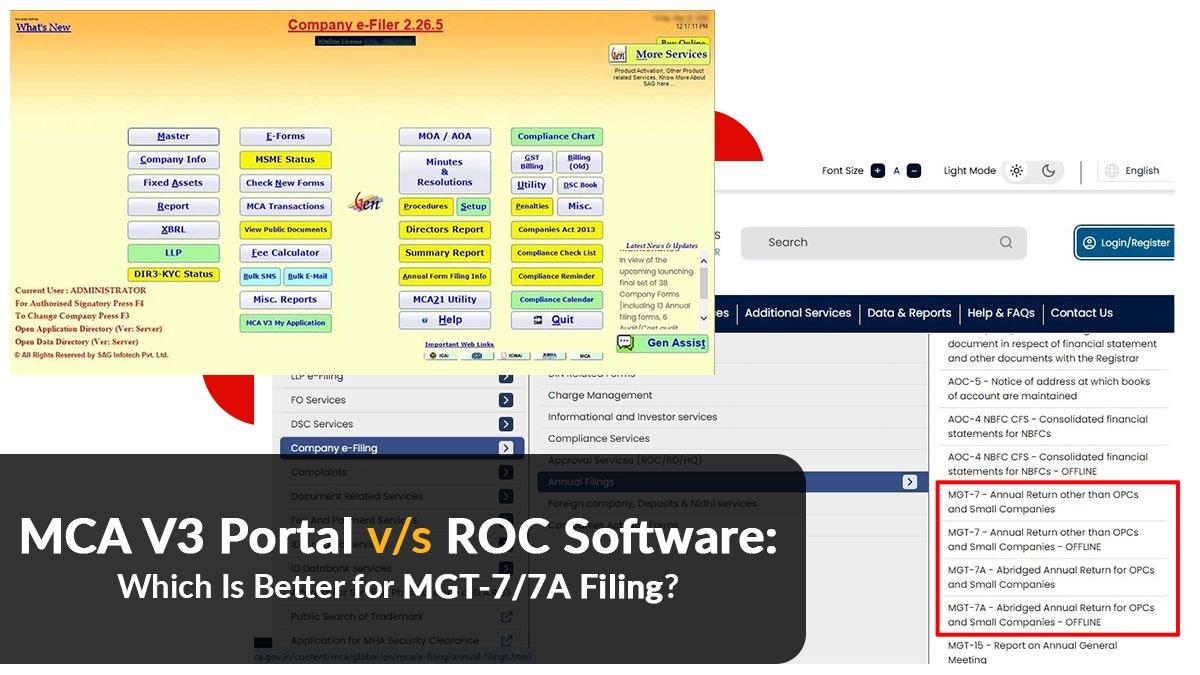
The transition from the Ministry of Corporate Affairs (MCA) V2 to the V3 portal has fundamentally changed the way Indian companies handle their compliance obligations. The V3 portal has been developed as a direct web-based filing system that offers greater clarity and real-time data validation. However, many professionals still rely on third-party ROC (Registrar of Companies) software to bridge the gap between complex financial data and the stringent requirements of the portal.
Whether to employ the portal directly or leverage dedicated software hinges on technical efficiency and data integrity concerns at the time of filing Form MGT-7 (Annual Return for companies other than OPCs and Small Companies) and Form MGT-7A (Annual Return for OPCs and Small Companies).
Structural Shift: Web-Form vs. Offline Preparation
The MCA V3 portal functions on a “Web-Form” architecture. Opposite to the V2 system, which utilises downloadable PDF forms, V3 needs users to input data directly into a web browser. The objective of this revision is to remove versioning errors, but it has also created a dependency on stable internet connectivity and session persistence.
Professional ROC software uses an “Offline-to-Online” model. Data is compiled, validated, and cross-referenced within a local environment. The software contacts the MCA servers using an API or automated data mapping only once the final output has been created. This method provides protection against portal timeouts and data corruption, frequent problems for professionals during busy filing periods.
Table-Wise Comparison: MCA V3 Portal vs. ROC Software
We need to see the tables required for MGT-7 and MGT-7A to know the operational differences and the way each system manages the data.
Registration and Business Activities (Tables I – III)
MCA V3 Portal: As per the Corporate Identification Number (CIN), most of the basic company information is pre-filled. But if this pre-filled information is outdated or wrong, correcting it within the web form is difficult. It frequently needs a “Refresh” action, which may clear other fields that were already entered manually.
ROC Software: Such solutions keep a permanent database for each client. They furnish pre-filled information but permit users to cross-check it against the previous year’s records stored locally. If any discrepancy is found in the business activity codes (NIC codes), the software proposes a searchable database of codes, whereas the portal needs accurate manual entry.
Share Capital and Debentures (Table IV)
MCA V3 Portal: Users are required to manually enter every change in shareholding, including transfers and splits. Validation arises only at the end of the form, which means an error in the “Paid-up Capital” section might not be signalled until the user tries to file the entire document.
ROC Software: Such tools provide automated capital tracking. When a company has issued bonus shares or manages transfers in the year, the software computes the closing balances. It functions as an “Auto-Math” check in real-time, confirming the total number of shares matches the nominal value before data gets uploaded on the portal.
Turnover and Net Worth (Table V)
MCA V3 Portal: The section comprises simple manual data entry fields. But no built-in logic is there to validate whether such numbers align with the financial statements filed in Form AOC-4, increasing the possibility of inconsistent filings.
ROC Software: The majority of professional software suites merge the preparation of MGT-7 and AOC-4. On entering financial numbers in the AOC-4 module, the software maps the pertinent turnover and net worth data to Table V of MGT-7, ensuring consistency across the annual filing package.
Holding, Subsidiary, and Associate Companies (Table VI)
MCA V3 Portal: It needs the manual entry of CINs for each related entity every year. The portal verifies the CIN; it does not permit users to verify if the relationship was present in the previous year’s filing.
ROC Software: It keeps a relational database. The software suggests carrying forward or marking a listed subsidiary as ceased from the previous year. It averts the common mistake of omitting a subsidiary that has had no change in status.
Shareholding Pattern (Table VII)
MCA V3 Portal: This table needs a thorough breakdown of Promoters and Non-Promoters. In the V3 portal, MCA filing is a meticulous procedure. Manual entry is risky for companies that have a large number of shareholders, consuming much time.
Read Also: How ROC Software Makes the MCA Filing Checklist Easy
ROC Software: Its main benefit is the “Bulk Excel Import” feature. From the RTA or a private spreadsheet, practitioners can download shareholder lists and upload them directly. After that, the software classifies the data into the Table VII format.
Security and Validation: The Hidden Layer
The MCA V3 portal utilises an “Inline Validation” system. It seems effective, but it can be restrictive. If the backend logic of the portal does not accept a particular entry (even if the entry is legally defensible), the user is often blocked from moving to the next “Save & Allied” step.
ROC software uses a “Pre-submission Validation Engine.” Developers often update the same engine to show the latest MCA business norms. It shows “Hard Errors” (which will cause portal rejection) and “Soft Errors” (which are inconsistencies that might lead to a Notice from the ROC). On solving the same locally, the user prevents the disappointment of the portal crashing in the final DSC (Digital Signature Certificate) attachment phase.
Document Management and Attachments
MGT-7/7A needs various attachments along with a list of shareholders and MGT-8 (where applicable).
MCA V3: Files are required to comply with specific size limits, normally 2MB for specific attachments. The portal may not accept files if the naming convention has special characters or if the PDF version is not compatible.
ROC Software: Such tools may include built-in PDF optimisers that automatically compress the shareholder list to meet MCA size limits while maintaining readability. They auto-generate the “List of Shareholders” as per the entered data in Table VII, removing the requirement to create a separate PDF manually.
Closure- Which Path to Choose?
The MCA V3 Portal proposes a pocket-friendly and clear filing route for a small company or a One Person Company (OPC) with a static shareholding and simple business activities. It removes the requirement for third-party subscriptions.
The best ROC software is necessary for entities with complex capital structures, frequent share transfers, or multiple subsidiaries. The main advantage of using the software is data persistence, Excel imports, consistent cross-form integration with AOC-4, and offline functionality.
The software’s benefits outweigh its cost, particularly in professional compliance settings where delays carry significant penalties. The software’s validation and automation features propose “peace of mind” that the current web portal has not matched until now.
With the development of the MCA V3 portal, various issues may be addressed. V3 remains the ultimate objective; however, ROC software currently provides the most reliable path forward.