

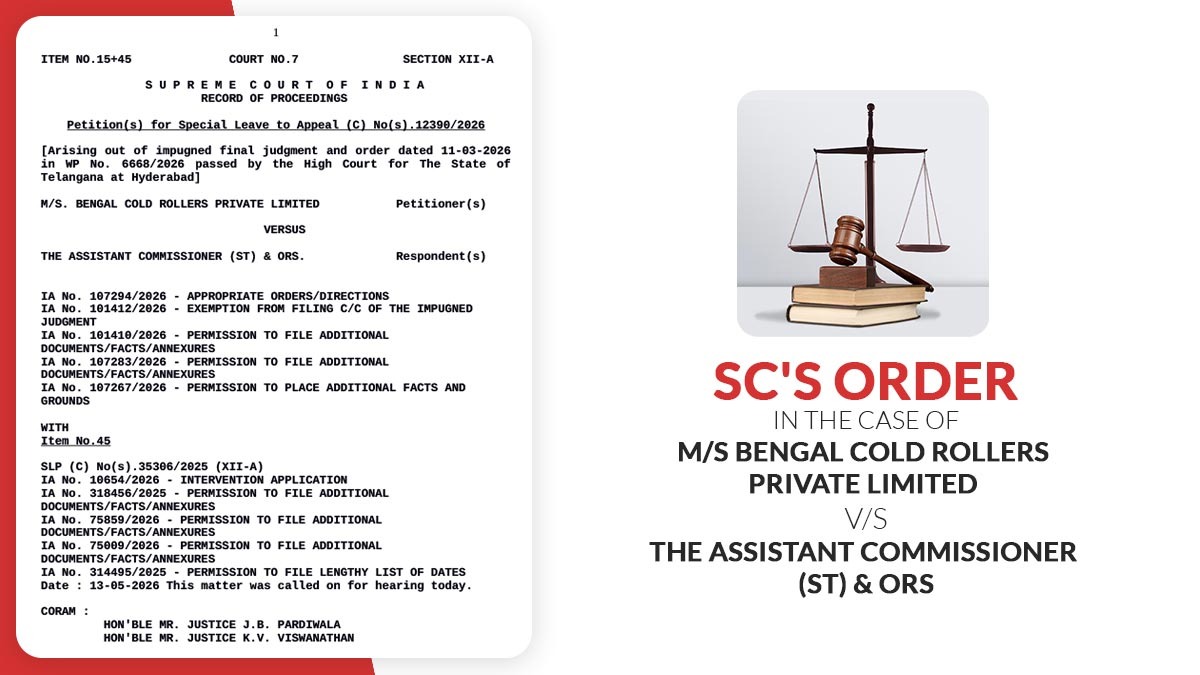
The Supreme Court of India has allowed a GST assessee to raise before the appellate authority its grievance regarding the alleged loss of 14 seized files by the tax department.
The Court directed the company to pursue the statutory appellate remedy under Section 107 of the GST Act with a reduced pre-deposit requirement of 5% of the principal tax amount. The Court further observed that the appellate authority should examine the matter independently and without being influenced by the earlier observations made by the High Court.
The bench of Justices J.B. Pardiwala and K.V. Viswanathan asked the applicant to submit the appeals against each assessment order before the appellate authority and granted 4 weeks to do so. The Court ordered that these appeals could be lodged with a 5% pre-deposit of the principal tax.
Read Also: SC of India Directs GST Dept to Explain Digitisation of Missing Seized Files Through Affidavit
The bench of Justices J.B. Pardiwala and K.V. Viswanathan asked the applicant to submit appeals against each assessment order before the appellate authority and allotted 4 weeks for its functioning.
The company petitioned the High Court, claiming tax authorities acted unfairly by continuing legal proceedings without providing seized documents they alleged were missing.
As per the applicant, a search was performed by tax authorities, and 14 files were seized from its premises. These files allegedly contained records, along with invoices and other documents required for answering the allegations mentioned in the Show Cause Notice (SCN) issued for various financial years from 2019-20 to 2023-24.
The company stated that, due to the unavailability of documents, it was unable to establish that the allegations of fake transactions and fake invoicing lacked any basis.
The applicant before the HC asked for directions to declare the action of the tax department as illegal and breaches the Section 67(5) of the GST Act, 2017. Also, till the disposal of pending proceedings, it requested abeyance of the adjudication proceedings and asked to quash the proceedings initiated u/s 74 of the GST Act.
The department rebutted the company’s claim of prejudice and stated that the allegedly missing files were not important in the assessment proceedings. At the time of making the assessment orders, no faith was placed in the documents from those files, the tax authorities stated.
The Supreme Court observed that the assessment had progressed significantly during the proceedings. A final assessment order for the 2018-19 tax year was issued on December 30, 2025, with subsequent final assessment orders for the 2019-20 tax year and other years also being made.
Thereafter, the Court observed that the case had progressed beyond the assessment phase and that the applicant had no choice but to pursue statutory appeals.
The Apex Court did not dismiss the grievances regarding the lost files. And it permitted the company to raise that issue before the appellate authority, which was referred to analyse all related aspects independently and in accordance with the law.
Subsequently, the Court explained that the appellate authority must not be influenced by the High Court’s observations while deciding the case.
| Case Title | M/s Bengal Cold Rollers Private Limited vs. The Assistant Commissioner (ST) & ORS |
| Case No. | No(s).12390/2026 |
| For the Appellant | Mr Balbir Singh, Mr Karan Sachdev, Mr Somesh Jain, Ms Disha Jham, Mr Sumit Khadaria |
| For the Respondent | Ms Devina Sehgal, Mr Yatharth Kansal, Mr Srikanth Varma Mudunuru |
| Supreme Court | Read Order |