

The petitioner, Manju Devi Agarwal, filed returns in Form GSTR-1 and Form GSTR-3B for the financial years 2017-18 to 2022-23. During audit and scrutiny proceedings conducted by the GST department, discrepancies were allegedly detected regarding short payment of tax, excess availment of Input Tax Credit (ITC), and non-payment of GST on certain receipts reflected in Form 26AS and the profit and loss accounts. The department alleged violations of Sections 9, 16, 50, and 74 of the CGST Act, 2017.
The SCN issued u/s 74 alleged that the applicant had indulged in suppression and wilful misstatement with the intent to evade tax. Before the issuance of SCN, the applicant had earlier deposited the tax via DRC-03 after the discrepancies were specified in the audit.
But, the department stated that interest and penalty liabilities stayed unpaid. Therefore, the applicant was asked to pay interest u/s 50 and penalty u/s 74.
Even after the service of the SCN, the applicant did not submit any written reply. In the personal hearing, the representative of the applicant allegedly considered the obligation for interest and penalty and undertook to deposit the remaining amount within 2 months. After that, adjudication orders dated 04.02.2025 and 06.02.2025 were passed confirming interest and penalty demands.
Rather than claiming the statutory appellate remedy u/s 107 of the CGST Act, the applicant approached the HC after nearly 10 months, contesting the SCNs, adjudication orders, garnishee proceedings under DRC-13, and contesting a CBIC Circular dated 16.09.2025.
Main Issue:
Whether proceedings u/s 74 of the CGST Act could validly continue even after the taxpayer had voluntarily deposited the tax before issuance of the SCN, and whether the department could invoke allegations of suppression and wilful misstatement to justify the levy of interest and penalty u/s 74.
Patna High Court
The Court said that the show cause notice (SCN) includes allegations of wilful suppression and misstatement with the intent to evade tax. As the applicant neither submitted any response challenging these allegations nor disputed the proceedings before the adjudicating authority, the applicant cannot thereafter contest the invocation of Section 74 in writ jurisdiction.
Important: How GST Software Fixes Common Mistakes in SCN Replies
The Court also observed that the applicant had voluntarily deposited tax amounts after the audit objections were raised, and admitted liability towards interest and penalty via its representative in a personal hearing.
In the same situation, the applicant was stopped from choosing a contradictory stand before the High Court. The Court held that only a tax payment after detection in audit does not automatically preclude initiation of proceedings u/s 74, especially where allegations of suppression and incorrect claim of input tax credit (ITC) are particularly made.
The Court outlined that the applicant had a perfect statutory remedy of appeal u/s 107 of the CGST Act; however unable to claim it within the limitation. The submitted writ petition, after lapse of the appellate limitation period, could not be entertained only to avoid statutory remedies.
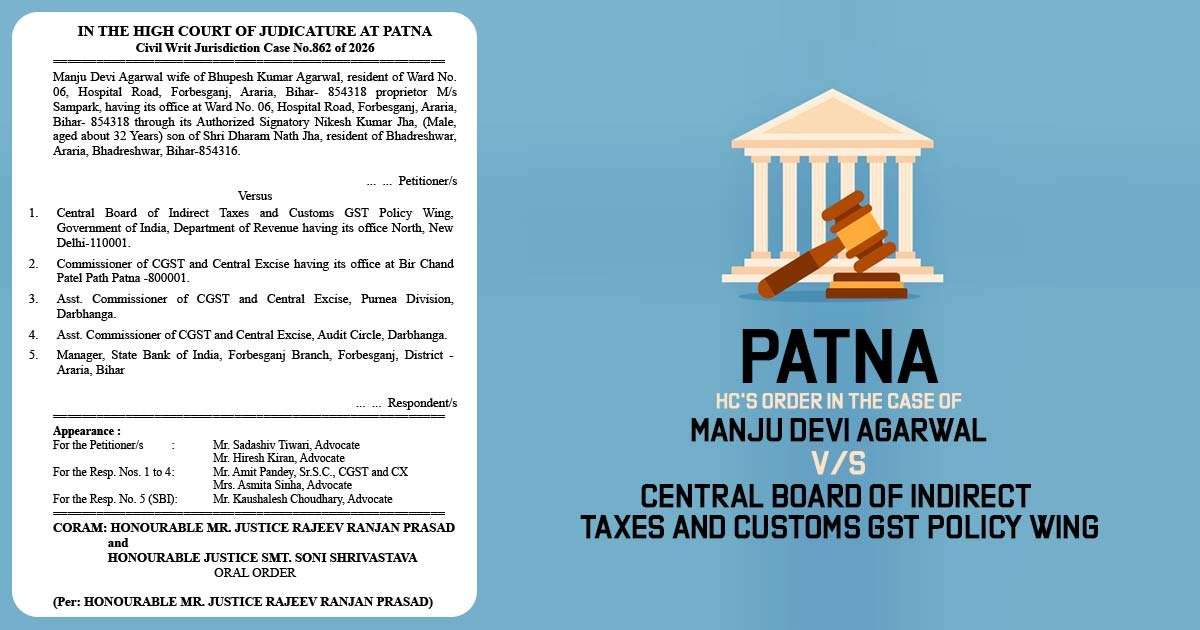
| Case Title | Manju Devi Agarwal vs. Central Board of Indirect Taxes and Customs, GST Policy Wing |
| Case No. | Case No.862 of 2026 |
| For the Appellant | Mr Sadashiv Tiwari and Mr Hiresh Kiran |
| For the Respondent | Mr Amit Pandey, Mrs Asmita Sinha, and Mr Kaushalesh Choudhary |
| Patna High Court | Read Order |