

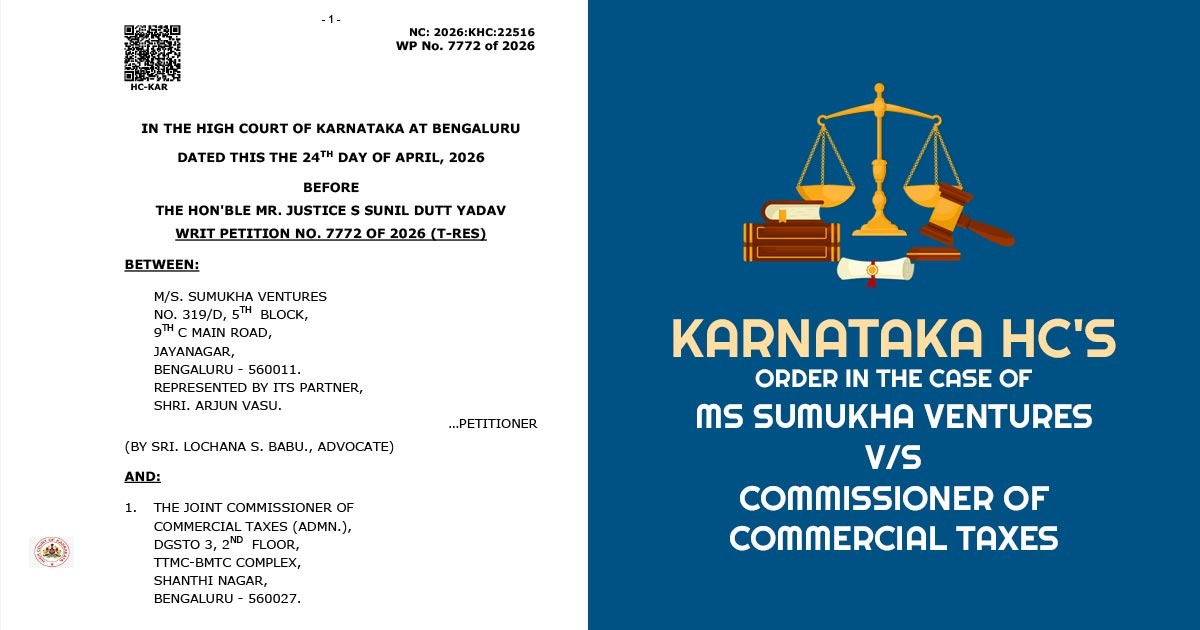
The Karnataka High Court has set aside a GST Order-in-Original passed against a taxpayer, noting that an objection had been raised regarding the same officer conducting audit and adjudication proceedings.
A bench led by Justice S. Sunil Dutt Yadav observed that the proceedings initiated by both the audit and enforcement authorities were impermissible and in violation of the principles of natural justice. This was because the authority, while conducting the audit, had already expressed an opinion and recorded findings at an earlier stage.
The validity of the GST SCN was contested by the petitioner on September 30, 2025, and the consequential order-in-Original was passed by the GST authorities. Justice S. Sunil Dutt Yadav in the High Court of Karnataka heard the case.
Both the audit authority and the enforcement authority initiated the parallel proceedings, the applicant stated. It was claimed that the very same officer who conducted the audit then proceeded to adjudicate the case and pass the order-in-original. As per the applicant, the same procedure was not allowable and breached the principles of natural justice because the officer conducting the audit had earlier created an opinion and recorded findings at the time of the audit stage itself.
The applicant also mentioned that once an officer has mentioned views and findings at the time of audit proceedings, the same officer cannot alone adjudicate the issue without being impacted by earlier conclusions. Reliance was also placed on Circular No. 31/05/2018-GST dated February 9, 2018, and Circular No. 169/01/2022-GST dated March 12, 2022, which specify procedural safeguards in GST adjudication proceedings under the Central tax authorities.
The Additional Government Advocate, on behalf of the State authorities, claimed that the applicant had not objected before the adjudicating authority and thus the issue must be analysed via the authority itself. After that, the State claimed that the circulars relied upon by the applicant applied to Central GST authorities and, in the absence of similar notifications by the State authorities, those processes were not binding upon the State GST department.
The High Court said that in the GST cases, assessees frequently raised similar objections. The Court, considering the recurring nature of the controversy, held that the issue needs appropriate adjudication by the competent authority.
Read Also:- Karnataka HC Allows Common GST Notices Under Sections 73 and 74 for Multiple Years
As per that, the Court kept all claims open and remitted the case back to the Deputy Commissioner of Commercial Taxes. The applicant was granted liberty to raise objections concerning jurisdiction before the authority. Also, the Court said that upon such objections being raised, the adjudicating authority can get necessary administrative orders from the Joint Commissioner of Commercial Taxes, who had assigned the matter.
The court asked that the authority first record findings on the jurisdictional objection before proceeding to analyse the merits of the case. No additional measures on merits are to be opted till these findings are recorded.
Important: How to Easily Prepare an Audit via GST Software?
Subsequently, HC set aside the impugned Order-in-Original and remanded the case for fresh consideration in light of its observations.
| Case Title | Ms Sumukha Ventures V/S Commissioner of Commercial Taxes |
| Case No. | 7772 OF 2026 (T-RES) |
| Counsel For PETITIONER | Sri. Lochana S. Babu, Adv. |
| Counsel For Respondent | Sri. K. Hemakumar, Aga |
| Karnataka High Court | Read Order |