

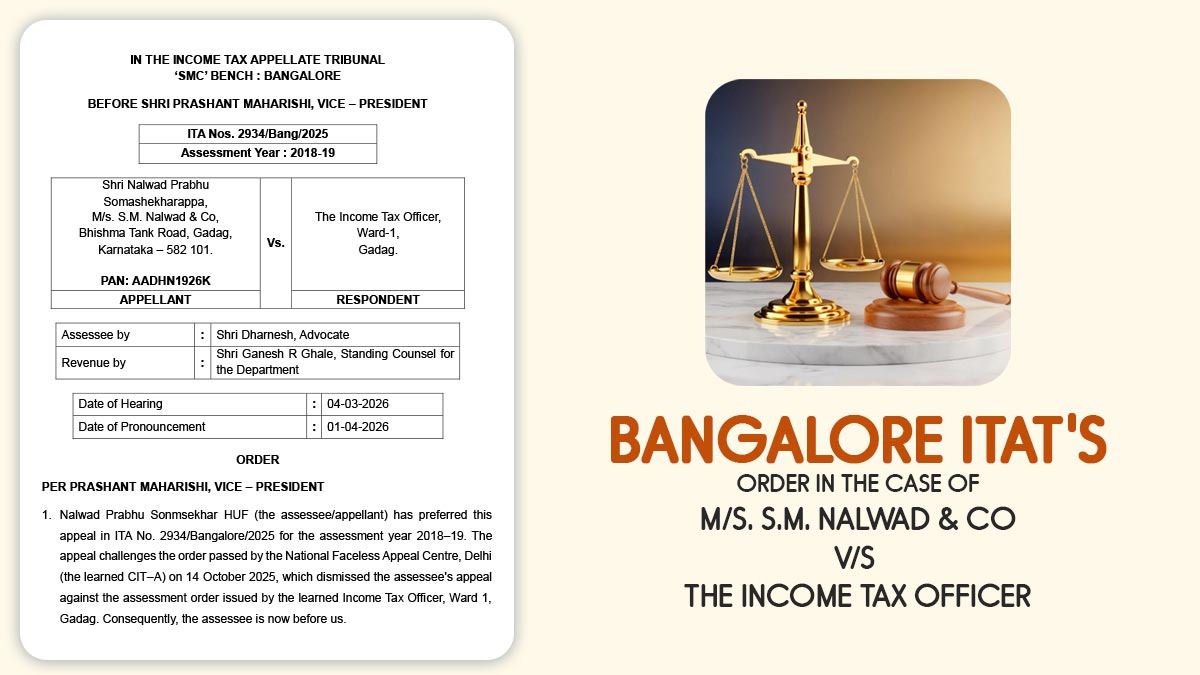
The Income Tax Appellate Tribunal (ITAT), Bangalore Bench, in a ruling, had remanded a section 54F deduction claim under the Income Tax Act, 1961, emerging from the sale of a co-owned property for fresh examination after marking that the taxpayer was averted via adequate cause from providing complete information at the time of assessment proceedings.
The taxpayer, Nalwad Prabhu HUF, submitted the return for AY 2018-19, declaring a total income of Rs 3.21 lakh. The case was chosen for limited scrutiny to validate the deduction claimed u/s 54F concerning long-term capital gains.
During the assessment proceedings, the Assessing Officer issued multiple notices u/s 142(1) seeking details related to the deduction claim. While the assessee submitted certain documents, such as the computation of income, the sale deed, and ledger extracts, key particulars, including bills, vouchers, and property details, were not provided.
Even after repeated notices, along with a show-cause notice (SCN), there was no compliance. Therefore, AO disallowed the deduction claimed u/s 54F.
Read Also: Easy Explanation on TDS for Property Sale by NRI (New Guide)
The dissatisfied taxpayer carried the case in appeal before the CIT(A), claiming that the investment in the construction of a residential house was duly made and that relevant documents existed. It was stated that the property was jointly constructed with his brother and that a similar claim of the co-owner had been accepted.
Placing reliance on Yogesh & Patel v. ITO (Ahmedabad ITAT), wherein exemption u/s 54F was permitted to co-owners for a jointly constructed property, it was provided that his case stood on an identical footing.
But, CIT(A) dismissed the appeal for the reason that the claim remained unverifiable in the absence of supporting material on record.
In contrast, the Revenue argued that the taxpayer did not adequately demonstrate the investment in the residential property. They claimed that the bank statements and calculations provided were insufficient and that no primary records were submitted. Therefore, the disallowance u/s 54F was justified.
Before the Tribunal, the taxpayer maintained that he had invested his 50% share of the sale proceeds in constructing an independent residential unit on jointly owned land, leading to nil taxable capital gains.
He also submitted records for the construction and clarified that the earlier lack of submission was due to medical and technical issues.
Prashant Maharishi (Vice President) stated that the taxpayer had now placed complete material on record and had illustrated reasonable cause for the earlier lapse. For such situations, it was ruled that the case needs fresh verification at the level of the Assessing Officer (AO).
Subsequently, the ITAT remanded the issue to the assessing officer with directions to analyse the claim afresh and grant deduction u/s 54F if the requirements are fulfilled, post furnishing a enough chance of hearing. Therefore, the appeal was permitted for statistical objectives.
| Case Title | M/s. S.M. Nalwad & Co vs. The Income Tax Officer |
| Citation | ITA Nos. 2934/Bang/2025 |
| Date | 01.04.2026 |
| Assessee by | Shri Dharnesh |
| Revenue by | Shri Ganesh R Ghale |
| Bangalore High Court | Read Order |