

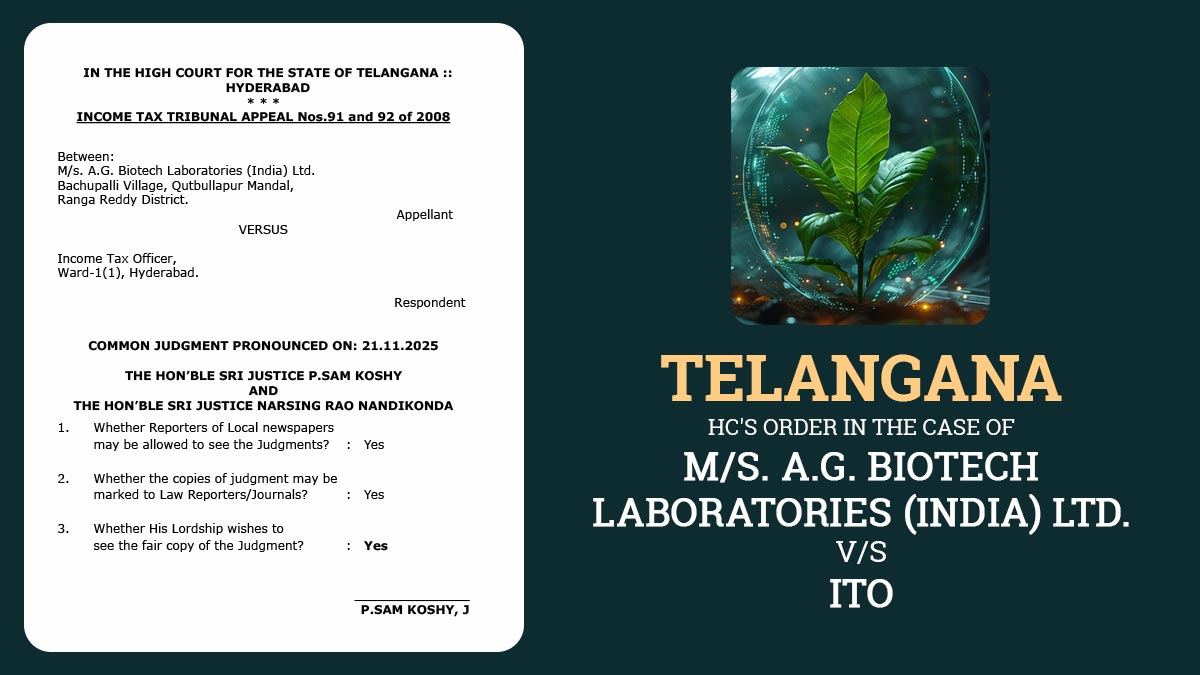
The Telangana High Court has held that revenue generated from the sale of tissue-cultured plants is categorised as farming income and is thus exempt from income tax under section 10(1) of the Income Tax Act, 1961.
The Bench of Justice P. Sam Koshy and Justice Narsing Rao Nandikonda has said that the statutory test is not conquered because scientific or technological processes are employed. The Court stressed that agriculture cannot be limited to primitive or traditional methods and should evolve with technological advancements.
The question before the Court was whether income from tissue culture and micro-propagation of plants could be categorised as agricultural income, or whether it included taxable business income due to the use of advanced laboratory-based scientific processes.
The revenue authorities had considered the income as business income because its major activity consists of sophisticated laboratory techniques performed under sterile conditions, with agricultural land being used only incidentally for growing mother plants. The opinion has been kept by ITAT, outlining that the final commercial product was the outcome of scientific intervention instead of direct agricultural operations on land.
The taxpayer said that its operation was fundamentally concerned with agriculture. Mother plants were grown on agricultural land through basic operations such as tilling, planting, irrigation, manuring, and human labour. After that, tissue samples extracted from these plants were multiplied using tissue culture technology, followed by hardening and nurturing in greenhouses and soil before sale.
Tissue culture is a modern and scientific method of plant propagation, similar to grafting, budding, or nursery cultivation, and does not sever the agricultural character of the activity. Reliance was placed on precedents including CIT v. Soundarya Nursery (Madras High Court) and Shri Puransingh M. Verma v. CIT (Gujarat High Court), where income from nursery operations was considered as agricultural income.
As per the income tax department, laboratory-based multiplication is directed to a commercial and industrial process, and agricultural operations on land were merely preparatory in nature. Categorisation made by State Governments or banks for subsidy or loan purposes was unrelated to determining income tax liability.
The court, after thoroughly examining statutory provisions and judicial precedents, including the landmark Supreme Court ruling in Raja Benoy Kumar Sahas Roy, concluded that the foundation of the taxpayer’s activities was rooted in basic agricultural operations, specifically the cultivation of mother plants. While tissue culture is an advanced and efficient propagation method, it remains fundamentally linked to agriculture.
Also Read: No GST on Paddy Storage Rent: TN AAR Affirms as Agricultural Produce
The use of laboratories and scientific processes does not change the nature of the income as long as the agricultural base is maintained. Modern agricultural practices, including biotechnology, align with the evolving definition of agriculture u/s 2(1A) of the Act.
The Bench relied on its own recent ruling in PCIT v. Nuziveedu Seeds Ltd., where income from hybrid seed production concerning scientific research and farmer supervision was held to be agricultural in nature.
The court held that income via tissue culture operations comprises agricultural income exempt u/s 10(1) of the Income Tax Act. The questions of law were answered in the taxpayer’s favour and against the revenue, and the orders of ITAT were set aside.
| Case Title | M/s. A.G. Biotech Laboratories (India) Ltd. vs. ITO |
| Case No. | Income Tax Tribunal Appeal Nos.91 and 92 of 2008 |
| For Petitioner | Mr A.V.A. Siva Kartikeya, Mr A.V. Krishna Koundinya |
| For Respondent | Ms Bokaro Sapna Reddy, Mr J.V. Prasad |
| Telangana High Court | Read Order |